Are you planning to establish a commercial poultry feed mill plant in South Africa? Whether your project involves a small chicken feed manufacturing facility or a large automated feed factory, selecting the right production capacity, machinery configuration, and plant layout is essential for a successful investment.
RICHI Machinery supplies industrial poultry feed processing equipment and customized complete feed production lines for commercial feed manufacturers, poultry farming enterprises, agricultural companies, and livestock feed businesses.
Our poultry feed mill solutions can be designed for different production capacities, from approximately 1 T/H to large industrial projects requiring multiple processing lines. Depending on the equipment configuration, a plant can manufacture poultry mash feed, feed pellets, or both.
This guide explains how to set up a poultry feed mill in South Africa, including equipment selection, manufacturing processes, production capacities, factory planning, investment considerations, and project references.
Why Invest in a Poultry Feed Mill Plant in South Africa?
South Africa has an established poultry and animal feed industry serving commercial broiler producers, layer farms, livestock enterprises, and feed distribution businesses.
Poultry feed is an important operating input for chicken farming. Feed manufacturers must therefore consider raw material supply, formulation quality, production consistency, logistics, and market demand when evaluating a new project.
For investors planning to establish a chicken feed manufacturing business, the main opportunities may include supplying independent poultry farms, serving integrated farming operations, expanding an existing feed business, or manufacturing feed for internal consumption.
However, the commercial feasibility of a feed mill depends on local market conditions. Investors should evaluate raw material costs, electricity availability, labor, transportation, regulatory requirements, and expected feed sales before selecting equipment.
1–100 T/H Poultry Feed Mill Plant Capacity Options
RICHI Machinery provides customized poultry feed production line solutions for different commercial production requirements.
The appropriate plant capacity depends on expected daily demand, operating hours, product types, and expansion plans.
| Plant Capacity | Typical Application | Production Characteristics |
|---|---|---|
| 1–2 T/H | Small commercial feed manufacturers and large poultry farming enterprises | Relatively compact equipment arrangement |
| 3–4 T/H | Growing regional poultry feed businesses | Flexible batching and packaging options |
| 5–7 T/H | Medium-sized commercial feed factories | Continuous processing and higher output |
| 8–10 T/H | Established poultry feed manufacturers | Greater storage and automation requirements |
| 13–18 T/H | Large commercial poultry feed operations | Industrial batching and pelletizing systems |
| 30–35 T/H | High-capacity feed manufacturing enterprises | Advanced material handling and centralized control |
| 40–100 T/H | Large industrial feed manufacturing projects | Customized multi-line or parallel processing arrangements |
Large production capacities may require multiple pellet mills, additional grinding systems, parallel processing equipment, and extensive storage infrastructure.
The capacity of a complete factory should not be confused with the rated output of a single feed pellet mill.
What Types of Chicken Feed Can the Plant Produce?
A properly designed poultry feed mill can manufacture different feed products according to the nutritional requirements of the intended birds.
Broiler Feed
Broiler feed formulations vary according to the growth stage, including starter, grower, and finisher diets.
Different products may require different particle sizes, pellet diameters, or crumbled feed specifications.
Layer Feed
Layer feed is formulated according to the nutritional requirements of laying hens.
It may be manufactured as mash feed or pellets, depending on customer preferences and feeding systems.
Breeder Poultry Feed
Breeder feed requires suitable nutritional formulations and controlled ingredient dosing.
The feed manufacturing process must support the required formulation consistency and product specifications.
Free-Range and Other Poultry Feed
Feed manufacturers may also produce suitable formulations for free-range chickens and other poultry species.
Product specifications should be established according to the intended application and applicable feed standards.
Mash Feed vs. Pellet Feed: Which Production System Do You Need?
One of the most important decisions when building a poultry feed factory is whether to manufacture mash feed, pellet feed, or both.
| Feature | Mash Feed Production | Pellet Feed Production |
|---|---|---|
| Finished Product | Mixed powdered or granular feed | Compressed feed pellets |
| Main Processing Stages | Cleaning, grinding, batching and mixing | Cleaning, grinding, batching, mixing, conditioning, pelletizing and cooling |
| Pellet Mill Required | No | Yes |
| Cooling Equipment | Generally not required for conventional mash feed | Required for hot pellets |
| Equipment Complexity | Relatively simpler | Additional processing systems |
| Typical Application | Commercial poultry mash feed | Commercial pellet and crumble feed |
Some feed factories are designed with a separate discharge route after mixing, allowing the same plant to manufacture both mash and pellet feed.
If both products are required, this should be specified during the initial process design.
Main Equipment Required for a Poultry Feed Mill in South Africa
A complete commercial poultry feed mill consists of several interconnected processing systems.
| Equipment | Main Function |
|---|---|
| Raw Material Cleaning Equipment | Removes impurities before processing |
| Feed Hammer Mill | Reduces grain ingredients to the required particle size |
| Batching and Weighing System | Measures ingredients according to the feed formulation |
| Feed Mixer | Mixes different ingredients uniformly |
| Steam Conditioning System | Prepares mixed feed for pelletizing |
| Ring Die Poultry Feed Pellet Mill | Manufactures poultry feed pellets |
| Counterflow Pellet Cooler | Reduces pellet temperature after pelletizing |
| Pellet Crumbler | Produces smaller feed particles when required |
| Screening Equipment | Separates qualified feed from fines and oversized particles |
| Packaging Equipment | Weighs and packages finished feed |
| Conveying and Storage Systems | Transfers and stores materials throughout the factory |
| Electrical Control System | Coordinates equipment operation and monitoring |
The final equipment list depends on the plant capacity, feed formulas, automation requirements, and available factory conditions.
How Does a Poultry Feed Manufacturing Plant Work?
A typical poultry feed pellet manufacturing process includes:
Raw Material Receiving → Cleaning → Grinding → Batching → Mixing → Steam Conditioning → Pelletizing → Cooling → Crumbling (If Required) → Screening → Packaging
Raw Material Cleaning and Grinding
Grain ingredients such as maize, wheat, and other suitable materials are cleaned and ground to the required particle size.
Grinding specifications should be selected according to the feed formula, poultry category, and intended finished product.
Batching and Mixing
Different ingredients are weighed according to the feed formula and transferred to a mixer.
Commercial plants may use automated batching systems to improve weighing consistency and support multiple feed recipes.
Micro-ingredients such as vitamins and minerals may require dedicated weighing and premixing procedures.
Conditioning and Pelletizing
For pellet feed production, the mixed feed enters a conditioner, where steam may be added to prepare the material for pellet formation.
The conditioned feed then enters an industrial ring die pellet mill.
Pellet quality depends on the feed formulation, particle size, conditioning parameters, ring die specifications, and operating conditions.
Cooling and Crumbling
Fresh pellets leave the pellet mill at an elevated temperature and are cooled using suitable equipment.
For products requiring smaller particle sizes, a crumbler can be installed after cooling.
Crumbled feed is commonly considered for certain young poultry feeding applications, subject to the intended feed specification.
Screening and Packaging
The screening system separates qualified feed from fines and other unwanted particle sizes.
Finished products can be packaged in bags or transferred to bulk storage and loading systems.
Poultry Feed Mill Plant Layout Design Examples
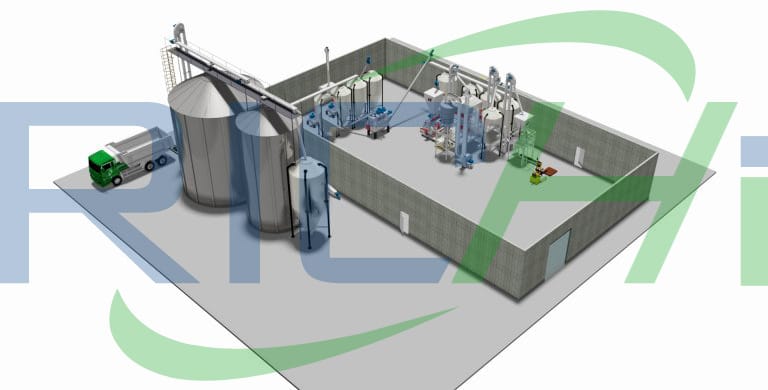
RICHI Machinery provides customized plant layouts according to the selected production capacity, workshop dimensions, storage requirements, and automation level.
The following diagrams illustrate different poultry feed mill capacity configurations. They are reference layouts rather than fixed designs for every project.
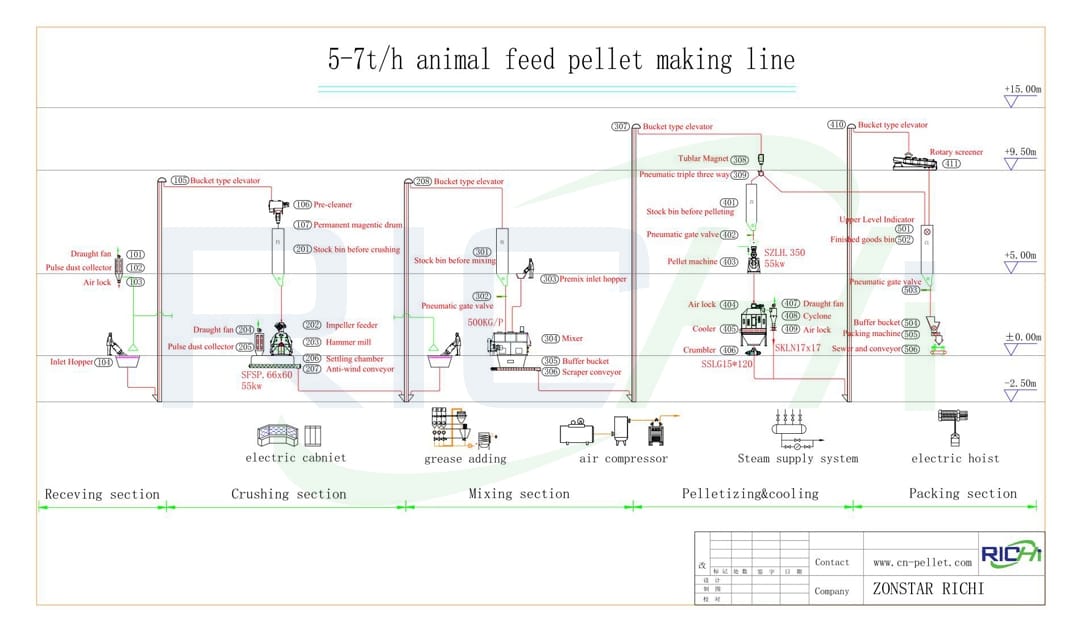
5 T/H Poultry Feed Mill Layout
A 5 T/H feed plant can be suitable for medium-sized commercial poultry feed manufacturers requiring a complete processing and pelletizing system.
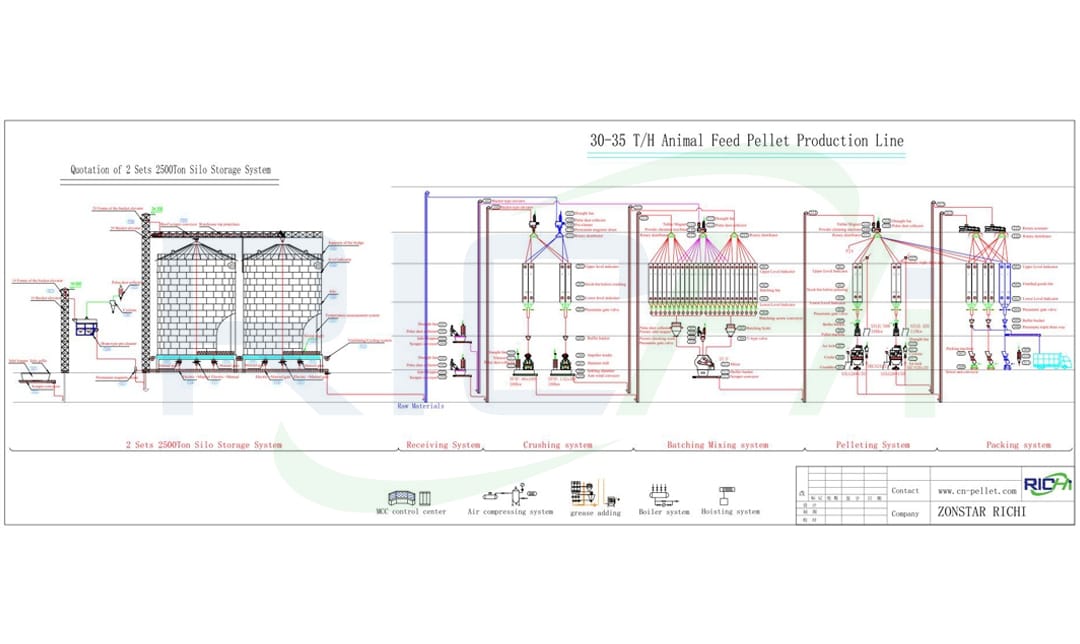
30 T/H Poultry Feed Manufacturing Plant Layout
A 30 T/H factory generally requires higher-capacity raw material handling, batching, mixing, pelletizing, and finished feed storage systems.
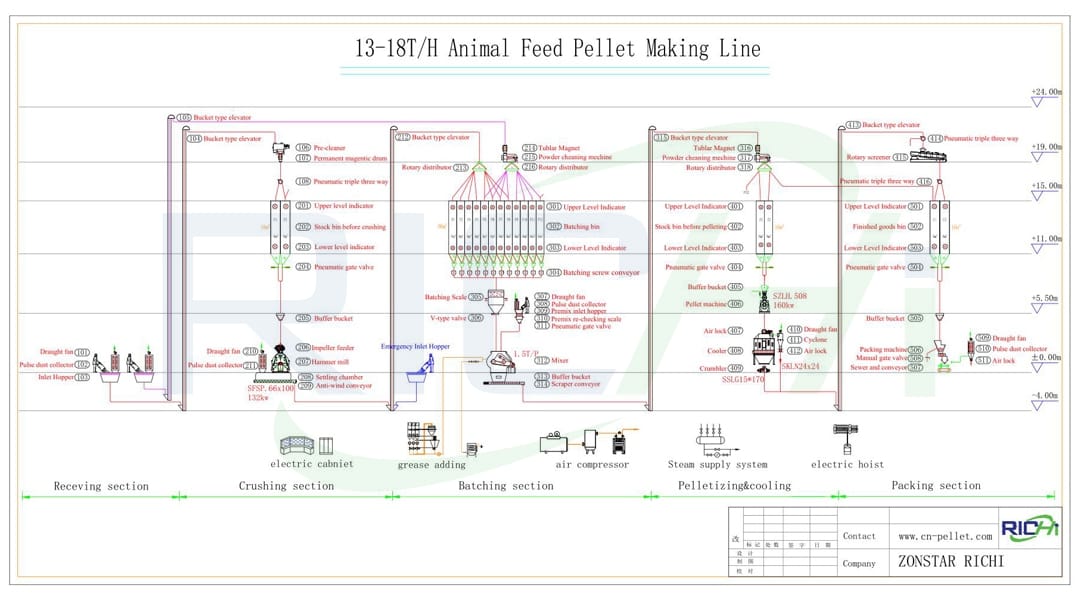
15 T/H Chicken Feed Production Line Layout
A 15 T/H feed factory may be suitable for established commercial feed manufacturers and integrated poultry enterprises.
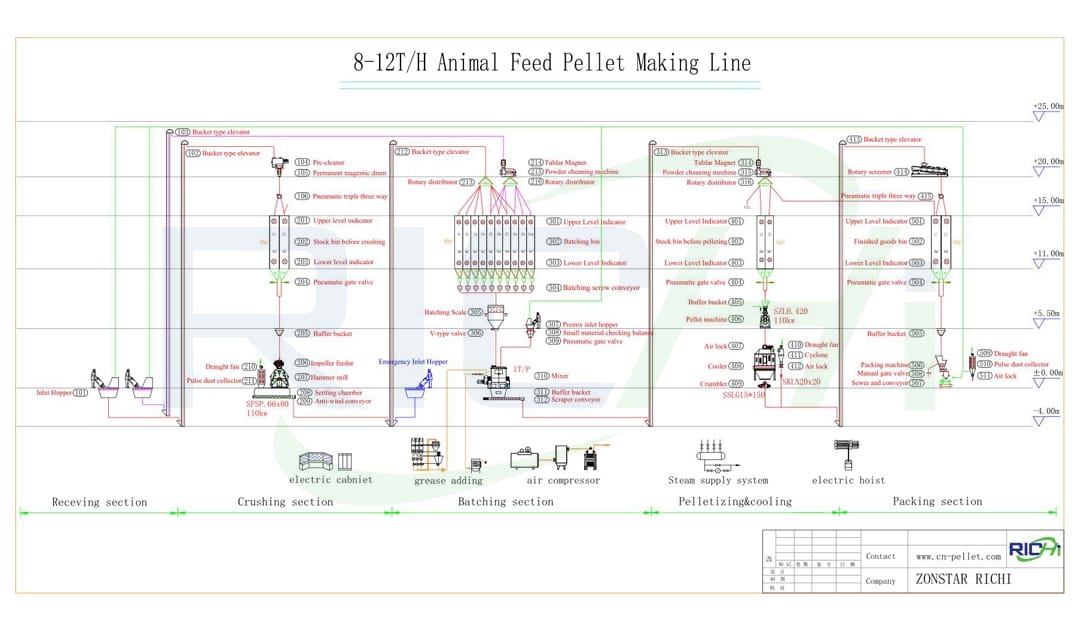
10 T/H Poultry Feed Plant Layout
A 10 T/H plant can incorporate automated batching, industrial pelletizing, cooling, screening, and packaging systems.
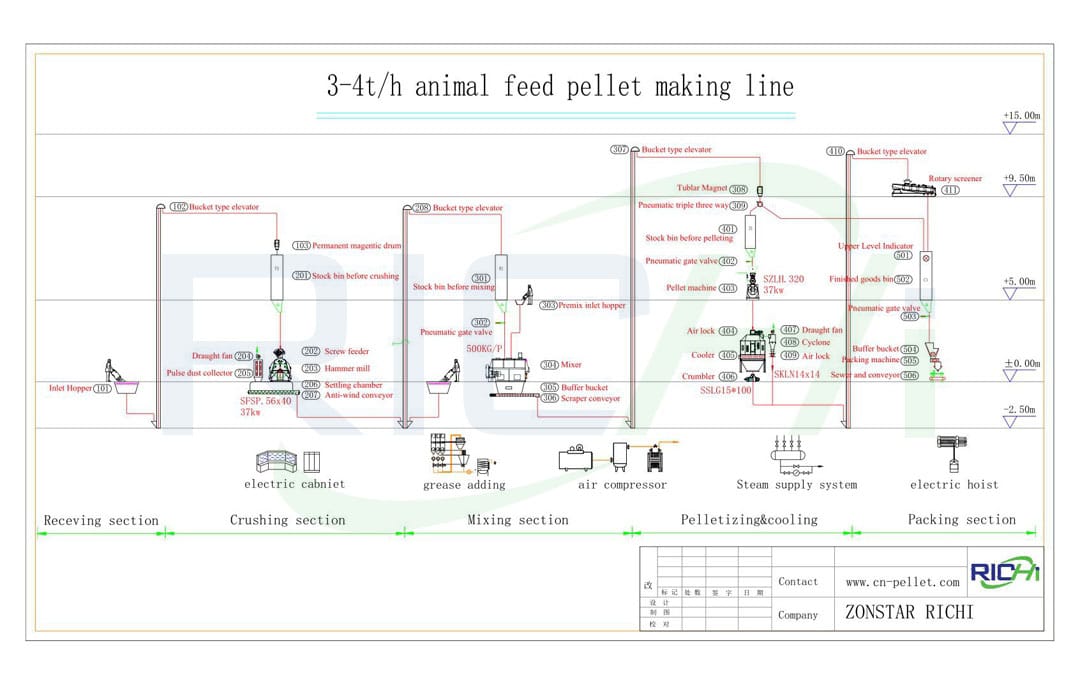
3 T/H Chicken Feed Mill Layout
A 3 T/H feed plant can provide a relatively compact commercial processing configuration, depending on the selected equipment and factory conditions.
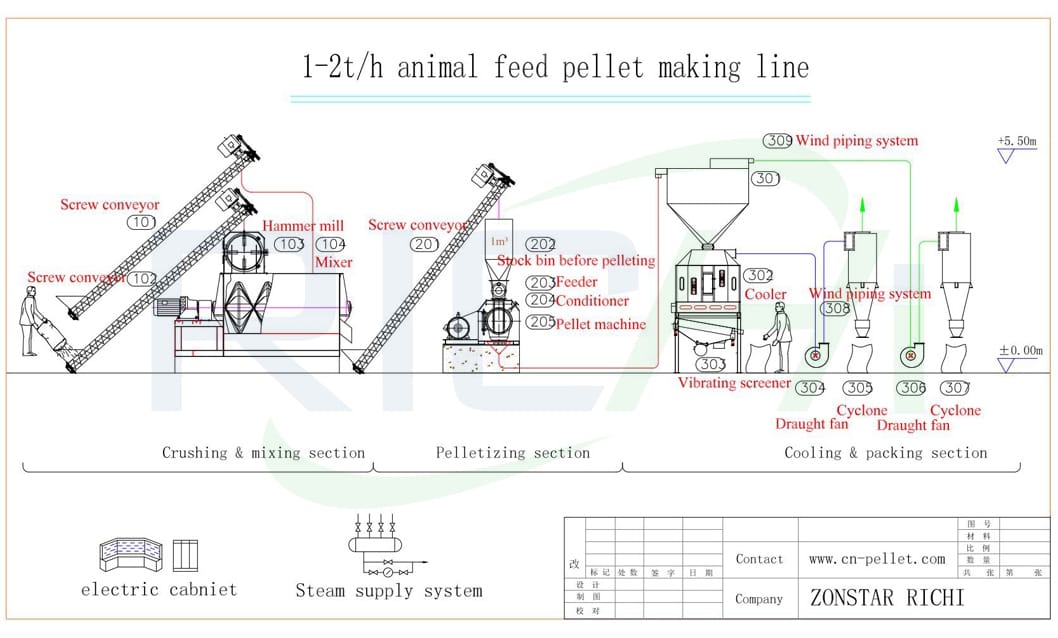
2 T/H Poultry Feed Production Line Layout
A 2 T/H production line can be configured for smaller commercial feed manufacturing operations requiring industrial grinding, mixing, and pelletizing equipment.
For more information about the available capacity configurations, customers can request a customized technical proposal based on their project requirements.
How Much Does a Poultry Feed Mill Plant Cost in South Africa?
The investment required to establish a poultry feed mill in South Africa depends on the production capacity, equipment configuration, automation level, raw material handling requirements, and project scope.
There is no single fixed price for a complete poultry feed factory because each project may require different machinery, storage systems, buildings, and auxiliary equipment.
Feed Processing Equipment Investment
Machinery investment may include grinding, batching, mixing, pelletizing, cooling, screening, conveying, and packaging equipment.
For large automated projects, additional systems may include raw material silos, multiple pellet mills, centralized control, and automated bulk loading.
Factory Construction and Infrastructure
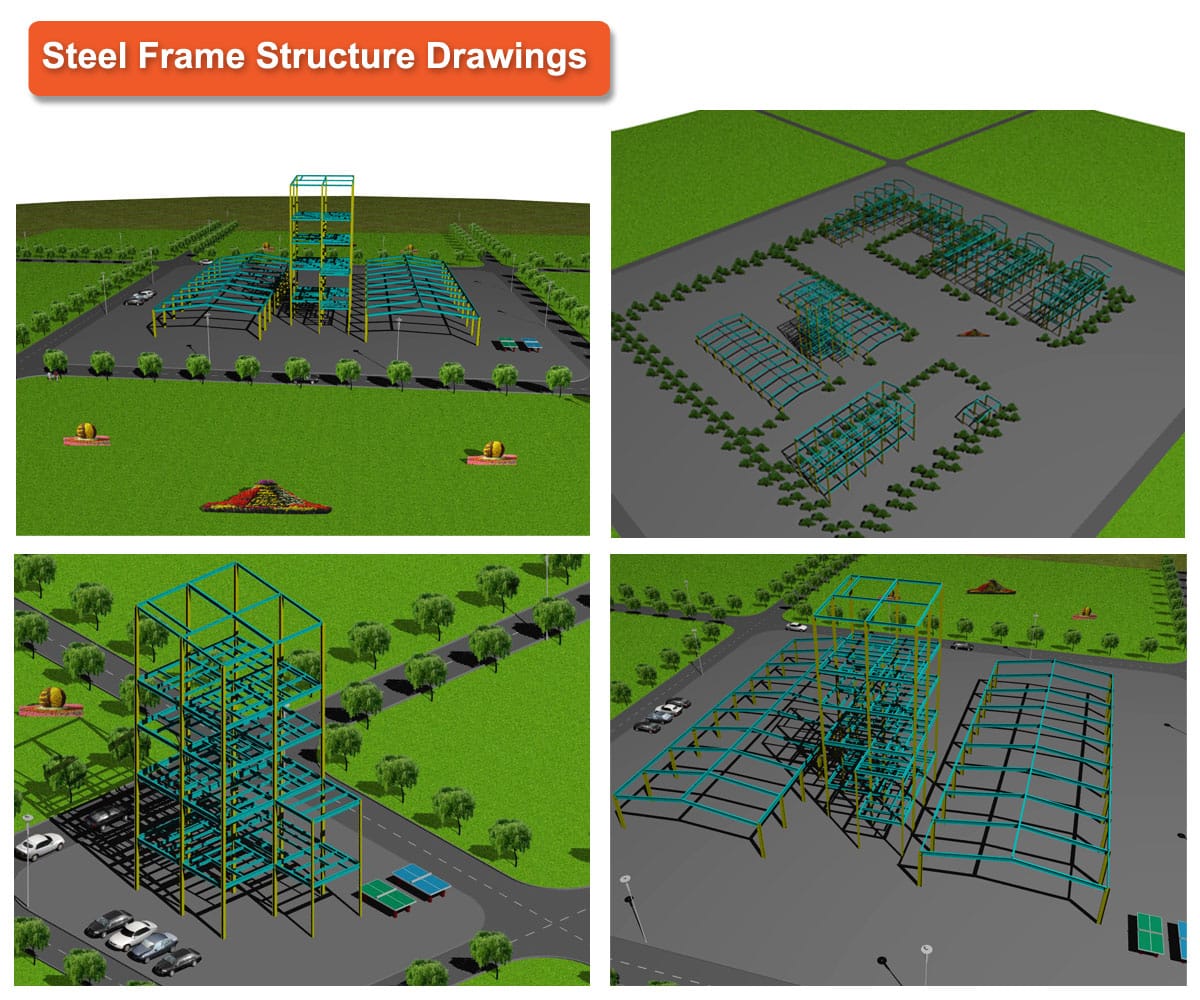
Investors should account for workshop construction, equipment foundations, storage facilities, electrical installation, vehicle access, and maintenance areas.
Electricity and Utility Requirements
Industrial poultry feed processing equipment normally requires three-phase electricity.
Projects involving steam conditioning also need an appropriately designed steam supply system.
Electrical capacity and utility requirements should be confirmed before equipment selection.
Transportation, Installation and Commissioning
For imported machinery, the project budget should consider international freight, customs clearance, inland transportation, installation, and commissioning.
Working Capital
In addition to equipment investment, a commercial feed business needs sufficient working capital for raw materials, labor, utilities, maintenance, packaging, and other operating expenses.
RICHI Machinery can prepare an equipment quotation based on the required production capacity and technical specifications. Total project investment should also be evaluated using local construction and operating cost information.
Key Considerations for Setting Up a Feed Mill in South Africa
Raw Material Availability
Maize and other grain ingredients are important inputs in many poultry feed formulations.
Investors should assess local supply conditions, seasonal price changes, ingredient quality, and transportation costs.
Factory Location and Logistics
The factory location should support efficient raw material delivery and finished feed distribution.
Access to reliable roads, industrial utilities, and appropriate storage facilities is important for commercial operation.
Electricity Supply
Stable electrical power is important for continuous operation of grinding, mixing, pelletizing, and conveying equipment.
Where power reliability is a concern, investors should evaluate suitable electrical infrastructure and contingency arrangements with qualified local specialists.
Feed Quality and Regulatory Compliance
Feed manufacturers must identify the applicable South African requirements for feed production, product registration where relevant, labeling, ingredient use, workplace safety, and environmental compliance.
Regulatory obligations should be confirmed with qualified local professionals and relevant authorities before production begins.
Dust Control and Industrial Safety
Grain handling and feed processing can generate combustible dust.
Commercial factories should include suitable dust collection, housekeeping, equipment protection, electrical safety, and fire prevention measures as determined by the project risk assessment.
South African Poultry Feed Market Considerations
South Africa's poultry and feed industries include commercial feed manufacturers, integrated poultry producers, independent farmers, and agricultural suppliers.
For a new feed manufacturing project, market research should focus on practical commercial indicators rather than relying only on historical industry growth forecasts.
Important factors include:
- Regional poultry feed demand.
- Commercial broiler and layer production activity.
- Maize and protein ingredient prices.
- Local feed manufacturing competition.
- Transport and distribution costs.
- Electricity and labor expenses.
- Feed quality and regulatory requirements.
- Expected customer contracts and sales channels.
Industry information published by the Animal Feed Manufacturers Association of South Africa and relevant government agencies can help investors evaluate current market conditions.
Historical production statistics and older market forecasts should not be treated as current market data without verification.
RICHI Poultry Feed Mill Project References
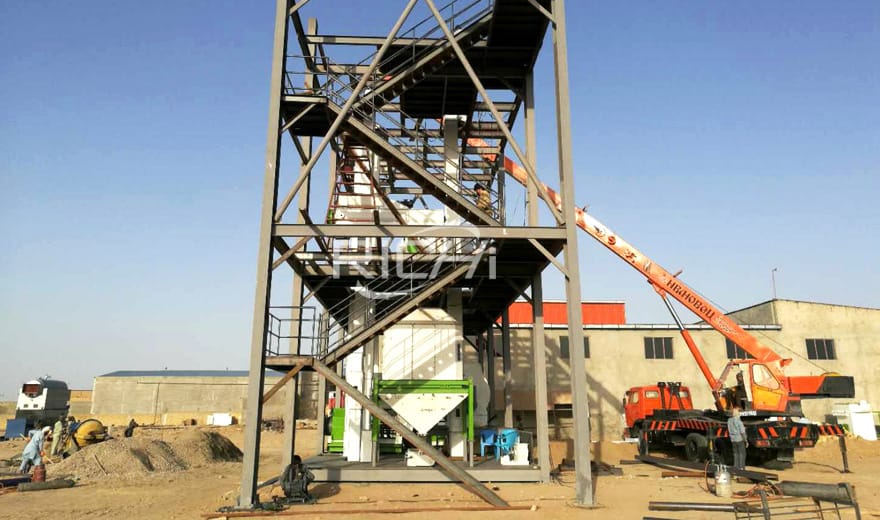
RICHI Machinery has supplied feed processing equipment and production line solutions for customers in different countries.
The following projects illustrate different commercial feed manufacturing applications.
Poultry Feed Projects in Africa
- Ethiopia 5–6 T/H Powder Feed Production Line – A commercial mash feed processing project.
- Kenya 5 T/H Automatic Batching Powder Feed Line – A feed manufacturing system with computerized batching.
- Zimbabwe 3–5 T/H Chicken Feed Pellet Production Line – A commercial poultry feed pellet processing project.
Additional International Poultry Feed Projects
- Uzbekistan 15 T/H Chicken Feed Pellet Line.
- Colombia 3–4 T/H Automatic Poultry Feed Production Line.
- Papua New Guinea 1–2 T/H Chicken Feed Pellet Line.
These references demonstrate different feed manufacturing capacities and configurations. Equipment selection for a South African project should be based on its own technical and commercial requirements.
How to Start a Poultry Feed Manufacturing Business in South Africa
Before purchasing equipment, investors should develop a practical project plan.
Step 1: Identify Your Target Customers
Determine whether the feed will be sold to commercial poultry farms, feed distributors, agricultural cooperatives, or used by an integrated poultry enterprise.
Step 2: Select the Production Capacity
Calculate the expected daily and annual feed requirements.
The selected capacity should reflect realistic sales demand and planned operating hours.
Step 3: Determine Feed Product Types
Confirm whether the plant will manufacture broiler feed, layer feed, breeder feed, mash feed, pellet feed, or multiple products.
Step 4: Evaluate Raw Materials
Identify ingredient suppliers, raw material specifications, storage requirements, and expected purchase costs.
Step 5: Select the Equipment Configuration
Choose the appropriate grinding, batching, mixing, pelletizing, cooling, and packaging systems according to the intended products.
Step 6: Plan the Factory and Utilities
Confirm the available land or workshop, electrical supply, steam requirements, storage space, and vehicle access.
Step 7: Prepare the Investment Budget
Include equipment, transportation, construction, installation, commissioning, working capital, and other necessary expenses.
Step 8: Complete Installation and Commissioning
After equipment delivery and installation, the production line should undergo appropriate inspections, testing, and commissioning before commercial operation.
Why Choose RICHI Machinery for Your Poultry Feed Mill Project?
RICHI Machinery provides industrial feed processing equipment and customized production line solutions for commercial feed manufacturing projects.
Our services can include:
- Project requirement analysis.
- Production capacity planning.
- Raw material evaluation.
- Feed manufacturing process design.
- Equipment selection and configuration.
- Factory layout planning.
- Electrical control system design.
- Installation guidance.
- Commissioning support.
- Spare parts and technical assistance.
Each production line is configured according to the customer's actual feed manufacturing requirements and factory conditions.
Frequently Asked Questions About Poultry Feed Mills in South Africa
What Is the Minimum Capacity of a Commercial Poultry Feed Mill?
RICHI Machinery generally focuses on commercial feed production lines starting at approximately 1–2 T/H, depending on the project requirements.
Can One Factory Produce Both Broiler and Layer Feed?
Yes. A properly configured feed mill can manufacture different poultry feed formulations.
Production changeovers may require adjustments to the feed recipe, pellet specifications, and operating settings.
Can a Poultry Feed Plant Produce Mash Feed and Pellets?
Yes. A production line can be designed with separate process routes for mash feed and pellet feed.
This requirement should be specified during the initial equipment design stage.
Does a Poultry Feed Mill Require Three-Phase Electricity?
Yes. Industrial feed processing equipment normally requires three-phase electrical power.
The final electrical configuration must match the local voltage, frequency, and available power capacity.
Can the Machinery Be Shipped to South Africa?
RICHI Machinery can discuss international equipment supply and transportation arrangements as part of the commercial quotation process.
Shipping terms, delivery scope, and installation services should be confirmed in the final agreement.
Can the Production Capacity Be Expanded Later?
Yes. Future expansion can be considered during the initial factory planning stage by reserving suitable space and infrastructure.
How Can I Get an Accurate Poultry Feed Mill Quotation?
Provide the required capacity, feed products, raw materials, pellet specifications, factory conditions, automation requirements, and installation location.
Get a Poultry Feed Mill Plant Quotation for South Africa
Are you planning to establish a commercial poultry feed manufacturing plant in South Africa?
RICHI Machinery can prepare a customized equipment configuration, production process, factory layout, and technical quotation according to your project requirements.
To receive a suitable proposal, please provide:
- What type of poultry feed do you want to manufacture?
- Do you need mash feed, pellet feed, or both?
- What raw materials will you use?
- How many tons per hour do you plan to produce?
- What pellet diameter do you require?
- Where in South Africa will the factory be located?
- Do you have an existing workshop or available land?
- What is the available electrical supply?
- Do you require automatic batching and packaging?
- What is your expected project investment budget?
Based on this information, our sales and engineering team can prepare a suitable production line design, equipment list, and commercial quotation.
RICHI Machinery – Commercial Poultry Feed Mill Plants and Industrial Feed Processing Equipment