If you are planning to build a small commercial cattle feed mill, a 1-3 T/H cattle feed pellet production line can be a practical solution for cattle farms, feed manufacturers, agricultural cooperatives, and regional feed suppliers.
RICHI Machinery provides industrial cattle feed pellet machines and complete feed production line solutions covering raw material crushing, mixing, conditioning, pelletizing, cooling, screening, conveying, and packaging.
This article explains the equipment configuration, processing flow, pellet mill selection, raw material requirements, investment cost, and application of a 1-3 T/H cattle feed pellet production line.
What Is a 1-3 T/H Cattle Feed Pellet Production Line?
A 1-3 tons per hour cattle feed production line is a complete feed processing system designed for small and medium commercial production.
Unlike a single pellet machine, a complete production line normally includes several processing stages:
Raw Material Receiving → Crushing → Mixing → Conditioning → Pelletizing → Cooling → Screening → Packaging
The exact configuration depends on the raw materials, required pellet size, feed formulation, automation level, and production capacity.
Who Is a 1-3 T/H Cattle Feed Line Suitable For?
A 1-3 T/H production line can be suitable for:
- Commercial cattle feed manufacturers.
- Medium and large cattle farms.
- Dairy farms.
- Sheep and goat farms.
- Agricultural cooperatives.
- Feed distributors.
- Regional livestock feed processing businesses.
For very small farms with limited feed consumption, purchasing finished feed may be more economical than building a complete production line.
What Raw Materials Can Be Used for Cattle Feed?
Cattle feed formulas vary according to animal type, production stage, local raw material availability, and nutritional requirements.
Common ingredients may include:
- Corn or maize.
- Wheat.
- Barley.
- Sorghum.
- Soybean meal.
- Rapeseed meal.
- Wheat bran.
- Rice bran.
- Alfalfa meal.
- Grass meal.
- Beet pulp.
- Molasses.
- Minerals and premixes.
Some fibrous agricultural materials such as straw, hay, or husk may also be used in certain formulations after suitable cutting, grinding, and nutritional evaluation.
Raw materials should not be selected only according to availability. Feed formulation should consider digestibility, nutritional balance, moisture, fiber content, and local feed standards.
RICHI 1-3 T/H Cattle Feed Pellet Machine Options
RICHI Machinery provides industrial ring die pellet mills for commercial cattle feed production.
For this capacity range, suitable pellet mill models may include:
- SZLH250 feed pellet mill for lower-capacity applications.
- SZLH320 ring die feed pellet mill for higher-capacity commercial production.
The final model should be selected according to the required output, raw material composition, pellet diameter, operating hours, and production process.
RICHI recommends industrial ring die pellet mills for commercial projects rather than household, portable, flat die, diesel, or gasoline pellet machines.
How Does a 1-3 T/H Cattle Feed Production Line Work?
A typical cattle feed production line includes the following processing stages.
1. Raw Material Crushing
Grain ingredients such as corn, wheat, and barley generally need to be crushed to a suitable particle size before mixing.
A hammer mill is commonly used for this stage.
Fibrous materials such as hay, straw, and alfalfa may require cutting or pre-crushing before entering the hammer mill.
2. Feed Mixing
Different ingredients are mixed according to the feed formulation.
The mixer helps distribute grains, protein materials, minerals, premixes, and other components uniformly throughout the batch.
Depending on the formula, liquid ingredients such as oil or molasses may also be added through a dedicated dosing system.
3. Feed Conditioning
Before pelletizing, the mixed material can pass through a conditioner.
The conditioning stage adjusts material temperature and moisture and prepares the feed for stable pellet formation.
Conditioning parameters should be selected according to the feed formula and required pellet quality.
4. Pelletizing
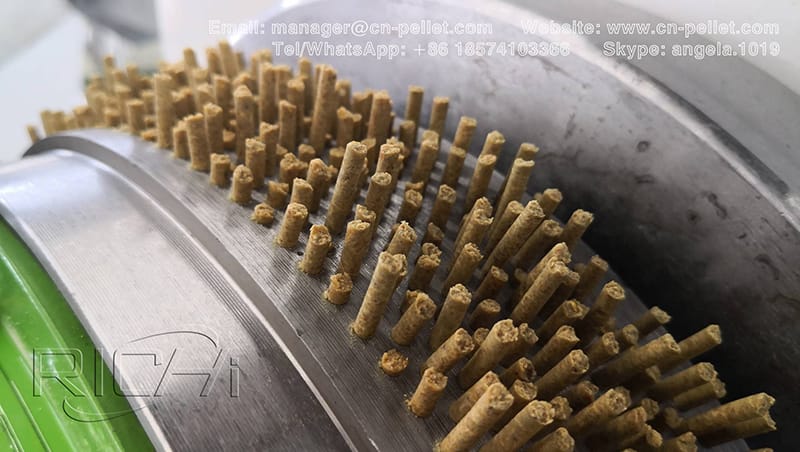
The conditioned feed enters the cattle feed pellet machine.
The ring die and rollers compress the material into uniform cylindrical pellets.
For many cattle and ruminant feed applications, pellet diameters of approximately 4-10 mm may be used.
5. Pellet Cooling
Freshly produced pellets have relatively high temperature and moisture.
A counterflow cooler reduces pellet temperature and improves stability before screening and packaging.
6. Pellet Screening
The screening system separates qualified finished pellets from fines and broken particles.
Fines can generally be returned to the appropriate processing stage to reduce material waste.
7. Feed Packaging
Finished cattle feed pellets can be packed using manual, semi-automatic, or automatic bagging systems.
Common commercial package sizes include 20 kg, 25 kg, 40 kg, and 50 kg.
Simple 1-3 T/H Cattle Feed Manufacturing Process
For a relatively simple small commercial project, the core process can be summarized as:
Crushing → Mixing → Conditioning → Pelletizing → Cooling → Screening → Packaging
Additional cleaning, automatic batching, storage bins, liquid dosing, and dust collection systems may be added according to project requirements.
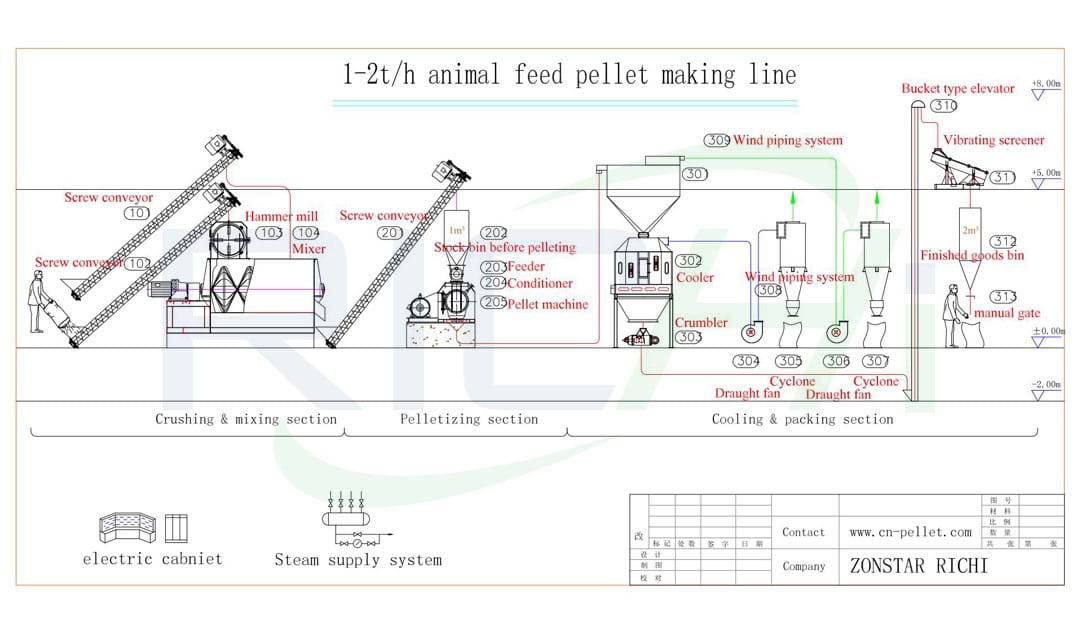
The process flow is for reference only. RICHI Machinery can customize the equipment configuration according to the customer's actual raw materials and production requirements.
Benefits of Producing Cattle Feed Pellets
Compared with loose mixed feed, pellet feed can offer several practical advantages when properly formulated and processed.
- More uniform physical form.
- Reduced ingredient segregation.
- Lower dust during handling and feeding.
- More convenient storage and transportation.
- Suitable for mechanized and automatic feeding systems.
- Better handling characteristics.
- More consistent feed intake in some feeding systems.
Pellet quality depends on raw material particle size, formulation, mixing uniformity, conditioning, moisture, ring die specifications, and operating parameters.
Pelletizing should not be described as a substitute for professional feed formulation or animal nutrition management.
Why Use a Ring Die Pellet Mill for Cattle Feed?
Ring die pellet mills are widely used in commercial feed plants because they are suitable for continuous industrial production.
Compared with small flat die equipment, ring die pellet mills offer several advantages for commercial projects:
- Higher production capacity.
- More stable continuous operation.
- Better integration with complete feed production systems.
- Better compatibility with conditioners.
- More suitable for automatic feeding and control systems.
- Improved production efficiency for commercial operations.
- Greater suitability for long-term industrial use.
Technical Parameters of a 1-3 T/H Cattle Feed Line
| Production Capacity | 1-3 T/H |
| Finished Product | Cattle and ruminant feed pellets |
| Pellet Diameter | Approximately 4-10 mm |
| Raw Materials | Grains, meals, bran, alfalfa, grass meal, premixes and other suitable ingredients |
| Pellet Mill Type | Industrial ring die feed pellet mill |
| Batching System | Manual or automatic |
| Bagging System | Manual, semi-automatic or automatic |
| Power Supply | Industrial three-phase electricity |
| Application | Commercial cattle feed plant, livestock feed factory, large cattle farm |
How Much Does a 1-3 T/H Cattle Feed Production Line Cost?
The equipment investment for a 1-3 T/H cattle feed production line depends on the final capacity, automation level, raw materials, workshop conditions, and equipment configuration.
For reference, a commercial 1-2 T/H feed production line may generally require approximately USD 30,000-60,000 in equipment investment.
A 3-4 T/H feed production line may require approximately USD 60,000-200,000, depending on the configuration.
Therefore, the price of a 1-3 T/H project should not be represented by a single fixed number.
The final cost depends on:
- Required production capacity.
- Raw material receiving and cleaning.
- Crushing system configuration.
- Manual or automatic batching.
- Feed mixing system.
- Conditioning requirements.
- Pellet mill model.
- Cooling and screening equipment.
- Manual or automatic packaging.
- Dust collection system.
- Electrical automation.
- Steel structures and workshop layout.
The equipment quotation is normally calculated separately from land, civil construction, international freight, customs duties, and local installation expenses.
How Much Feed Can a 1-3 T/H Line Produce Per Day?
Daily production depends on the actual hourly capacity and operating time.
| Capacity | 8 Hours/Day | 16 Hours/Day |
|---|---|---|
| 1 T/H | 8 tons | 16 tons |
| 2 T/H | 16 tons | 32 tons |
| 3 T/H | 24 tons | 48 tons |
These figures are theoretical values. Actual production depends on equipment utilization, maintenance, feed formulation, raw material supply, and operating conditions.
Can One Production Line Make Cattle, Sheep and Goat Feed?
Yes. A properly configured ruminant feed production line can generally process different feed formulations for cattle, sheep, goats, and other ruminants.
The main equipment can remain the same while operators adjust:
- Feed formulation.
- Ingredient proportions.
- Pellet diameter.
- Conditioning parameters.
- Production settings.
Different animal species and growth stages require different nutritional formulations, so feed recipes should be developed accordingly.
Can a Cattle Feed Line Produce Poultry Feed?
Some main equipment, such as crushers, mixers, pellet mills, coolers, and packaging systems, may be used in both livestock and poultry feed plants.
However, different animal feeds require different formulations, pellet sizes, conditioning parameters, and process configurations.
If a customer plans to produce both cattle and poultry feed, RICHI Machinery can evaluate the requirements and design a combined or flexible production system.
How Much Space Is Required for a 1-3 T/H Feed Plant?
The required workshop area depends on equipment arrangement, building height, raw material storage, finished product storage, automation, and future expansion plans.
A commercial feed plant should reserve sufficient space for:
- Raw material receiving.
- Raw material storage.
- Crushing and mixing equipment.
- Pelletizing equipment.
- Cooling and screening systems.
- Packaging equipment.
- Finished product storage.
- Electrical control systems.
- Maintenance access.
- Dust collection and ventilation.
RICHI Machinery can prepare a customized plant layout according to the customer's existing workshop or available land.
Power Requirements for a 1-3 T/H Cattle Feed Plant
Commercial cattle feed production equipment normally requires industrial three-phase electricity.
Before equipment selection, customers should confirm:
- Local voltage.
- Frequency.
- Three-phase power standard.
- Available transformer capacity.
RICHI can configure motors and electrical control systems according to the destination country's electrical standards.
Why Choose RICHI Machinery?
RICHI Machinery provides industrial feed equipment and complete feed production line solutions rather than only individual machines.
Our services include:
- Raw material analysis.
- Production capacity planning.
- Feed processing design.
- Equipment selection.
- Production line configuration.
- Workshop layout design.
- Electrical control system design.
- Installation guidance.
- Commissioning support.
- Spare parts and after-sales service.
Each cattle feed project is designed according to the customer's actual production requirements.
Typical Cattle and Ruminant Feed Projects
RICHI Machinery has supplied cattle and ruminant feed production equipment for customers in different countries.
You can view a ruminant feed pellet production line in Indonesia for reference.
For larger commercial projects, you can also view the 10 T/H cattle feed pellet production line in South Africa.
Frequently Asked Questions About 1-3 T/H Cattle Feed Lines
Can I Buy Only the Pellet Machine?
Yes, if your raw materials are already properly crushed, mixed, and prepared for pelletizing.
For most commercial projects, a complete processing line provides more stable and efficient production.
Is a 1 T/H Line Suitable for Commercial Production?
Yes. A 1 T/H feed line can be used for small commercial feed production, provided the local market, feed demand, and operating economics justify the investment.
Can the Production Line Be Expanded Later?
Yes. During the initial factory design stage, space and interfaces can be reserved for future expansion.
Can Molasses Be Added to Cattle Feed?
Yes, depending on the feed formulation. A dedicated liquid dosing system may be required to control the addition amount and maintain consistent mixing.
How Can I Get an Accurate Quotation?
To prepare an accurate equipment proposal, please provide your raw materials, required production capacity, pellet size, destination country, local voltage, automation requirements, and workshop dimensions.
Get a Customized 1-3 T/H Cattle Feed Production Line Proposal
If you are planning to build a commercial cattle feed production line, RICHI Machinery can provide a customized solution according to your raw materials, production capacity, feed formulation, and factory conditions.
To receive a suitable proposal, please provide:
- What type of animal feed do you want to produce?
- What raw materials will you use?
- What are the raw material particle sizes?
- What is the approximate moisture content?
- How many tons per hour do you require?
- What pellet diameter do you need?
- Which country will the equipment be installed in?
- What is the local voltage?
- Do you need only a pellet machine or a complete production line?
Our sales and engineering team can prepare a customized equipment configuration, process flow, factory layout, and complete quotation.
RICHI Machinery – Industrial Cattle Feed Pellet Machines & Complete Ruminant Feed Production Line Solutions