Many customers from South America contact us with a seemingly simple question: “I want to make wood pellets for heating. How much is a wood pellet machine?”
But wood pellet production is very different from simply buying a machine and putting wood into it. A pellet mill is only one part of the production process.
Before considering which pellet machine to buy, you need to understand your raw materials, their moisture content and size, the required production capacity, the necessary processing equipment, factory conditions, electricity supply, and the total investment required for the project.
This guide explains the basic production logic for anyone considering producing wood or biomass pellets, whether the pellets will be used for heating or sold commercially.
1. Can I Make Wood Pellets at Home for My Own Heating?
Technically, wood can be processed into fuel pellets. However, commercial wood pellet production is generally not suitable for personal or household production.
Industrial pellet production requires much more than a pellet mill. Depending on the condition of the raw material, the project may require wood chipping, crushing, drying, pelletizing, cooling, screening, dust collection, conveying, storage and packaging equipment.
It also requires sufficient factory space, industrial electrical power, continuous raw material supply, operators and regular equipment maintenance.
Therefore, if your objective is simply to produce a small quantity of pellets for heating one house, purchasing an industrial pellet production line is usually not economically reasonable.
RICHI Machinery mainly provides equipment and complete production solutions for commercial and industrial pellet projects, rather than small household or DIY pellet machines.
2. A Wood Pellet Mill Is Not a Complete Wood Pellet Production Line
One of the most common misunderstandings is that raw wood can be fed directly into a pellet mill.
In reality, the pellet mill has a very specific job: compressing properly prepared biomass material into pellets.
It is not designed to turn logs, branches or large wood chips directly into finished pellets. Before pelletizing, the raw material must meet suitable requirements for particle size, moisture content and cleanliness.
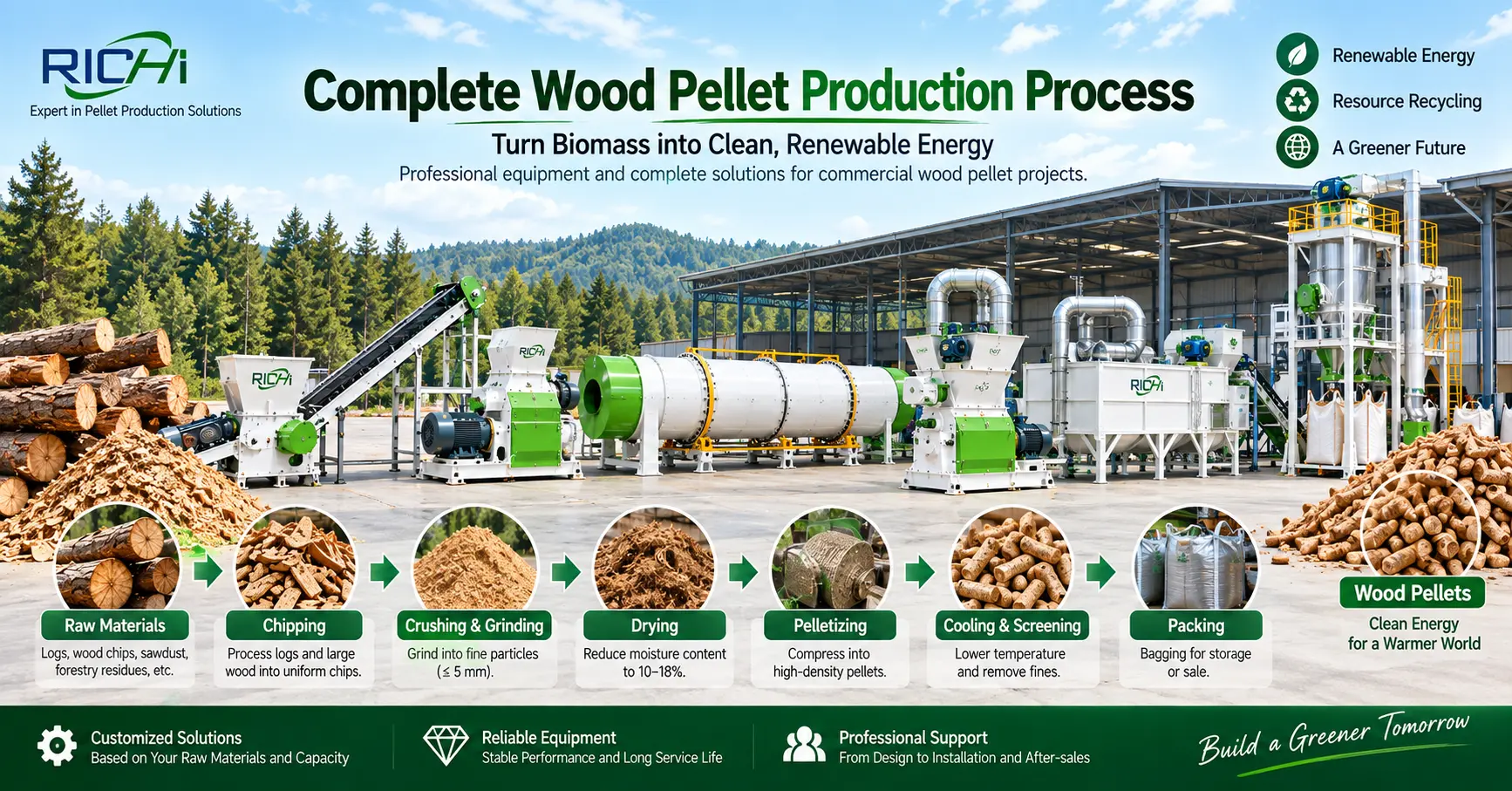
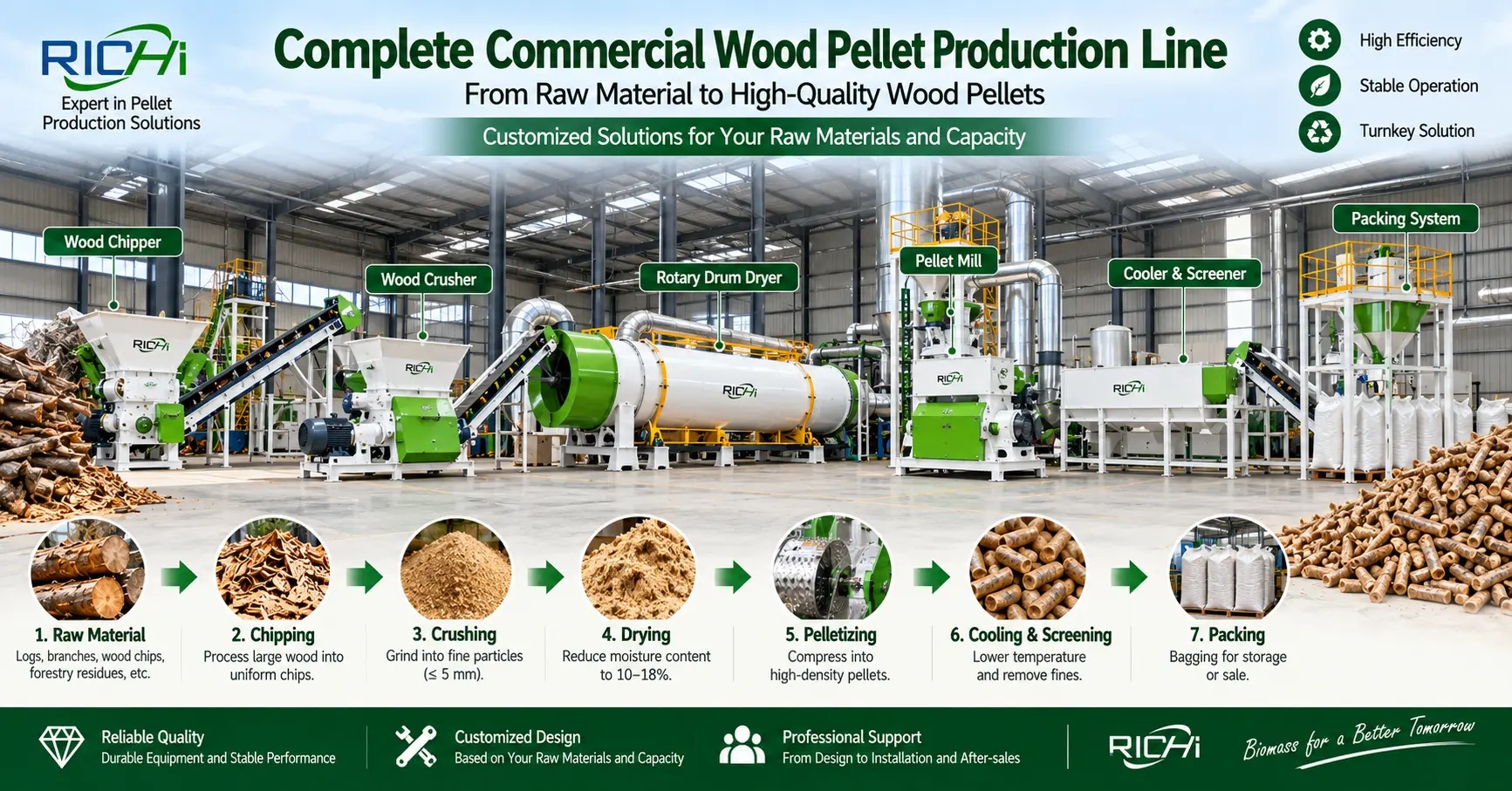
A typical wood pellet production process may include:
- Raw material receiving and storage
- Chipping – for logs, branches and oversized wood
- Crushing or grinding – reducing the material to suitable small particles
- Drying – reducing excessive moisture
- Pelletizing – compressing the prepared biomass into pellets
- Cooling – reducing pellet temperature and improving stability
- Screening – separating fines from finished pellets
- Packaging or bulk storage
Additional conveying, dust collection, electrical control and auxiliary systems are normally required to connect these processes into a continuous production line.
3. Your Raw Material Comes Before the Pellet Machine
If you are planning a wood pellet project, one of the first questions should not be “Which pellet machine should I buy?”
The first question should be:
“What exactly is my raw material?”
South America has abundant forestry and agricultural biomass resources, but different raw materials require very different processing systems.
Common examples include:
- Sawdust
- Wood shavings
- Wood chips
- Forestry residues
- Branches
- Wood logs
- Furniture and wood-processing residues
- Other suitable biomass materials
Even when two customers want to produce exactly the same amount of wood pellets per hour, their production lines can be completely different because their raw materials are different.
4. Why Does the Shape and Size of the Raw Material Matter?
Consider three customers:
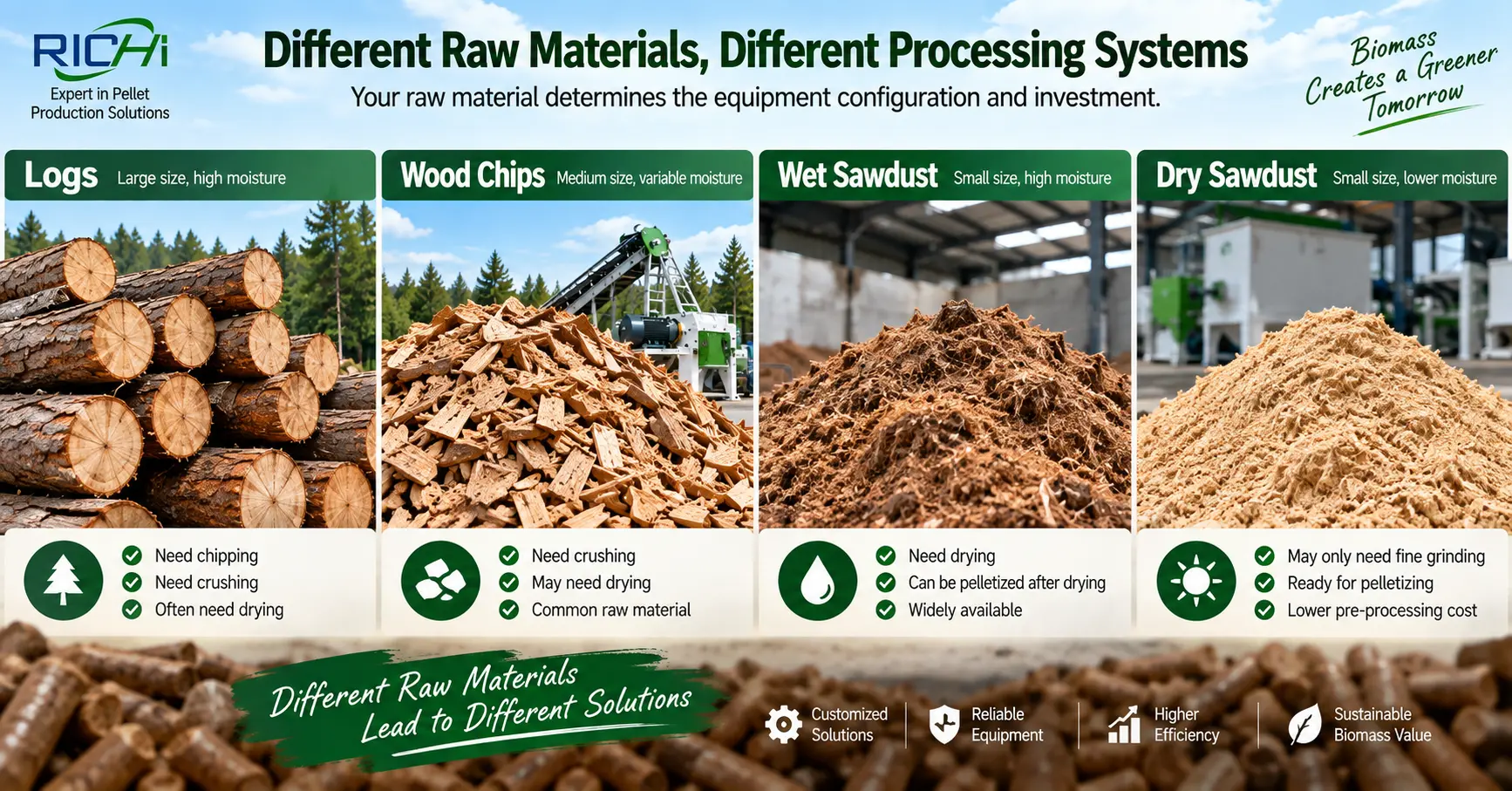
Customer A: has dry, fine sawdust.
Customer B: has wet wood chips.
Customer C: has fresh logs and forestry residues.
All three customers may want to produce 1 ton of pellets per hour, but they cannot use the same equipment configuration.
Dry sawdust may already be relatively close to the particle size required for pelletizing. Wood chips normally require further crushing. Logs and large branches usually require size reduction before they can even enter the grinding stage.
A simplified process comparison may look like this:
Dry sawdust:
Sawdust → Fine grinding if required → Pelletizing → Cooling → Screening → Packing
Wet wood chips:
Wood chips → Grinding → Drying → Pelletizing → Cooling → Screening → Packing
Fresh logs:
Logs → Chipping → Grinding → Drying → Pelletizing → Cooling → Screening → Packing
This is why we cannot accurately determine a complete production line simply from the required pellet capacity.
5. Why Must Wood Be Crushed Before Pelletizing?
A ring die pellet mill needs relatively small and reasonably uniform particles. Large pieces of wood cannot pass through the pelletizing system correctly.
Crushing and grinding therefore have several important functions:
- Reduce large biomass into suitable particles
- Improve material uniformity
- Improve feeding stability
- Support more stable pellet formation
- Reduce abnormal load on the pellet mill
- Help achieve more consistent finished pellet quality
For many wood pellet projects, the material is normally reduced to approximately 5 mm or below before pelletizing, although the exact preparation requirements depend on the raw material and final product.
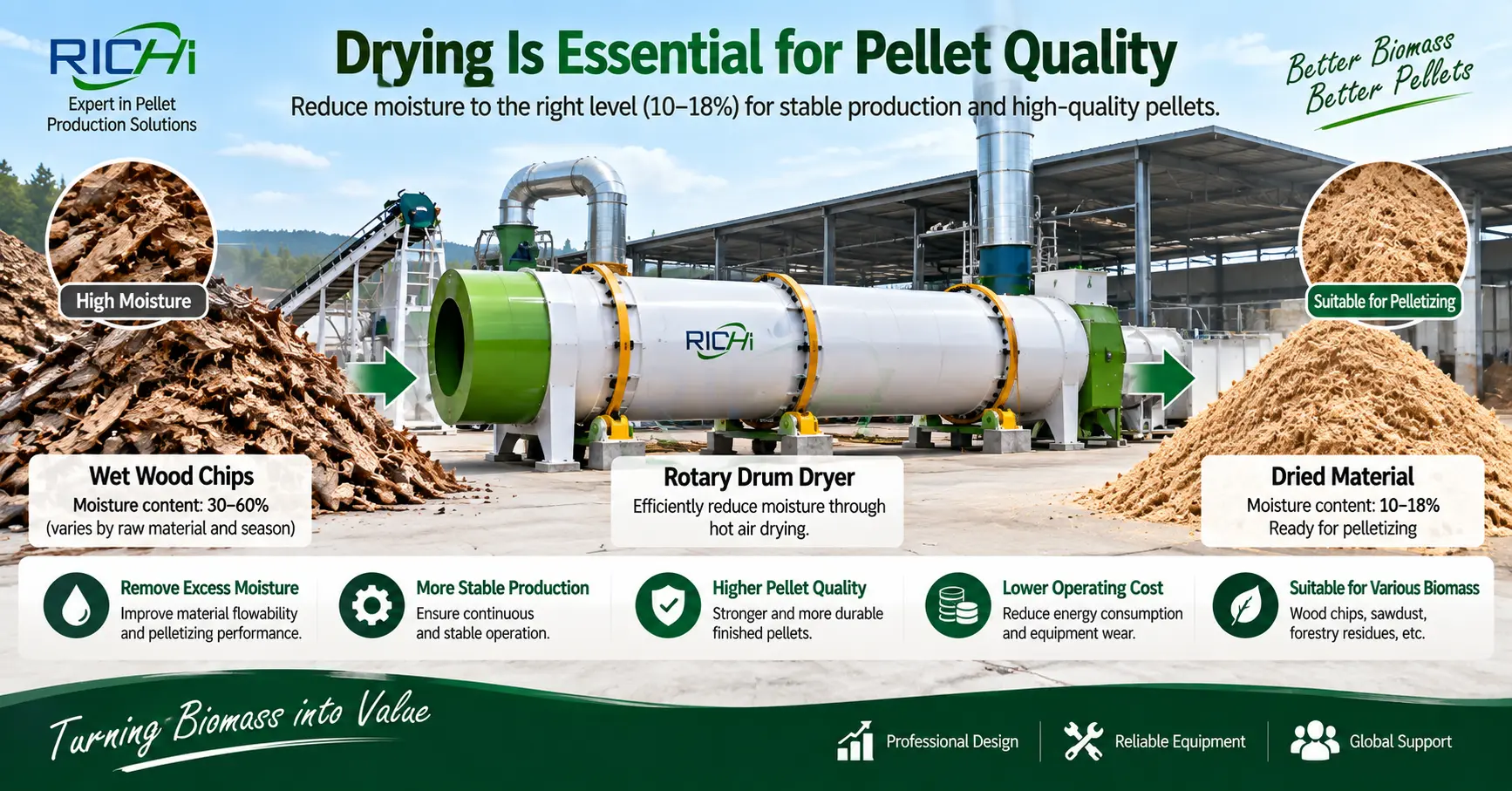
6. Why Is Moisture So Important?
Moisture content is another factor that directly affects pellet production.
Fresh wood, forestry residues and newly processed wood chips can contain a large amount of water. Such material normally cannot be sent directly into the pellet mill.
For many wood pellet applications, the material should generally be conditioned to approximately 10–18% moisture before pelletizing, with the exact target depending on the raw material and production conditions.
If the material is too wet, pellet formation and production stability may be affected. If it is too dry, pellet quality and the pelletizing process can also be affected.
Therefore, when the incoming material contains excessive moisture, a drying system becomes an important part of the complete production line.
7. Why Can Two Pellet Plants With the Same Capacity Have Very Different Prices?
This is one of the most important concepts for new investors to understand.
Suppose two customers both require a 1–1.2 T/H wood pellet production line. This does not mean their projects will have the same price.
For example:
Project A: dry sawdust with suitable particle size.
The raw material requires relatively little pre-processing.
Project B: wet logs.
The raw material may require chipping, crushing and drying before pelletizing.
Although both plants produce approximately the same amount of pellets per hour, Project B requires substantially more equipment, power, conveying systems and factory space.
Therefore:
Same pellet capacity ≠ same production line.
Same pellet capacity ≠ same investment.
8. Production Capacity Is One of the Most Important Decisions
After determining your raw material conditions, you need to determine how many pellets you plan to produce.
Production capacity is normally expressed in kilograms or tons per hour, such as:
- 1-1.2 T/H Pellet Production Line
- 2-2.5 T/H Pellet Production Line
- 3-3.5 T/H Pellet Production Line
- 4-5 T/H Pellet Production Line
- 6-7.5 T/H Pellet Production Line
- 8-10 T/H Pellet Production Line
Capacity affects much more than the model of the pellet mill.
It can affect:
- Pellet mill model and quantity
- Crusher capacity
- Dryer size
- Cooling system
- Conveying equipment
- Dust collection system
- Electrical power requirements
- Workshop dimensions
- Raw material storage
- Finished pellet storage
- Automation level
- Total project investment
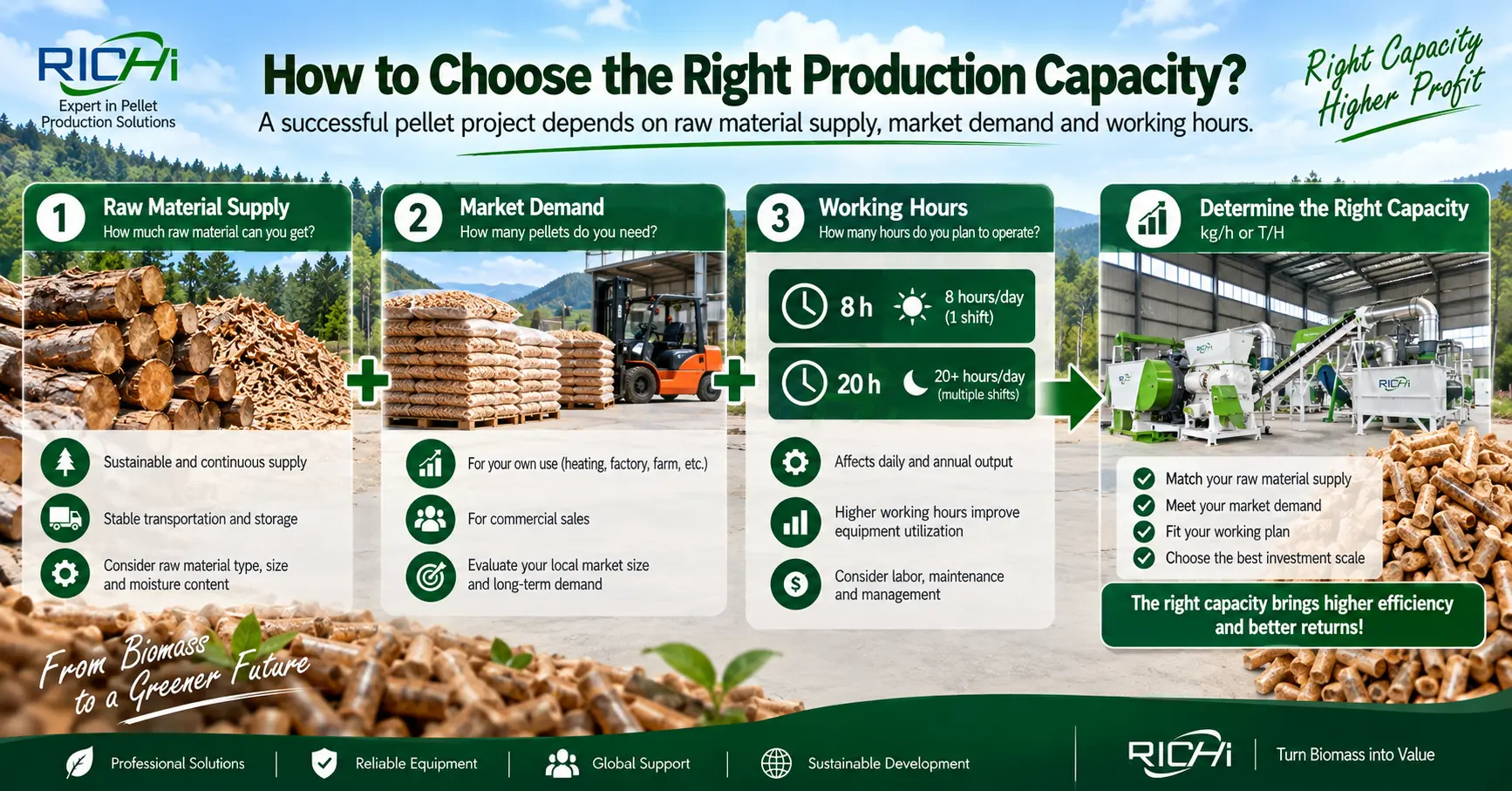
9. How Should I Decide the Right Production Capacity?
Do not choose a capacity simply because a larger machine sounds better. Your capacity should be based on the actual economics of your project.
Raw Material Supply
How much raw material can you obtain continuously?
A pellet factory does not need raw materials only once. It requires a stable supply every day, every month and every year.
For example, planning a large pellet plant makes little sense if you only have enough wood residues to operate the line occasionally.
Pellet Demand
If the pellets will be sold, how large is your market? How many tons can your customers realistically consume?
If the pellets will be used for your own business, factory, farm, hotel or heating system, calculate your annual fuel consumption before determining plant capacity.
Working Hours
There is a major difference between operating a production line for 8 hours per day and operating it for 20 hours per day.
For example, a theoretical 2 T/H line operating for 8 hours has a very different daily production potential from the same line operating continuously for multiple shifts. Actual output will also be influenced by the raw material, operating conditions and downtime.
10. How Much Does a Complete Wood Pellet Production Line Cost?
There is no single fixed price for a complete wood pellet plant. The following figures can be used as a preliminary FOB investment reference.
| Production Capacity | Reference FOB Price |
|---|---|
| 0.2–0.3 T/H | Starting from USD$20,000 |
| 0.3–0.5 T/H | Starting from USD$30,000 |
| 1.0–1.2 T/H | Starting from USD$40,000 |
| 1.5–2.0 T/H | Starting from USD$60,000 |
| 2.5–3.0 T/H | Starting from USD$80,000 |
| 3.0–4.0 T/H | Starting from USD$100,000 |
| 5.0–6.0 T/H | Starting from USD$180,000 |
| 6.0–8.0 T/H | Starting from USD$200,000 |
| 10–12 T/H | Starting from USD$300,000 |
| 12–15 T/H | Starting from USD$500,000 |
| 20–24 T/H | Starting from USD$600,000 |
Important: These are reference ranges, not fixed quotations.
The wide price range exists because the raw material condition can completely change the required production process.
For the same capacity:
- Dry sawdust may not require a large drying system.
- Wet sawdust may require drying.
- Wood chips may require crushing and drying.
- Logs may require chipping, crushing and drying.
Automation level, factory layout, storage requirements, local electrical standards and other project-specific requirements can further affect the final equipment configuration and price.
11. Why Is a Small Pellet Plant Still Relatively Expensive?
Another common question is: “If I only need 200 or 300 kg per hour, why does the project still cost so much?”
Because reducing capacity does not eliminate the production process.
If your raw material is wet and oversized, you may still need:
Chipping → Crushing → Drying → Pelletizing → Cooling → Screening → Conveying → Dust Collection → Packing
The machines can be smaller, but many of the processing stages remain necessary.
This is one reason why industrial wood pellet production does not scale down economically to household use. A person who only wants a few bags of heating pellets does not have the same economics as a commercial pellet producer.
12. Heating Pellets and Commercial Pellet Production
Many customers initially become interested in pellet production because they use wood pellets for heating. That is understandable, especially in regions where wood and forestry residues are readily available.
However, there is an important distinction between:
using pellets and manufacturing pellets.
A pellet stove may consume a relatively small quantity of pellets, while a commercial pellet production line is designed to continuously process a much larger amount of biomass.
For individual household heating, purchasing finished pellets is often more practical than establishing an industrial pellet factory.
Pellet manufacturing becomes more commercially reasonable when you have:
- A continuous source of low-cost biomass
- Sufficient production demand
- Industrial factory space
- Three-phase electrical power
- A realistic investment budget
- A market for selling the pellets or significant internal fuel demand
13. Having Free Wood Does Not Automatically Mean Pellet Production Will Be Cheap
Some customers say: “I already have free wood, so producing pellets should be inexpensive.”
Having your own raw material is certainly an important advantage, but the cost of the wood itself is only one part of pellet production.
You still need to consider:
- Collection
- Transportation
- Storage
- Chipping
- Crushing
- Drying
- Electricity
- Labor
- Equipment maintenance
- Packaging
- Factory investment
In particular, very wet raw materials can significantly increase both the initial equipment investment and the operating energy consumption.
14. Before Asking for a Quotation, Prepare These Project Details
If you are seriously considering a wood pellet production project, providing the following information will make equipment selection and quotation much more accurate.
- What raw material will you use?
Sawdust, wood chips, logs, branches, forestry residues or another biomass? - What is the current size of the material?
Fine sawdust and whole logs require completely different processing systems. - What is the approximate moisture content?
Is the material dry, naturally stored, or freshly harvested? - How much raw material can you supply continuously?
- How many kilograms or tons of pellets do you want to produce per hour?
- Will the pellets be used for your own heating or sold commercially?
- Do you already have a factory building and three-phase electricity?
15. So, Do You Need a Pellet Machine or a Complete Pellet Plant?
If you already have properly crushed material with suitable moisture content, a pelletizing section may be sufficient for your project.
But if your raw material is logs, branches, wet wood chips, wet sawdust or other untreated biomass, you should evaluate the complete production process, not only the pellet mill.
The correct sequence is:
Raw material → Raw material condition → Required processing → Production capacity → Equipment configuration → Factory layout → Investment
Not:
Choose a pellet machine first → Try to make the raw material fit the machine later.
Start With Your Raw Material, Not the Pellet Machine
If you are considering producing wood pellets in Brazil, Argentina, Chile, Colombia, Peru, Uruguay, Paraguay, Bolivia or another South American country, the most important first step is to understand your own project conditions.
Do not begin by asking only for the price of a pellet machine.
First determine: what raw material you have, its size, its moisture content, how much is continuously available, and how many pellets you actually need to produce.
These factors determine whether you need crushing, drying and other processing systems, which pellet mill is suitable, how large the factory needs to be, and ultimately how much the complete project will cost.
RICHI Machinery provides ring die pellet mills and complete industrial wood and biomass pellet production lines. For a commercial project, our technical team can configure the production process according to your raw materials, capacity, factory conditions and final pellet requirements.
If you want to evaluate a wood pellet project, tell us your raw material, raw material size, moisture condition and required production capacity first. With this information, we can determine what equipment your project actually needs.