Sustainable development, resource utilization efficiency, and carbon emission reduction goals are not just talk; they have already become one of the policy objectives for value-added projects targeting biomass waste. In the past, we would typically dispose of agricultural and industrial biomass waste through burning, landfilling, or natural decomposition. Now, with the option of pellets production, how to add value has become an important goal today.
No metter what, biomass pellet production technology has become one of the mature and commercial solutions. Many customers have chosen this pelletizing solution, and their finished pellets have been successfully used in power plants, home heating, BBQ, animal bedding, and various other fields.
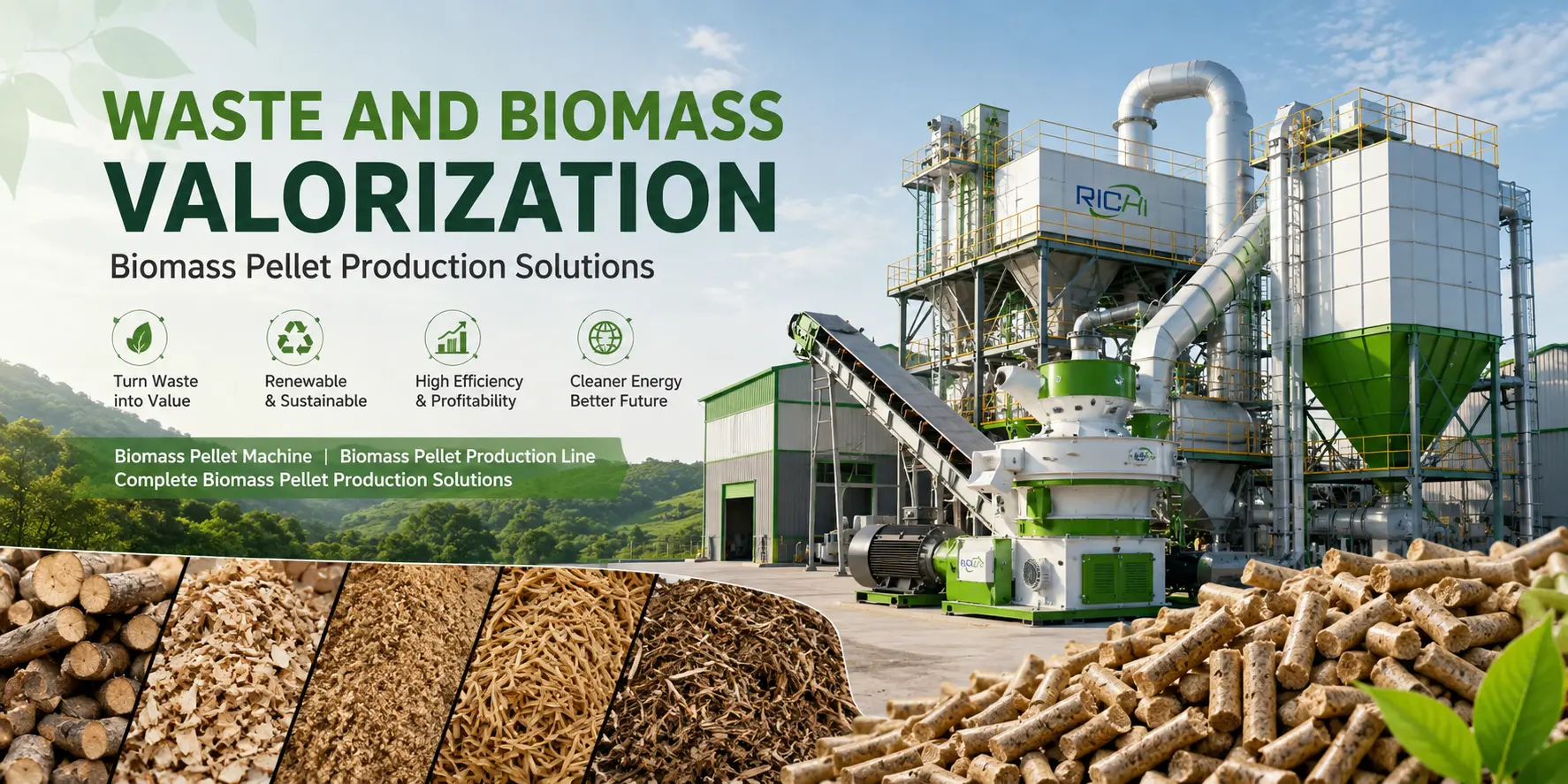
Understanding Waste and Biomass Valorization First
What Is Biomass Valorization?
Literaly, any technology or solution that converts biomass waste into products with higher economic and practical value is a process of biomass value-added.
And some common value-added projects and solutions include: biomass pelletized fuel, carbonization of bio-fuel, composting, etc. Among these options, pellet production provides a commercial and highly scalable solution for the large-scale utilization of biomass waste.
Environmental and Economic Benefits
The biomass value-added project not only helps to reduce the management difficulties of various waste, to a certain extent mitigating the harm humans cause to the environment; on the other hand, it also creates certain additional income and job opportunities in the commercial and employment sectors. This is also a process of human self-repair.
- Reduce landfill waste and open-field burning
- Lower greenhouse gas emissions
- Increase resource utilization efficiency
- Create renewable energy products
- Generate additional business income
- Support circular economy initiatives
Why Pelletization Is a Practical Valorization Method
From the process perspective: the biomass pellet production solution accelerates the recycling and utilization of waste, equivalent to a cleaner for nature. From the result perspective: the treatment scheme of improving biomass density creates a standard low-carbon fuel product with a large market demand.
What raw materials are suitable for biomass pellet production?
Wood-Based Biomass Materials
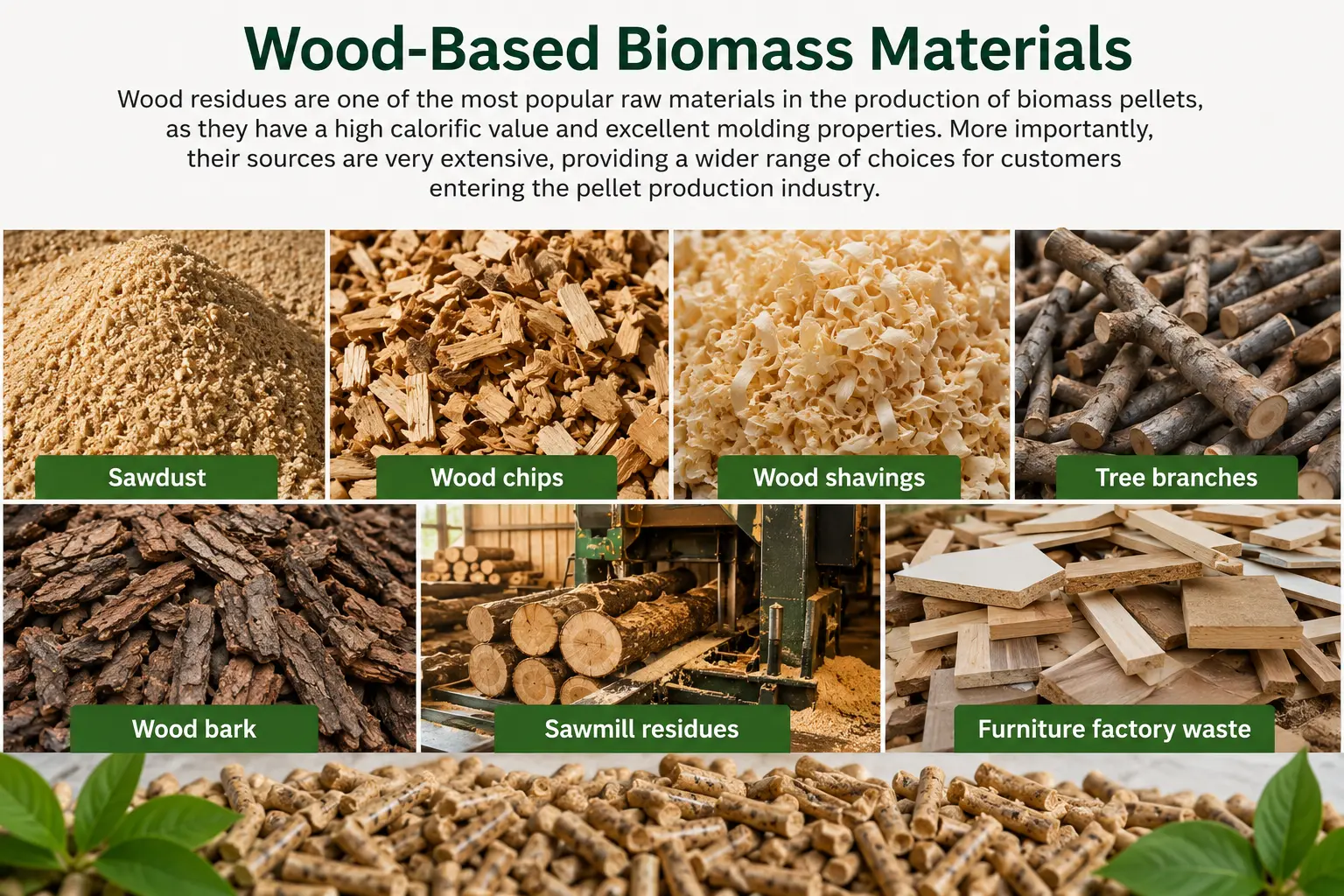
Wood residues are one of the most popular raw materials in the production of biomass pellets, as they have a high calorific value and excellent molding properties. More importantly, their sources are very extensive, providing a wider range of choices for customers entering the pellet production industry.
- Sawdust
- Wood chips
- Wood shavings
- Tree branches
- Wood bark
- Sawmill residues
- Furniture factory waste
Agricultural Biomass Materials
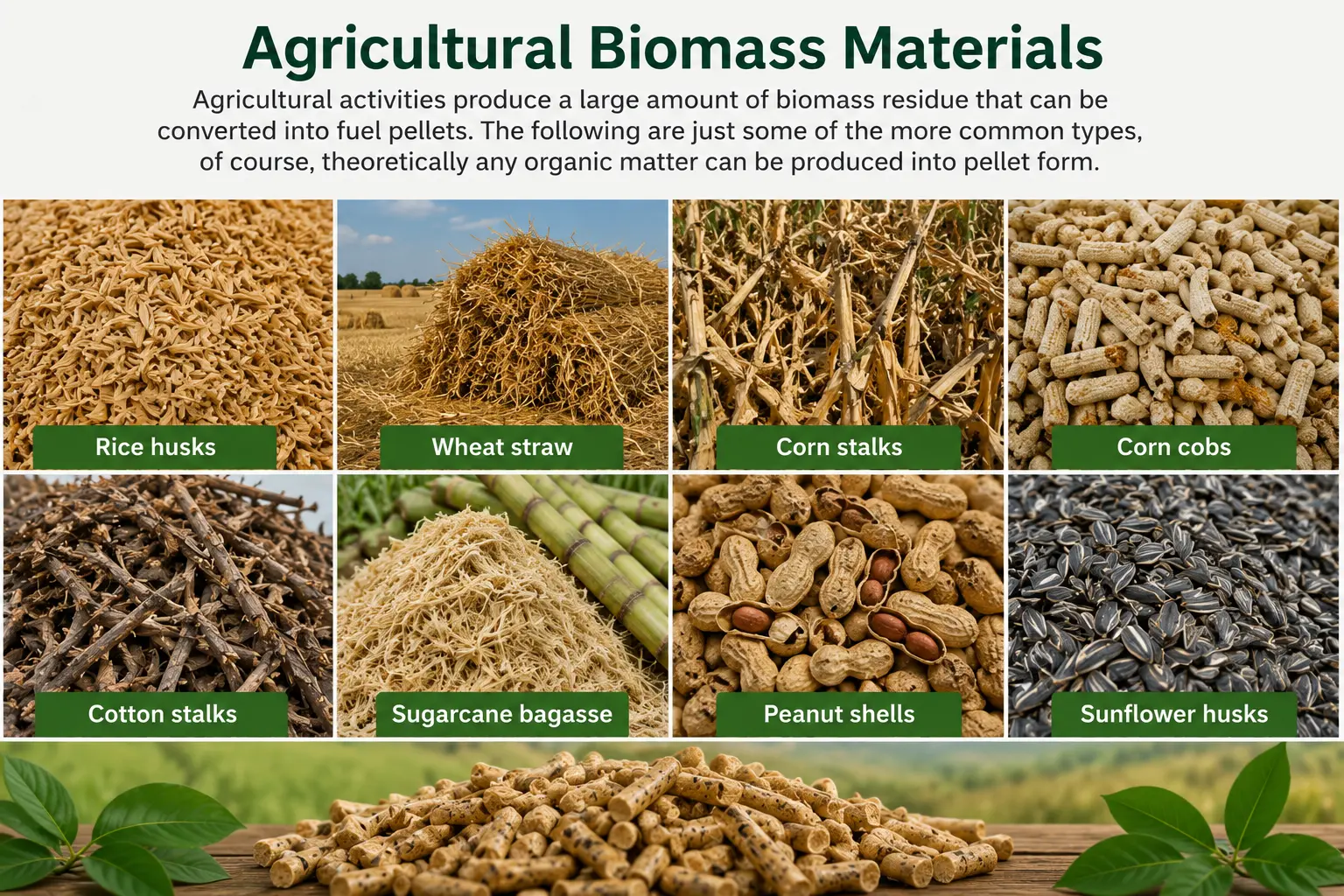
Agricultural activities produce a large amount of biomass residue that can be converted into fuel pellets. The following are just some of the more common types, of course, theoretically any organic matter can be produced into pellet form.
- Rice husks
- Wheat straw
- Corn stalks
- Corn cobs
- Cotton stalks
- Sugarcane bagasse
- Peanut shells
- Sunflower husks
Other Biomass Resources
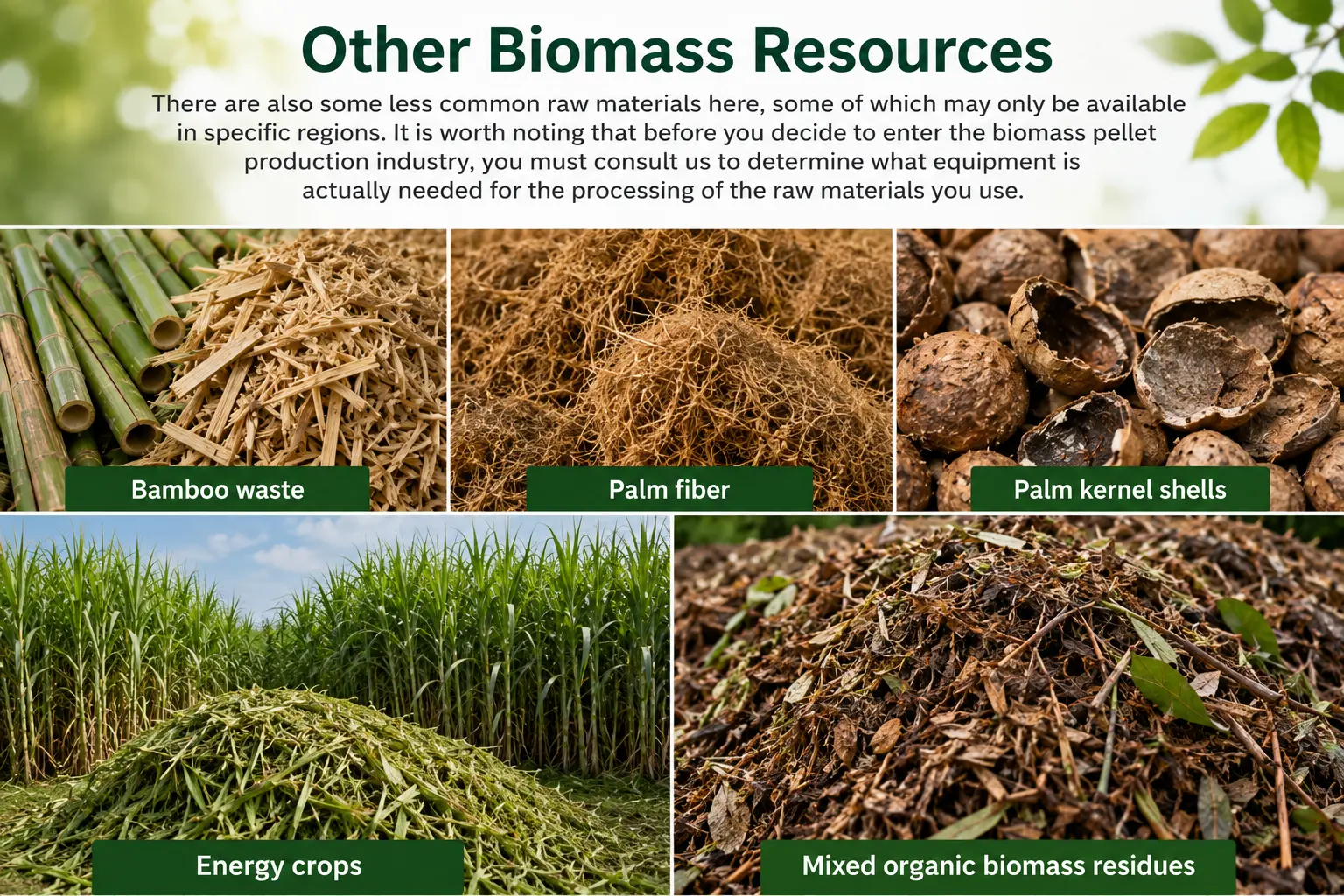
There are also some less common raw materials here, some of which may only be available in specific regions. It is worth noting that before you decide to enter the biomass pellet production industry, you must consult us to determine what equipment is actually needed for the processing of the raw materials you use.
- Bamboo waste
- Palm fiber
- Palm kernel shells
- Energy crops
- Mixed organic biomass residues
There is another very important point to understand: many customers believe that pellet production only requires one pellet machine, which is actually not the case. Pellet production is instead an industrial project that requires continuous raw material input and a complex production process. I think those who think they can produce pellets at home really need to understand this industry carefully and thoroughly.
How Biomass Pellet Production Solutions Create Value from Waste
Reducing Waste Disposal Costs
Many industries spend considerable resources transporting, storing, or disposing of biomass waste. Pellet production transforms these materials into valuable feedstocks, reducing disposal costs and improving operational efficiency.
Create New Economic Sources
Biomass pellets are widely used as renewable fuel in industrial boilers, heating systems, and power plants. Businesses can generate additional revenue by converting existing waste streams into marketable pellet products.
Supporting Sustainability Goals
Biomass pellet production contributes to sustainability objectives by reducing waste, improving resource efficiency, and supporting renewable energy development.
What processes and equipment are included in the complete biomass pellet production line?
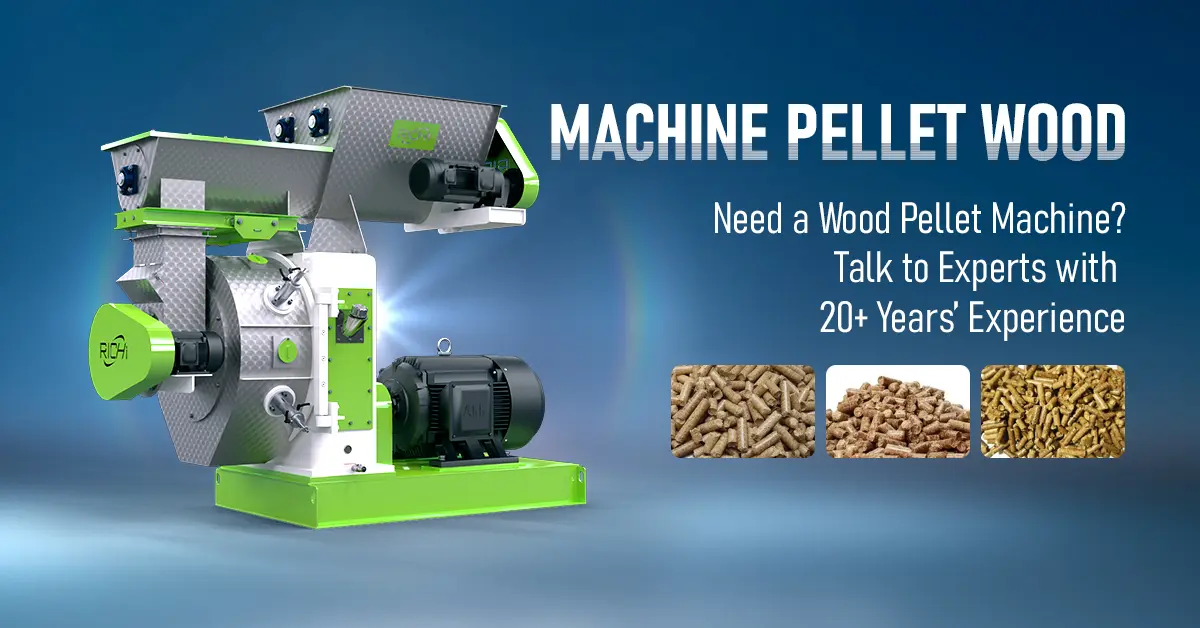
As I mentioned above, a complete biomass pellet production project requires more than just a pellet machine: how to handle raw materials, how to process finished pellets, and how the equipment works in coordination are all issues we need to address. So, a complete biomass pellet production line that integrates the entire process from raw material processing to the final product pellet packaging is the right choice to ensure the stable operation of the project and high-quality biomass pellet production.
Raw Material Receiving and Storage Systems
Raw material handling systems are designed to ensure continuous production while protecting feedstocks from contamination and excessive moisture exposure.
Size Reduction Equipment
Biomass pellet machines require feedstock particle sizes below 5 mm. Size reduction equipment is therefore an essential part of the production process.
Drying Systems
Moisture content plays a critical role in pellet quality. Most biomass materials must be adjusted to approximately 10%–20% moisture before pelletizing.
Rotary dryers are commonly used in biomass pellet production lines to achieve the required moisture range.
Biomass Pellet Machines
The biomass pellet machine is the core equipment within the production line. Using a ring die and roller system, the machine compresses biomass under high pressure to form dense and durable fuel pellets.
- High production efficiency
- Continuous operation capability
- Stable pellet quality
- Low operating costs
- Long equipment lifespan
Cooling and Screening Systems
After pelletizing, pellets are cooled to improve durability and screened to remove fines and broken particles.
Packaging and Storage Systems
Finished pellets can be packaged in bags or stored in bulk systems depending on customer requirements and logistics arrangements.
Biomass Pellet Production Process: From Waste to Fuel
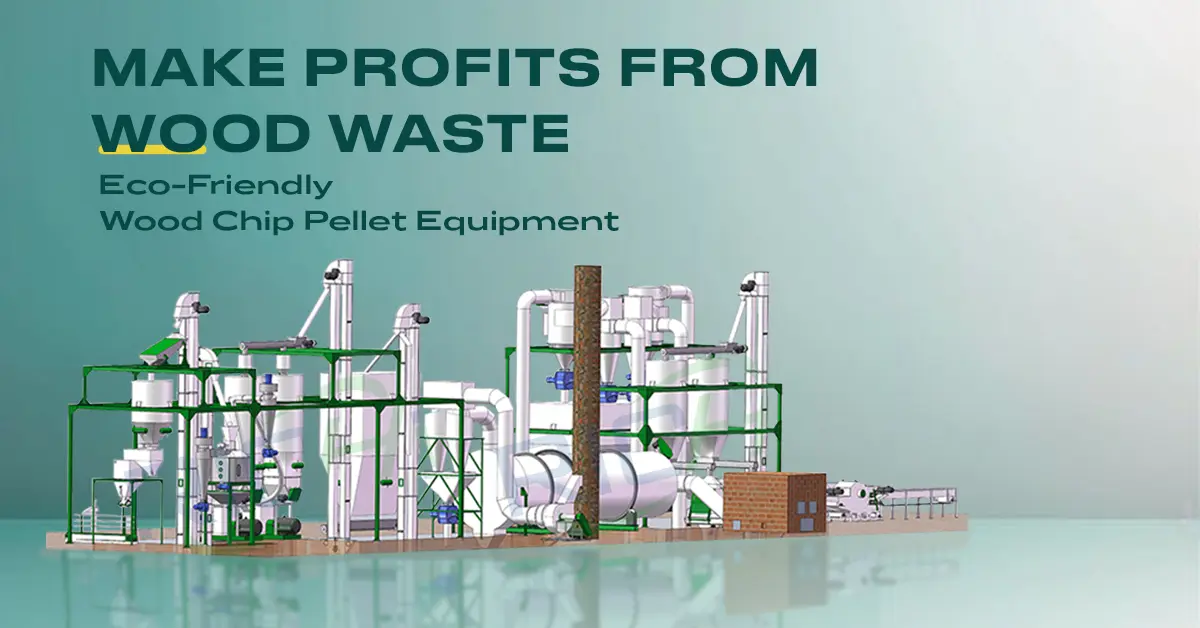
The biomass pellet production process transforms raw biomass into a standardized renewable fuel through several integrated processing stages.
Step 1: Raw Material Collection and Preparation
Biomass materials are collected, transported, and inspected before entering the production line.
Step 2: Crushing and Grinding
Large materials are reduced to suitable particle sizes using chippers, crushers, and hammer mills.
Step 3: Drying and Moisture Adjustment
Drying systems reduce moisture content to the optimal level required for efficient pellet production.
Step 4: Pelletizing
The prepared biomass enters the biomass pellet machine, where it is compressed through a ring die to form pellets.
Step 5: Cooling and Screening
Fresh pellets are cooled and screened to ensure consistent quality and durability.
Step 6: Packaging and Storage
The finished pellets are packaged or stored for transportation and distribution.
- Raw material receiving
- Size reduction
- Drying
- Pelletizing
- Cooling
- Screening
- Packaging
- Storage
Choosing the Right Biomass Pellet Production Line
Evaluate Raw Material Characteristics
Different biomass materials have unique physical properties that influence equipment selection, process design, and production performance.
Determine Production Capacity
Production capacity is one of the most important factors when selecting a biomass pellet production line.
- 1–2 TPH for small commercial projects
- 3–5 TPH for medium-scale pellet plants
- 10+ TPH for industrial biomass pellet manufacturing facilities
Consider Moisture Conditions
Projects processing green wood or fresh biomass typically require larger drying systems than projects using dry sawdust or agricultural residues.
Understand Market Requirements
Target markets determine pellet specifications, packaging methods, quality standards, and production capacities.
Typical Biomass Pellet Plant Applications
Industrial Boilers
Biomass pellets are widely used as an alternative fuel source for industrial steam generation and heating applications.
Power Generation Facilities
Many power plants use biomass pellets to reduce dependence on fossil fuels and lower carbon emissions.
Commercial Heating Systems
Commercial buildings and district heating systems increasingly utilize biomass pellets as renewable energy sources.
Combined Heat and Power Plants
CHP facilities benefit from the high energy density and consistent quality provided by biomass fuel pellets.
Industries Benefiting from Biomass Valorization Projects
Forestry Industry
Forestry companies can convert harvesting residues and wood waste into valuable pellet products.
Wood Processing Industry
Sawmills and furniture manufacturers can monetize sawdust, shavings, and production waste.
Agricultural Enterprises
Farmers and agricultural processors can create value from crop residues that would otherwise be discarded.
Renewable Energy Producers
Energy companies utilize biomass pellets to support renewable power generation and carbon reduction initiatives.
Challenges in Biomass Pellet Production and Their Solutions
High Moisture Content
Excess moisture reduces pellet quality and production efficiency. Proper drying systems help maintain optimal processing conditions.
Inconsistent Raw Material Quality
Variations in particle size, moisture, and composition can affect pellet quality. Effective material preparation helps minimize these issues.
Equipment Wear and Maintenance
Biomass processing can create wear on equipment components. High-quality machinery and preventive maintenance programs help maximize reliability.
Pellet Quality Control
Monitoring density, durability, moisture content, and dimensions ensures consistent product quality and customer satisfaction.
Future Trends in Waste and Biomass Valorization
Circular Economy Development
Governments and industries increasingly promote circular economy principles that prioritize resource recovery and waste utilization.
Industrial Decarbonization
Biomass pellets are expected to play a growing role in helping industries reduce carbon emissions and meet sustainability targets.
Smart Biomass Pellet Plants
Automation, intelligent controls, and real-time monitoring systems are improving efficiency, reliability, and operational performance across modern biomass pellet production facilities.
Why Choose a Customized Biomass Pellet Production Solution
Tailored Equipment Configuration
Every biomass project has unique raw materials, capacities, and production goals. Customized solutions ensure optimal equipment selection.
Higher Production Efficiency
Properly designed production lines maximize output while minimizing energy consumption and operational costs.
Improved Pellet Quality
Integrated process control and professional equipment design help produce pellets that meet market requirements.
Lower Operating Costs
Efficient equipment configurations reduce maintenance requirements, energy usage, and labor costs over the life of the project.
To Customers Who Want To Enter Biomass Pellet Production Industry
The growing demand for renewable energy and sustainable waste management is creating new opportunities for biomass pellet producers around the world. Whether you have access to wood waste, agricultural residues, or other biomass resources, pellet production can be an effective way to convert low-value materials into marketable fuel products. Before starting a project, it is important to understand your raw material supply, target market, production capacity, and local energy policies to ensure long-term viability.
Entering the biomass pellet production industry is not simply about installing equipment—it is about building a complete and efficient production system. From raw material preparation and drying to pelletizing, cooling, and packaging, every stage of the process affects the quality and profitability of the final product. Careful planning and the right production solution can help transform biomass resources into a sustainable business while contributing to a cleaner and more circular economy.
In the end, contact RICHI Machinery today to discuss your raw materials, production capacity requirements, and investment goals. Our engineers will help you develop the most suitable biomass pellet production solution for your project.