If you just want a machine, put in raw materials, and get pellets out, then I suggest you either abandon this idea now or read this article carefully. Pellet production is never a simple matter. Can fallen leaves be turned into fuel pellets? What machine is required, and how much does an industrial leaf pellet production line cost? The short answer is that selected leaf materials can be pelletized, but manufacturing saleable fuel pellets is a complete industrial process, not simply feeding garden leaves into a small machine.
Businesses collecting large quantities of fallen leaves from municipal landscaping, forestry maintenance, parks or commercial vegetation-management operations may have an opportunity to evaluate leaf-based biomass pellets. Whether the project is feasible depends on the availability of clean feedstock, its seasonal supply, moisture, composition, processing cost and the intended pellet market.
RICHI Machinery explains to you in detail through this article about leaf pellet making machine, the processing steps required to turn leaves into pellets, equipment and production-line prices, combustion limitations, material quantities and the conditions for a commercial project.
1. Can You Really Make Pellets From Leaves?
Yes. Leaves contain organic material that can be densified into cylindrical pellets under suitable processing conditions. However, pellet formation and fuel quality are two different questions. A successful compression test does not guarantee adequate pellet durability, acceptable ash content, trouble-free combustion or a profitable manufacturing business.
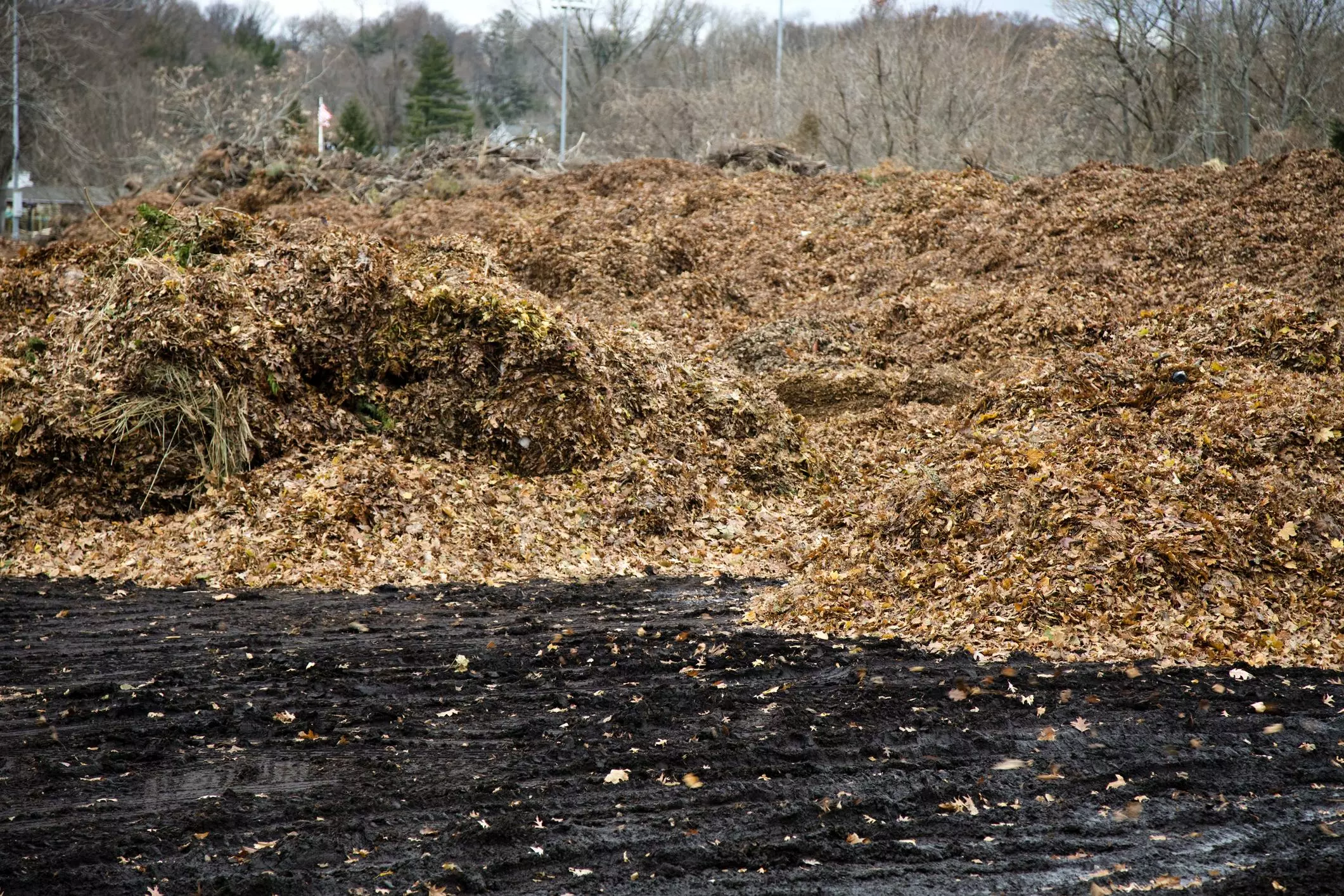
Potential materials include collected fallen tree leaves, certain agricultural leaf residues and screened landscape vegetation. Their suitability depends on leaf type, decomposition, moisture, contamination and chemical composition. Roadside leaf collections can contain sand, stones, plastics, salt and other unwanted substances; unsuitable or contaminated material should not be fed into the production line without appropriate evaluation and separation.
Are leaf pellets the same as wood pellets?
No. Pellets made from leaves alone should not be described as conventional wood pellets. Leaf-rich fuels may have substantially different ash, mineral and combustion characteristics from pellets made from clean wood residues. The correct fuel classification should be determined from the actual feedstock and relevant market requirements.
| Comparison | Clean Wood Residues | Collected Leaves |
|---|---|---|
| Incoming handling | Established sawdust and chip handling | Often very bulky and difficult to meter |
| Moisture | Can be controlled through established drying practices | Highly variable with collection and weather |
| Contamination | Depends on feedstock source | Outdoor collections can contain soil, stones and litter |
| Fuel ash | Generally lower for clean wood | Often higher and more variable |
| Commercial suitability | Established wood-pellet markets | Requires customer specification and fuel testing |
2. Why Are Fallen Leaves Difficult to Pelletize Commercially?
Low bulk density and difficult feeding
Loose leaves occupy a large volume relative to their weight. This increases the cost and complexity of collecting, moving, storing, conveying and feeding material into machinery. Industrial equipment may need shredding, controlled feeding, enclosed conveyors, dust extraction and measures to prevent bridging in hoppers.
Seasonal material availability
In many regions, most fallen leaves are collected during a limited part of the year. A plant that operates every working day needs sufficient year-round supplies, a realistic seasonal storage strategy or other tested biomass materials that can be processed outside the leaf collection season.
Moisture, contamination and variable composition
Wet leaves may require drying; extremely dry material may need conditioning. Soil and sand increase equipment wear and ash content. Material containing unsuitable foreign substances may not be viable. Leaf species and mixtures can also behave differently when compressed through a pellet die.
Pellet durability is not the same as fuel quality
Good-looking pellets may still have excessive ash or unsuitable ash-melting and emissions behavior for the intended boiler. Before entering a heating-fuel market, the pellet producer should confirm the relevant specifications and the combustion equipment's fuel requirements.
3. How to Turn Leaves Into Pellets: Industrial Production Process
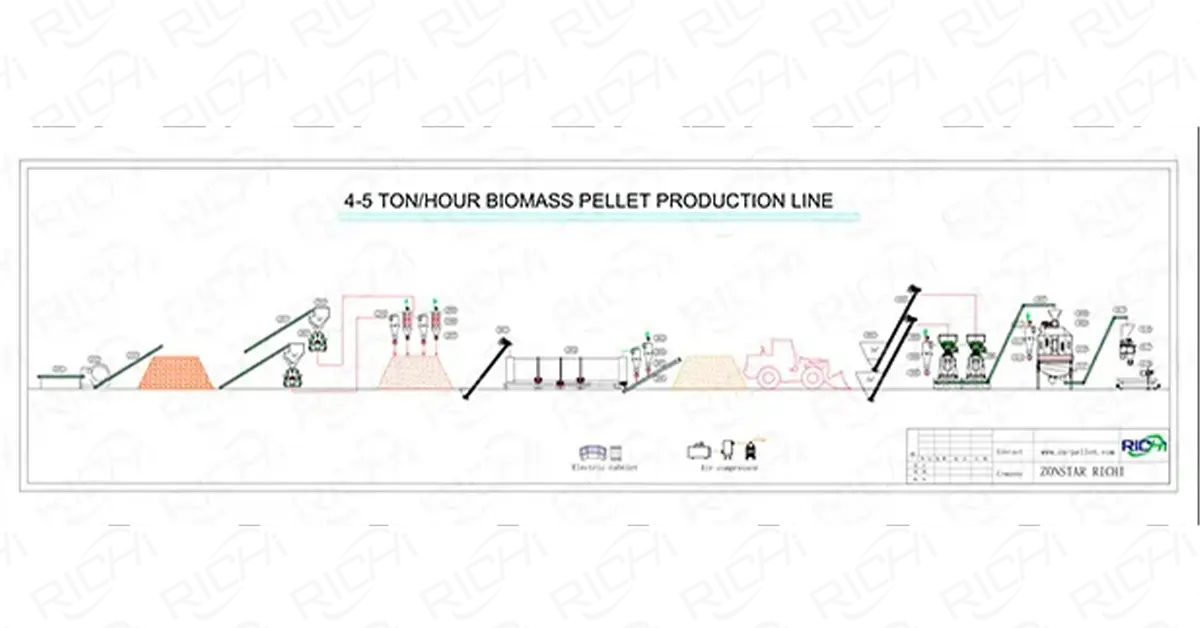
Typical process: Collection and receiving → Sorting and cleaning → Shredding → Fine grinding → Drying (when necessary) → Mixing/conditioning → Ring-die pelletizing → Cooling → Screening → Packaging or bulk storage.
Step 1: Collection, receiving and storage
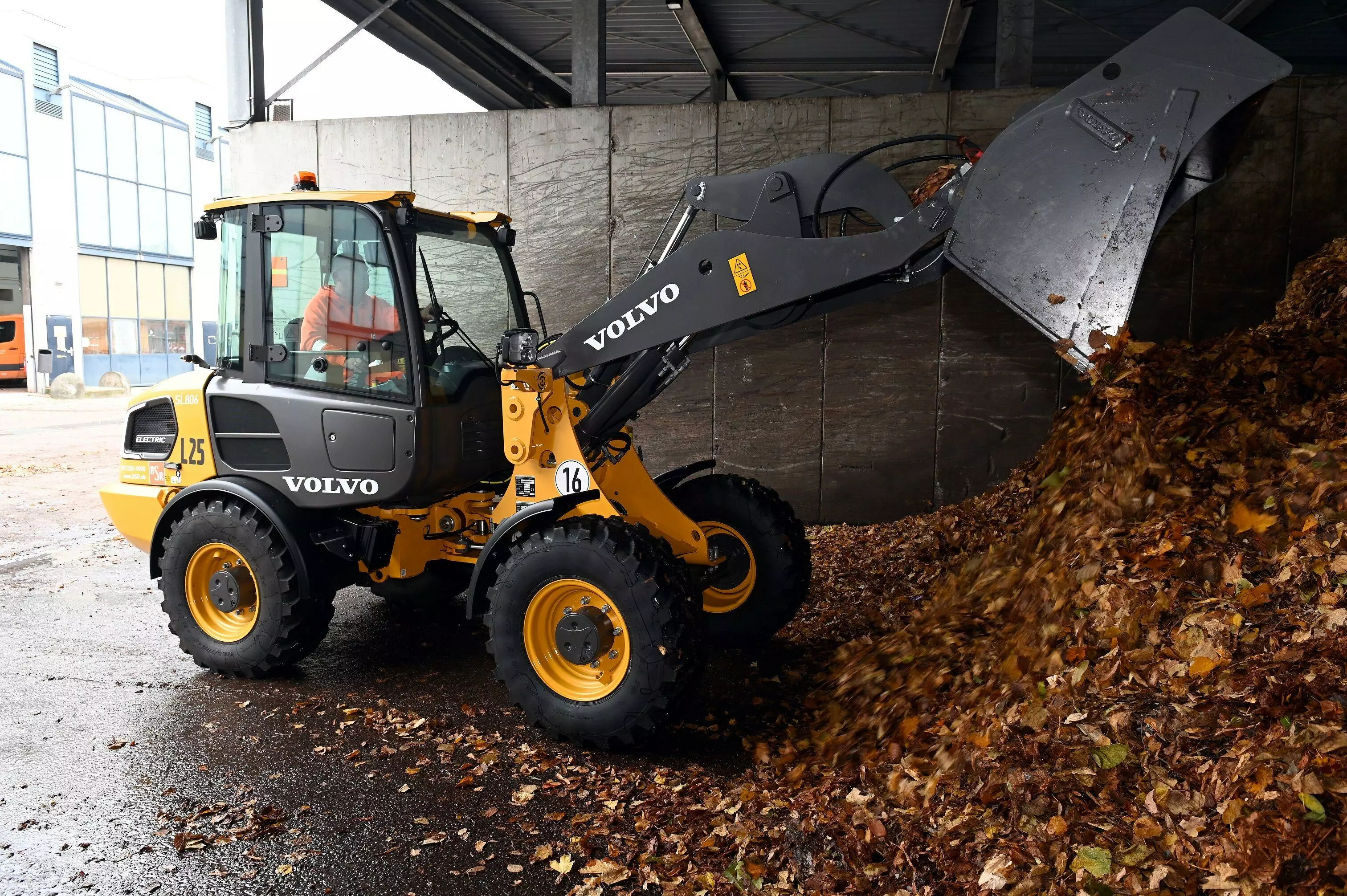
Confirm collection contracts, feedstock tonnage and the period during which leaves can be delivered. Plan vehicle access, covered storage, fire-safety measures, raw material reception and handling systems. Loose leaves may require densification or pre-shredding to make transport and storage more practical.
Step 2: Sorting, screening and removal of foreign matter
Remove plastics, stones, metal, excessive sand and other debris. A particular plant may need screens, magnets, manual sorting and stone-removal equipment. This is especially important for municipally collected leaves.
Step 3: Shredding and grinding
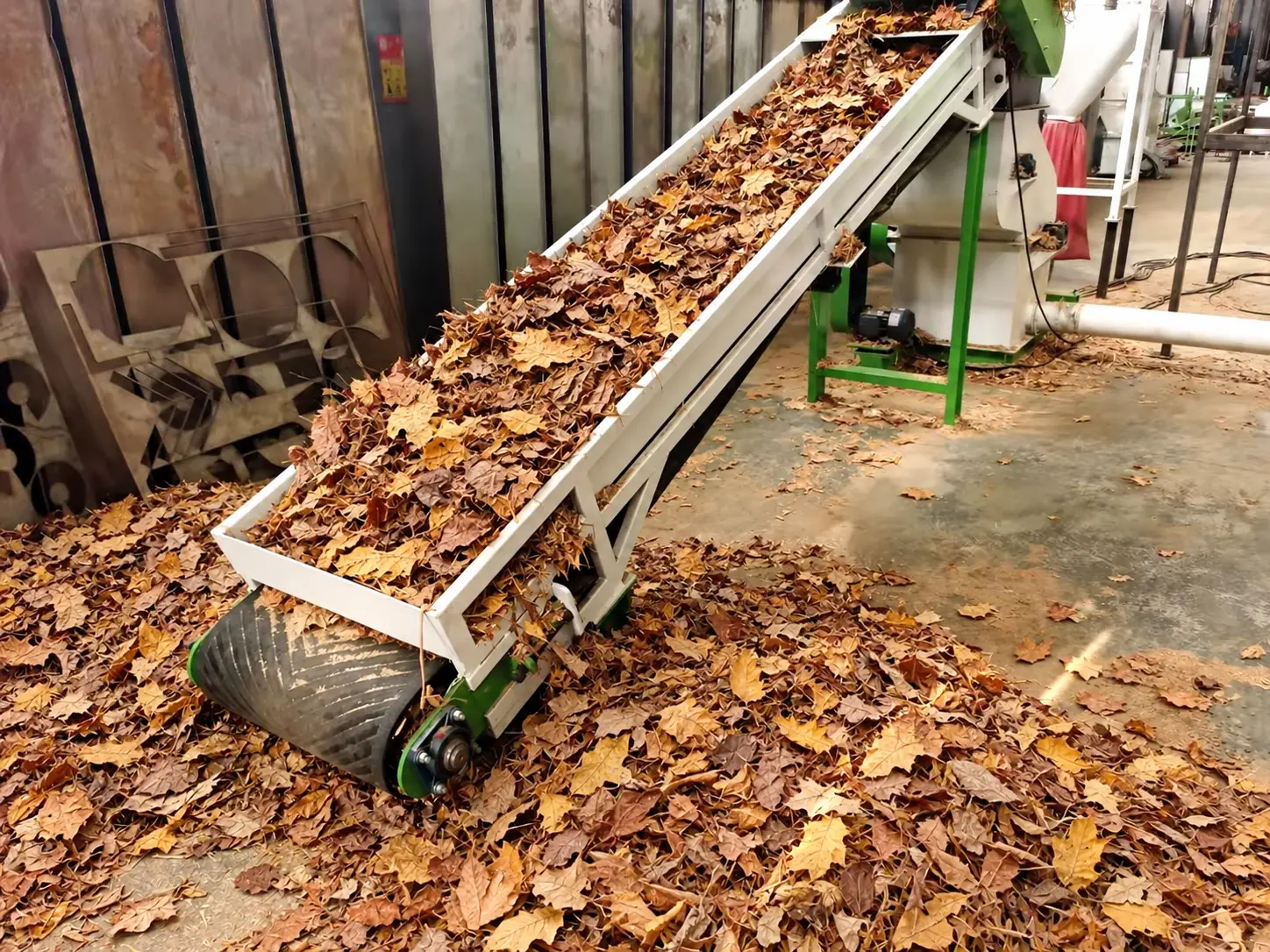
Large piles or mixed vegetation may first require shredding. A suitable grinder then prepares a consistent particle size for pelletizing. A preliminary target of approximately 5 mm or smaller may be considered for selected applications, but the correct specification depends on the final pellet diameter and actual material tests.
Step 4: Drying and moisture adjustment
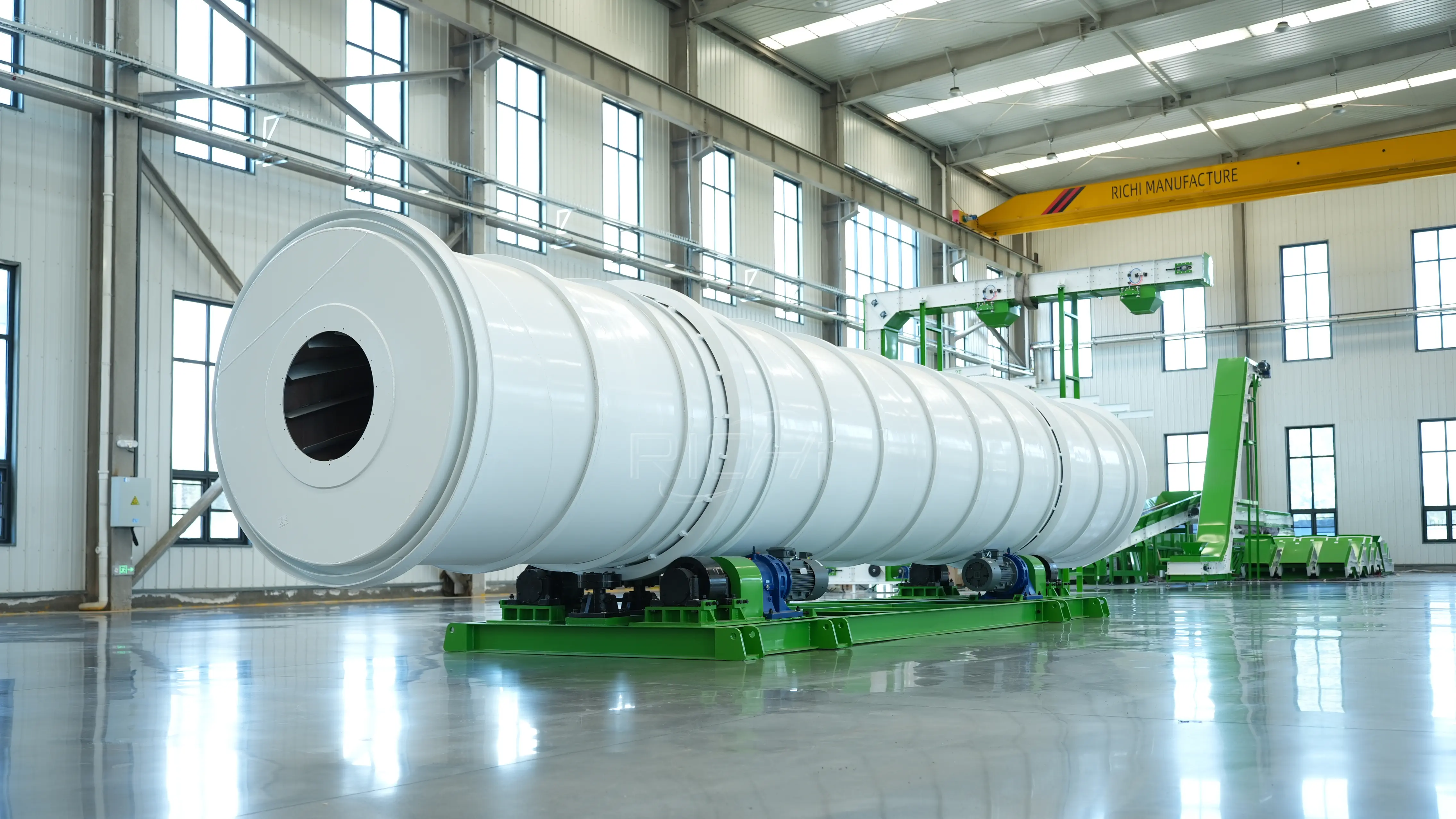
Drying is required only when incoming moisture is above the acceptable processing range. For initial pelletizing trials, moisture around 10–15% may be considered as a starting test window, not as a guaranteed universal operating specification. The optimal condition must be determined experimentally. A dryer and heat source must be sized from the actual moisture balance rather than the nominal pellet mill capacity alone.
Step 5: Mixing and conditioning
Some leaf materials may benefit from controlled mixing with compatible, untreated woody residues such as sawdust. This could improve processing consistency, but it changes both feedstock costs and final pellet properties. No universal leaf-to-sawdust ratio can be recommended without testing.
Step 6: Pelletizing with an industrial ring-die pellet mill
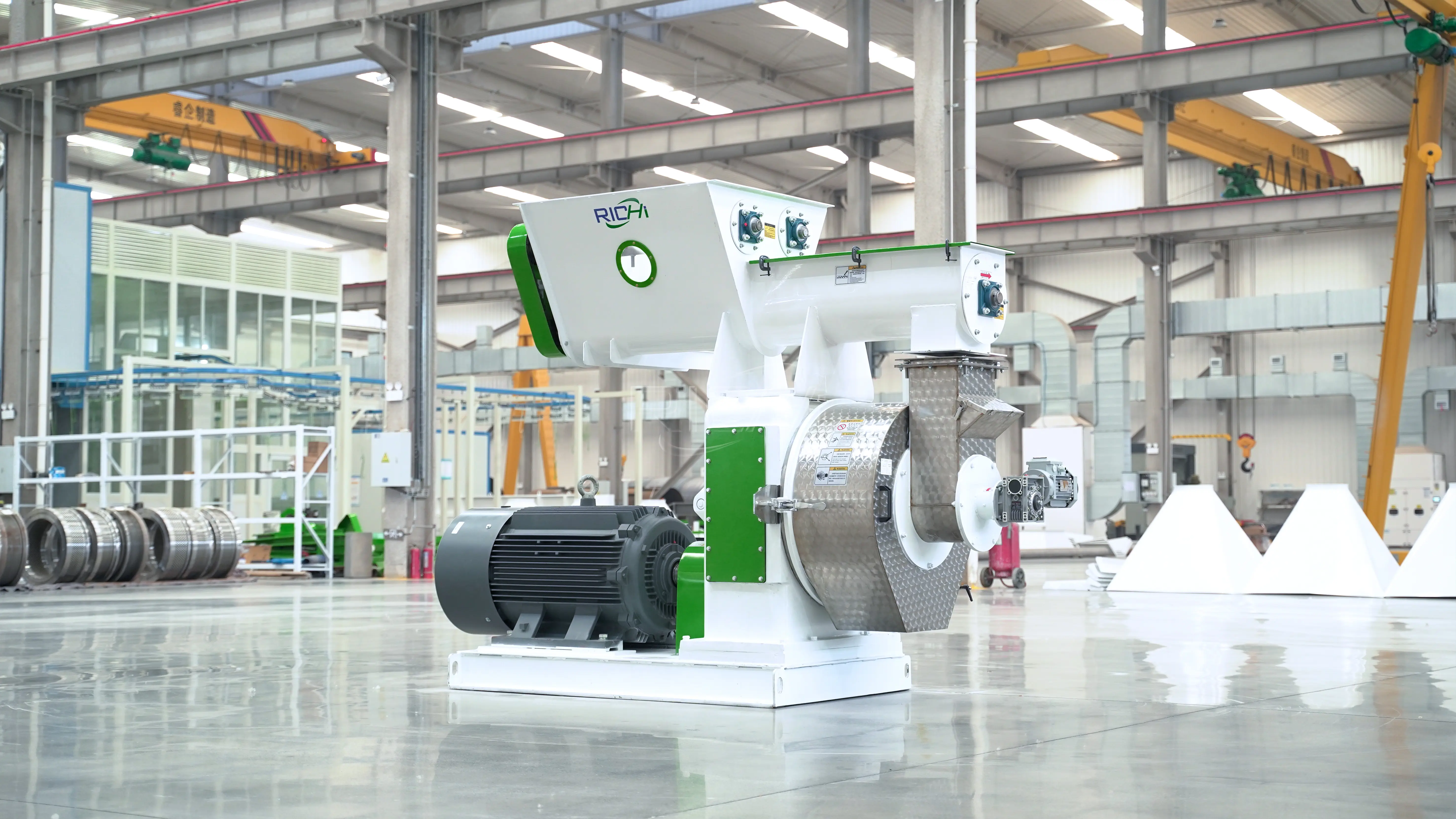
A ring-die pellet mill uses rollers to push prepared material through die holes, producing compact cylindrical pellets. For some biomass fuel applications, 6 mm and 8 mm diameters are common design options. Different leaf materials may require adjustments to feeding, die configuration, moisture and operating parameters. Rated capacity on conventional biomass is not a guaranteed output for leaves.
Step 7: Cooling, screening and fines handling
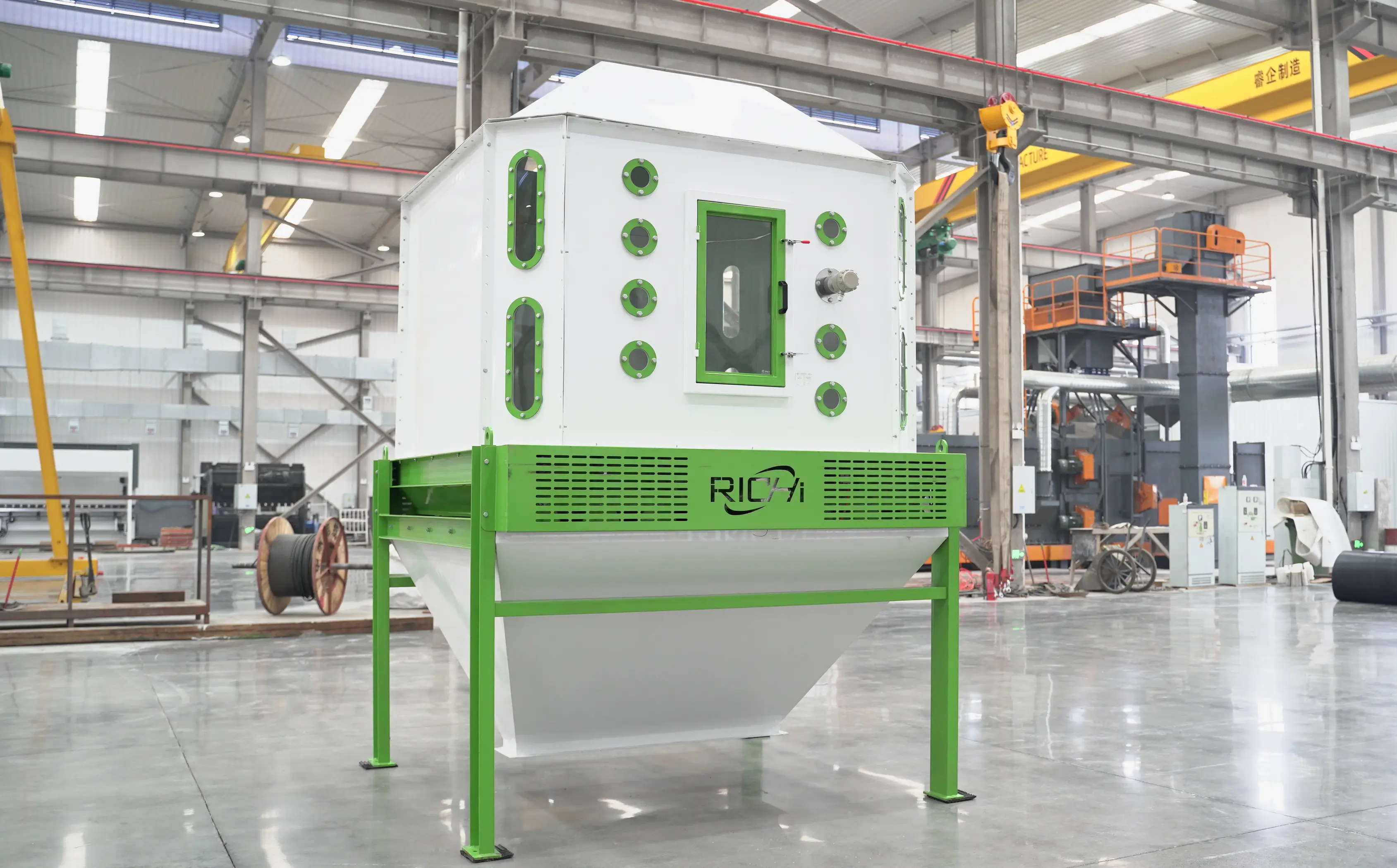
Fresh pellets need cooling for subsequent handling. Screening removes fines and broken material, with controlled recycling of appropriate fines where the process allows.
Step 8: Bagging and finished product storage
Choose bulk delivery or automated weighing and bagging based on the customer. Protect finished pellets against moisture and follow applicable dust, fire and storage safety procedures.
4. What Machine Turns Leaves Into Pellets?
The main forming machine is a biomass ring-die pellet mill. However, a complete leaf pellet production line is a coordinated system rather than a single machine. This matters particularly when feedstock arrives loose, wet or contaminated.
| Equipment | Purpose | When Needed |
|---|---|---|
| Receiving hopper / feeding conveyor | Manage incoming raw material | Most industrial projects |
| Screening / metal and stone removal | Reduce contamination | Depending on incoming leaves |
| Shredder and grinder | Reduce volume and particle size | Generally required, exact stages vary |
| Industrial dryer | Remove excess moisture | Only if material moisture requires it |
| Mixer / conditioning equipment | Prepare consistent feedstock | Depending on process and blending |
| Biomass ring-die pellet mill | Form pellets | Core machine |
| Cooler and screener | Stabilize and grade pellets | Commercial finished-pellet production |
| Bagging / bulk handling | Prepare product for customers | According to sales format |
A nominal 2 t/h pellet mill will not deliver 2 t/h of finished pellets if the upstream dryer, grinder or feed conveyors cannot provide a corresponding flow of acceptable material. RICHI evaluates the line as a whole.
5. Leaf Pellet Making Machine Price
The cost depends on machine size, feedstock testing, preprocessing, automation, factory requirements and whether the quotation covers the pellet mill alone or a complete line. The following prices are RICHI reference prices for industrial biomass machines; they are not guaranteed capacity or performance quotes for leaf-only feedstocks.
Industrial biomass pellet mill reference prices
| Model | Main Motor | Nominal Biomass Capacity* | Reference Price (USD) |
|---|---|---|---|
| MZLH320 | 22 kW | 0.2–0.3 t/h | $15,100 |
| MZLH350 | 37 kW | 0.3–0.5 t/h | $20,500 |
| MZLH420 | 90 kW | 1.0–1.2 t/h | $29,600 |
| MZLH520 | 132 kW | 1.5–2.0 t/h | $45,100 |
| MZLH678 | 200 kW | 2.5–3.0 t/h | $67,100 |
| MZLH768 | 315 kW | 3.0–4.0 t/h | $80,500 |
*Capacities are general reference ratings for suitable biomass feedstocks, not performance guarantees for leaves. Actual leaf throughput requires material assessment and trials. Prices are indicative and must be reconfirmed.
Complete industrial biomass pellet production line reference budgets
| Nominal Production Scale | General Equipment Budget (USD) |
|---|---|
| 0.2–0.3 t/h | $20,000–$140,000 |
| 0.3–0.5 t/h | $28,000–$160,000 |
| 1.0–1.2 t/h | $39,000–$220,000 |
| 1.5–2.0 t/h | $56,000–$270,000 |
| 2.5–3.0 t/h | $78,000–$350,000 |
| 3.0–4.0 t/h | $95,000–$430,000 |
| 5.0–6.0 t/h | $160,000–$570,000 |
These are broad general biomass-line budgets, not leaf-specific turnkey offers. Actual costs may vary substantially with collection and cleaning systems, dryer capacity, conveying, dust collection, blending, control systems and site conditions. Building construction, civil works, freight, import charges, installation and local utilities may be additional. Do not use a stand-alone pellet mill price as the total project investment.
6. How Many Leaves Are Needed for a Commercial Pellet Plant?
This question should be answered before choosing a machine. Industrial pellet production requires a continuous volume of suitable prepared material. A few bags of leaves collected from a garden do not represent an industrial raw-material supply.
The following calculation assumes 8 operating hours per day and that finished pellet mass is approximately 90% of the sufficiently dry, cleaned material entering the pelletizing process. It is an illustrative planning assumption only, not the conversion rate for wet, freshly collected leaves.
| Finished Output | Pellets per 8-Hour Day | Illustrative Prepared Feedstock per Day |
|---|---|---|
| 0.3 t/h | 2.4 tonnes | approx. 2.7 tonnes |
| 1.0 t/h | 8 tonnes | approx. 8.9 tonnes |
| 2.0 t/h | 16 tonnes | approx. 17.8 tonnes |
| 3.0 t/h | 24 tonnes | approx. 26.7 tonnes |
| 5.0 t/h | 40 tonnes | approx. 44.4 tonnes |
For example, a line producing 2 tonnes per hour, operating 8 hours a day and 25 days per month, would produce 400 tonnes of pellets per month at its theoretical full output. It would need more incoming leaves than the weight of pellets produced because water and rejected contaminants are removed along the way. The exact requirement depends on measured initial moisture, material cleanliness and process yield.
Example: wet-leaf mass balance
If leaves contain 40% moisture and finished pellets have 10% moisture, the water-balance minimum is approximately 1.5 tonnes of incoming leaves for 1 tonne of finished pellets, assuming no dry matter is rejected or lost. Real plants may need additional material due to screening rejects and processing losses. This example must not be mistaken for a universal production ratio.
Seasonal supply is equally important. An annual plant target must be matched with signed or credible raw-material supply arrangements, transport logistics and suitable storage volume.
7. Is Making Wood Pellets From Leaves Possible?
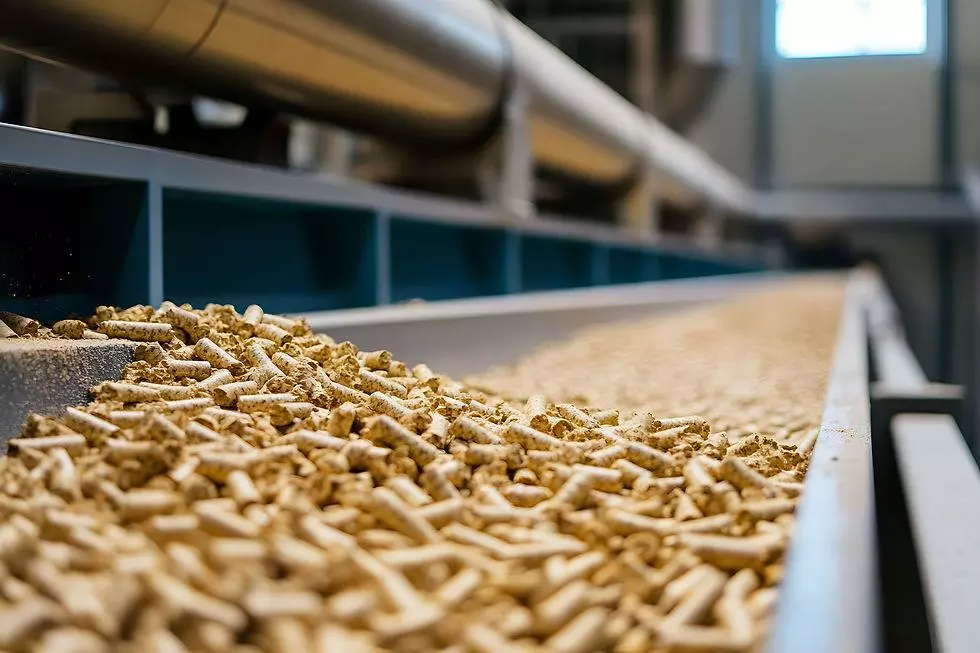
Searches for making wood pellets from leaves often reflect confusion about the fuel type. A machine may be capable of forming leaf-based pellets, but that does not make the finished product conventional wood pellets. Some leaves can be blended with suitable wood residues; however, the product composition, classification and target customer specifications must be considered carefully.
For relevant non-woody pellet products and biomass blends, ISO 17225-6:2021 provides fuel quality classes within its stated scope. It should not be assumed that every mixture of fallen tree leaves is automatically covered or certified by that standard. The correct classification and applicable market rules must be verified for the actual feedstock.
8. Can Leaf Pellets Be Used as Heating Fuel?
Possibly, but not necessarily in standard residential wood-pellet appliances. Depending on the feedstock, leaf-based fuel can have higher ash and different concentrations of minerals and other elements. This can contribute to clinker formation, slagging, ash deposits, corrosion and emissions concerns.
Before selling leaf pellets as heating fuel, evaluate at least moisture, ash, energy content, pellet durability, elemental composition and ash-melting behavior. Confirm that the intended boiler, furnace or other combustion system accepts the tested product, and review local emissions and fuel requirements. Industrial boilers designed or adjusted for appropriate biomass fuels may be a more realistic market than ordinary domestic wood-pellet stoves.
9. Is a Leaf Pellet Production Business Profitable?
It can be worth investigating where suitable feedstock is available in large quantities, but a free or cheap raw material does not guarantee a profitable pellet business. The operating model should cover:
- Collection and logistics: source contracts, bulky-load transportation, contamination, handling and storage.
- Yield and feedstock quality: moisture loss, screening rejects, seasonal deterioration and potential blending materials.
- Production cost: electricity, drying energy, personnel, wear parts, maintenance, dust control and packaging.
- Market fit: buyer demand, acceptable ash and combustion specifications, sales price and offtake commitments.
- Investment: factory, land, utility supply, installation, working capital and contingency.
The project should be evaluated as an industrial manufacturing and waste-utilization business, not a way to dispose of a small pile of household leaves. The first commercial questions are how much usable leaf material is available every year and who will buy or use the resulting fuel.
10. Who Is a Suitable Customer for an Industrial Leaf Pellet Line?
Projects more likely to justify technical assessment include municipal green-waste operators, large landscaping and vegetation-management contractors, forestry residue processors, biomass fuel manufacturers and industrial investors with verifiable feedstock contracts and potential customers.
RICHI Machinery supplies commercial and industrial biomass pellet equipment. Industrial installations require appropriate premises, industrial three-phase electrical power, operators, working capital and reliable feedstock. For small amounts of household leaf waste, local composting or green-waste collection is usually more practical than purchasing industrial pellet equipment.
11. How RICHI Machinery Evaluates a Leaf Pellet Project
There is no responsible one-size-fits-all machine recommendation for a customer who has not yet identified the type, quantity or condition of their leaves. A practical project evaluation should proceed in this order:
- Confirm feedstock: leaf type, collection source, tonnes per month or year, seasonality, moisture and contamination.
- Confirm target product: fuel pellet diameter, intended use, buyers and required quality specifications.
- Assess and test material: identify preparation, possible blending, pellet formation and combustion-quality limitations.
- Define capacity: select realistic production hours and achievable tonnes per hour from the available supply.
- Develop a process arrangement: choose screening, shredding, grinding, drying, pelletizing, cooling, screening and packing systems as required.
- Prepare an equipment and budget proposal: account for industrial power, factory layout, automation and project-specific constraints.
RICHI's ring-die biomass pellet machines provide a starting point for configuration. Final machine suitability and output for leaf-rich materials must be confirmed from the customer's feedstock and engineering evaluation.
12. Frequently Asked Questions About Leaf Pellet Making Machines
Q1. Can dry leaves be turned into pellets?
Yes. Selected dry leaves can be ground, conditioned and compressed into pellets. The resulting durability and fuel properties depend on the leaf material and processing conditions.
Q2. What is the best machine that turns leaves into pellets?
For suitable commercial projects, an industrial biomass ring-die pellet mill may be the central machine. Cleaning, grinding, drying, cooling and other equipment may also be required.
Q3. How much is a leaf pellet making machine?
RICHI industrial biomass pellet mill reference prices begin at approximately US$15,100 for a selected 22 kW model. Complete production lines may cost several tens of thousands to hundreds of thousands of dollars. Leaf-specific performance and prices require technical confirmation.
Q4. Can leaves be used to make heating pellets?
Some leaf pellets may be usable in compatible biomass combustion systems after testing. They should not automatically be used in ordinary residential wood-pellet stoves.
Q5. Can I use a wood pellet machine for leaves?
Some industrial biomass pellet mills may be configurable for selected leaves, but their feeding arrangements, die parameters and actual capacities can differ from conventional sawdust processing.
Q6. Do leaves need drying before pelletizing?
Only if their incoming moisture is unsuitable. A moisture test is necessary to decide whether a dryer is required and to size it correctly.
Q7. Can leaves be pelletized without sawdust?
Certain leaf materials may form pellets without sawdust; others may benefit from blending. The correct formulation requires testing.
Q8. What diameter can leaf pellets be?
Diameters such as 6 mm and 8 mm can be considered, subject to the material, equipment configuration and final fuel application.
Q9. How many tonnes of leaves make one tonne of pellets?
There is no fixed ratio. For example, 40%-moisture leaves converted to 10%-moisture pellets require at least about 1.5 tonnes of incoming leaves per tonne of finished pellets on water balance alone, before accounting for rejects and losses.
Q10. Is a household leaves-to-pellets machine suitable for a business?
A small garden-waste experiment and an industrial pellet project are fundamentally different. RICHI specializes in commercial and industrial systems, not household leaf-disposal machines.
Q11. What is the minimum capacity of a RICHI biomass pellet mill?
Selected RICHI biomass models have nominal reference capacities around 200–300 kg/h under suitable material conditions. These figures are not guaranteed for leaf-only materials.
Q12. Can leaves be mixed with grass, straw and sawdust?
Potentially, but each mixture must be evaluated for processing, pellet durability, fuel ash and the intended market specifications.
Q13. Does leaf pellet production require an industrial factory and three-phase power?
Yes, commercial industrial installations require suitable production facilities and appropriate electrical infrastructure. The required factory area and connected power depend on capacity and equipment configuration.
Q14. Can my backyard fallen leaves support a commercial pellet plant?
Normally not. Industrial pellet production requires a stable, substantial raw-material supply, investment capital and a defined end-use market.
Q15. What should I prepare before requesting a leaf pellet production line quotation?
Provide the leaf type and photographs, monthly or annual usable quantity, moisture and contamination information, desired output, project country, planned operating hours, target fuel application and investment budget.
13. Request a Commercial Leaf Pellet Production Line Proposal
If you operate a green-waste processing business, manage a large biomass supply or are investing in commercial fuel pellet manufacturing, RICHI Machinery can review the project requirements and discuss a suitable industrial equipment configuration.
Please provide the following information for an initial project assessment:
- Raw material: Which leaves or biomass residues are available? Are they mixed with branches, grass, sand or sawdust?
- Reliable supply: How many tonnes of usable material can you secure per month or year, and for how many months?
- Production capacity: What finished-pellet output do you plan in kg/h or t/h?
- Fuel application: Who will buy or use the pellets, and in what equipment?
- Project conditions: Which country is the project in? Do you have industrial premises and three-phase electricity?
- Investment and contact: What is the preliminary equipment budget? Please provide your name and email address.
Important: RICHI Machinery focuses on commercial and industrial biomass pellet manufacturing projects. We do not specialize in small household machines for occasional garden leaf disposal.
Contact RICHI Machinery to discuss your commercial leaf pellet production project and request a preliminary equipment proposal.