Are you planning to build a 1-2 T/H cattle feed production line? For most investors, three questions come first: how much does a small cattle feed mill cost, what equipment is required, and how much profit can a cattle feed plant generate?
The answers depend on many factors, including raw material prices, feed formulation, labor costs, electricity prices, production hours, automation level, local cattle farming demand, and the final feed selling price.
RICHI Machinery is a professional feed machinery manufacturer and complete feed mill solution provider from China. Instead of supplying only a single pellet machine, we design complete commercial cattle feed processing systems covering raw material cleaning, crushing, mixing, conditioning, pelletizing, cooling, screening, conveying, and packaging.
This article explains the investment cost, equipment configuration, processing technology, production capacity, and potential profitability of a commercial 1-2 tons per hour cattle feed mill plant.
How Much Does A 1-2 T/H Cattle Feed Mill Plant Cost?
The investment required for a 1-2 tons per hour cattle feed plant is determined by the production process and equipment configuration rather than capacity alone.
For a commercial 1-2 T/H cattle feed pellet production line, the equipment investment is generally much higher than that of a simple feed mixer and small pellet machine combination.
As a general reference, a complete commercial 1-2 T/H animal feed production line may require an equipment investment of approximately USD 30,000-60,000, depending on the actual configuration.
This price range can vary significantly according to:
- Raw material types and particle sizes.
- Whether a complete crushing section is required.
- Manual or automatic batching system.
- Number of raw material bins.
- Mixing system configuration.
- Pellet size and formulation requirements.
- Cooling and screening requirements.
- Manual, semi-automatic, or automatic bagging.
- Dust collection and environmental protection systems.
- Electrical control and automation level.
- Local voltage and electrical standards.
- Steel structure and workshop layout.
Therefore, there is no single fixed cattle feed mill price. RICHI Machinery normally designs the production process first and then provides a complete equipment quotation based on the customer's actual project conditions.
What Is Included In The Investment Of A Small Cattle Feed Plant?
The total investment of a cattle feed factory is not limited to purchasing feed machinery.
A complete project budget usually includes:
- Feed processing equipment.
- Equipment transportation.
- Factory or workshop construction.
- Electrical installation.
- Raw material storage.
- Finished product warehouse.
- Installation and commissioning.
- Raw material purchasing capital.
- Labor expenses.
- Local permits and business registration.
For this reason, the equipment quotation and the total cattle feed plant investment should be calculated separately.
How Profitable Is A 1-2 T/H Cattle Feed Mill?
The profitability of a cattle feed mill depends primarily on production volume and the profit margin per ton of finished feed.
There is no universal annual profit figure because feed prices and operating costs vary substantially between countries and markets.
A simple profit calculation can be expressed as:
Annual Profit = Annual Feed Production × Net Profit Per Ton
For example, if a cattle feed mill produces 2,000 tons of finished feed annually and achieves a net operating margin of USD 20 per ton, the estimated annual operating profit would be:
2,000 tons × USD 20/ton = USD 40,000 per year
If the net profit reaches USD 40 per ton under favorable market conditions, the same production volume could generate approximately USD 80,000 per year.
These figures are calculation examples only. Actual profitability depends on local market conditions and should be evaluated using the customer's real raw material and feed selling prices.
What Factors Affect Cattle Feed Mill Profit?
The profitability of a cattle feed production business is mainly influenced by the following factors.
Raw Material Cost
Raw materials usually represent the largest operating cost of animal feed production.
Typical cattle feed ingredients may include:
- Corn.
- Wheat.
- Barley.
- Soybean meal.
- Rapeseed meal.
- Bran.
- Alfalfa.
- Grass meal.
- Minerals.
- Premixes.
- Other locally available agricultural materials.
Using locally available raw materials can significantly improve the economics of a cattle feed processing plant.
Feed Selling Price
The price difference between raw materials and finished compound feed directly affects the gross margin of the factory.
A feed manufacturer that can produce consistent, nutritionally balanced, and stable-quality cattle feed will generally have stronger market competitiveness.
Production Efficiency
Efficient crushing, mixing, pelletizing, cooling, and conveying systems can reduce electricity consumption, labor requirements, material loss, and equipment downtime.
Plant Utilization Rate
A 2 T/H feed mill that operates only a few hours each day will have a much longer investment recovery period than a plant operating continuously at a high utilization rate.
What Equipment Is Required For A 1-2 T/H Cattle Feed Plant?
A commercial cattle feed pellet production line requires much more than a pellet machine.
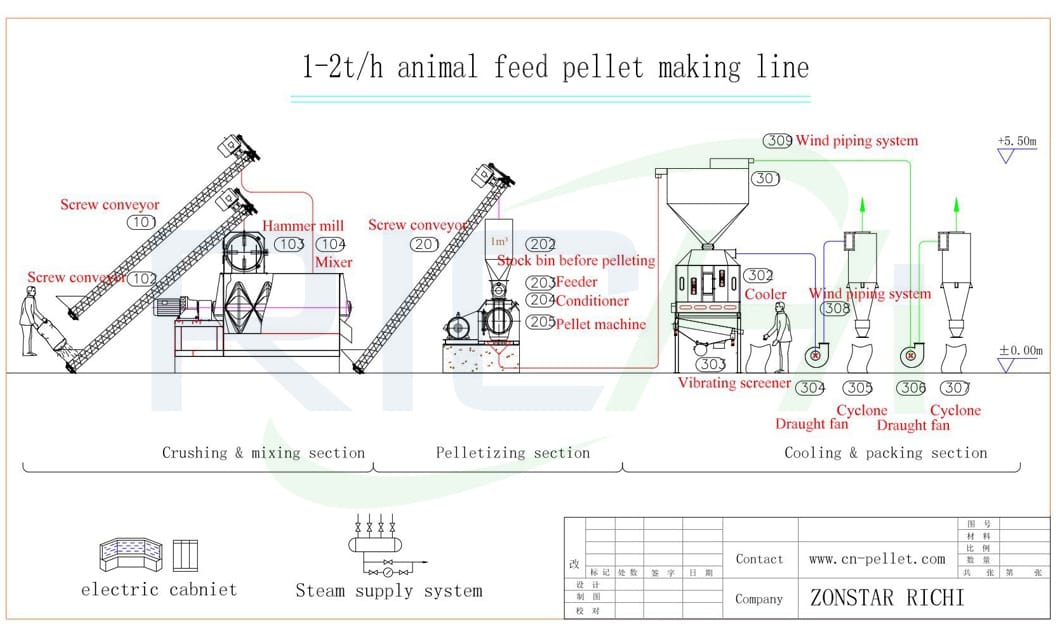
The basic processing flow is generally:
Raw Material Receiving → Cleaning → Crushing → Batching → Mixing → Conditioning → Pelletizing → Cooling → Screening → Packaging
Depending on the customer's formula and raw material conditions, additional equipment may also be required.
1. Raw Material Cleaning Equipment
Before crushing and mixing, impurities should be removed from feed raw materials.
Cleaning equipment can remove stones, metal impurities, large foreign materials, and other contaminants that may affect feed quality or damage downstream machinery.
A properly designed cleaning system also helps improve the reliability and service life of the entire cattle feed production line.
2. Raw Material Conveying Equipment
Conveying systems connect the different processing sections of the cattle feed plant.
Typical equipment includes:
- Bucket elevators.
- Screw conveyors.
- Chain conveyors.
- Belt conveyors.
The appropriate conveying equipment depends on factory layout, material characteristics, conveying distance, and production capacity.
3. Cattle Feed Grinding Machine
Feed ingredients such as corn, wheat, barley, and other grains generally need to be crushed before mixing and pelletizing.
A cattle feed hammer mill reduces raw materials to a suitable particle size for subsequent processing.
The required grinding fineness depends on the cattle feed formulation, raw material characteristics, pellet diameter, and nutritional requirements.
Using uniform particle sizes can improve mixing consistency and pellet quality.
4. Cattle Feed Mixing Machine
After grinding, different raw materials need to be mixed according to the feed formula.
A high-quality cattle feed mixer helps distribute grains, protein ingredients, minerals, premixes, and other additives evenly throughout the feed.
Mixing uniformity is one of the most important factors affecting finished feed quality.
Depending on the project configuration, liquids such as oil or molasses may also be added through a dedicated liquid addition system.
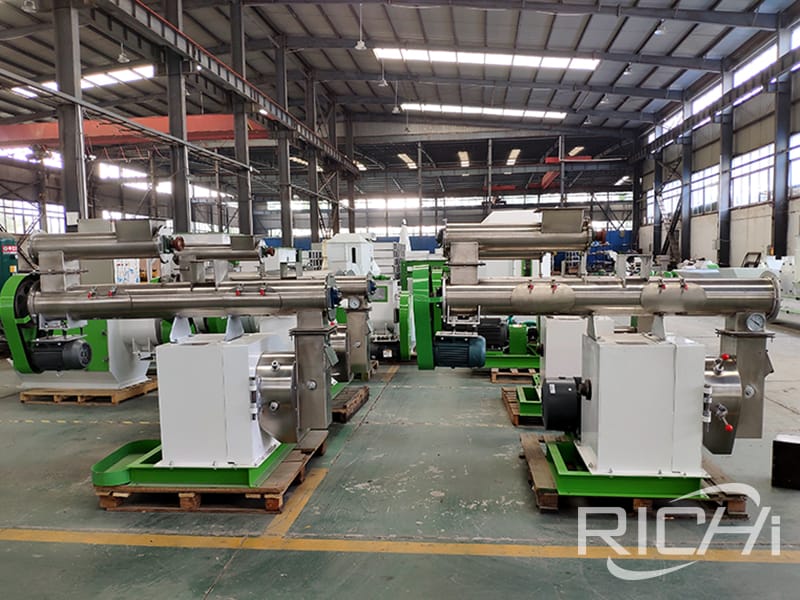
5. Cattle Feed Pellet Making Machine
The pellet mill is one of the core machines in a cattle feed pellet production line.
After mixing, the feed material enters the conditioning and pelletizing section. Under controlled processing conditions, the material is compressed through the ring die to form uniform feed pellets.
RICHI Machinery supplies industrial cattle feed pellet making machines suitable for commercial cattle and ruminant feed processing plants.
Depending on the feed formulation and cattle feeding requirements, pellet diameters can generally be customized by selecting a suitable ring die.
For many cattle feed applications, pellet sizes of approximately 4-10 mm may be used, but the actual specification should be determined according to the animal age, formula, and customer requirements.
6. Feed Pellet Cooling Machine
Fresh pellets discharged from the pellet mill have relatively high temperature and moisture content.
A counterflow feed pellet cooler reduces pellet temperature and helps stabilize the physical quality of the finished cattle feed.
After cooling, the pellets become more suitable for screening, storage, transportation, and packaging.
7. Feed Pellet Screening Machine
After cooling, finished pellets pass through a screening system.
The screener separates qualified pellets from fines and broken particles.
Qualified pellets continue to the packaging section, while fines can normally be returned to the production process to reduce material waste.
8. Cattle Feed Packaging Machine
The finished cattle feed pellets can be packed using manual, semi-automatic, or automatic bagging systems.
Common commercial package sizes include:
- 20 kg/bag.
- 25 kg/bag.
- 40 kg/bag.
- 50 kg/bag.
The bag size and packaging automation level can be customized according to the customer's local market.
1-2 T/H Cattle Feed Production Line Technical Parameters
A typical 1-2 T/H cattle feed production line can be designed according to the following general parameters:
| Production Capacity | 1-2 T/H |
| Finished Product | Cattle / Ruminant Feed Pellets |
| Pellet Diameter | Approximately 4-10 mm, customizable |
| Raw Materials | Corn, wheat, barley, soybean meal, bran, grass meal, alfalfa and other feed ingredients |
| Batching System | Manual or automatic |
| Packaging System | Manual, semi-automatic or automatic |
| Automation | Customized according to project requirements |
| Application | Commercial cattle feed mill, ruminant feed factory or farm feed processing center |
How Much Space Does A 1-2 T/H Cattle Feed Mill Need?
The workshop size required for a cattle feed mill depends on equipment layout, raw material storage, finished product storage, building height, and whether the production line uses a horizontal or vertical configuration.
A commercial project should provide sufficient space for:
- Raw material receiving.
- Raw material storage.
- Main production equipment.
- Finished product storage.
- Electrical control system.
- Equipment maintenance.
- Forklift or material movement.
- Dust collection and ventilation.
RICHI Machinery can design the factory layout according to the customer's available land and workshop dimensions.
Power Requirements For A Small Cattle Feed Mill
Commercial feed pellet production equipment normally requires industrial three-phase electricity.
The electrical system should be designed according to local voltage and frequency standards.
Before designing a cattle feed processing line, customers should provide information such as:
- Local voltage.
- Frequency.
- Three-phase electrical standard.
- Available transformer capacity.
RICHI Machinery can configure motors and electrical control systems according to the destination country's power conditions.
How To Choose A Suitable Cattle Feed Equipment Manufacturer?
When investing in a cattle feed mill, equipment price should not be the only consideration.
A reliable feed machinery supplier should be able to provide complete engineering support rather than simply selling individual machines.
Important factors include:
- Feed processing experience.
- Equipment manufacturing capability.
- Complete production line design capability.
- Customized factory layout.
- Stable spare parts supply.
- Installation guidance.
- Commissioning support.
- After-sales technical service.
For international projects, the supplier should also understand different electrical standards, transportation conditions, factory construction requirements, and local feed production practices.
What Should Be Considered Before Building A Small Cattle Feed Mill?
Choose A Suitable Plant Location
The feed plant should have convenient transportation for raw material receiving and finished product delivery.
The factory should also provide sufficient space for production, storage, ventilation, dust removal, fire protection, and future maintenance.
Confirm Your Feed Formula And Raw Materials
The equipment configuration depends greatly on what raw materials will be processed.
For example, a cattle feed formula containing large quantities of grass, hay, alfalfa, or other fibrous materials may require additional cutting or crushing equipment compared with a grain-based formula.
Determine Your Required Production Capacity
Customers should select feed mill capacity according to actual feed demand rather than simply choosing the smallest or cheapest production line.
A 1-2 T/H cattle feed line can be suitable for smaller commercial feed factories, cattle farms, feed distributors, or agricultural cooperatives that require continuous commercial production.
Consider Future Expansion
If feed demand is expected to grow, the initial factory layout can reserve space for future storage bins, larger pellet mills, automatic batching systems, or additional production lines.
RICHI Customized 1-2 T/H Cattle Feed Mill Solution
RICHI Machinery does not use exactly the same equipment configuration for every cattle feed project.
Before recommending equipment, our engineering team normally evaluates:
- What type of cattle feed you want to produce.
- Raw material types.
- Raw material particle size.
- Raw material moisture.
- Required production capacity.
- Required pellet diameter.
- Daily operating hours.
- Local voltage.
- Workshop dimensions.
- Automation requirements.
- Investment budget.
Based on this information, we can determine the cattle feed production process, select suitable equipment, design the workshop layout, and prepare a complete technical and commercial proposal.
Typical Cattle Feed Production Line Projects
RICHI Machinery has provided cattle and livestock feed production equipment for projects in different countries and regions.
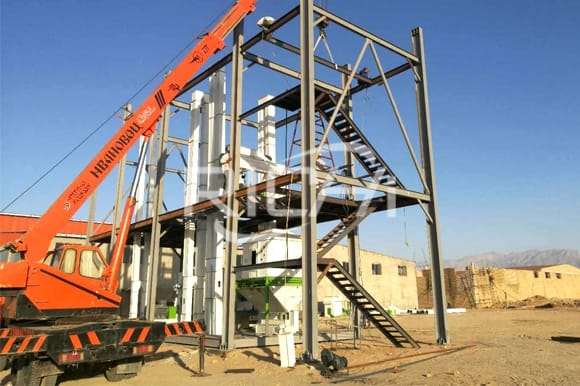
Saudi Arabia 15-16 T/H Cattle & Chicken Combined Feed Pellet Production Line
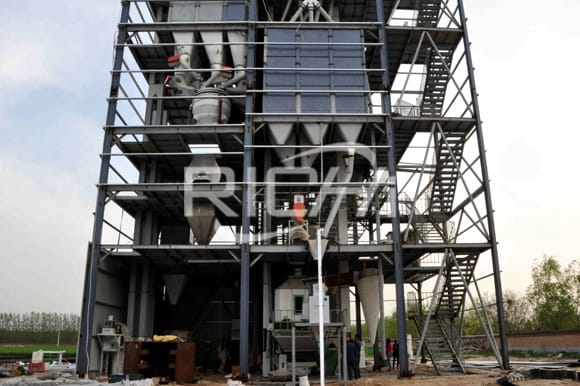
South Africa 10 T/H Cattle Feed Pellet Manufacturing Plant
In addition to small 1-2 T/H cattle feed plants, RICHI can design complete cattle and ruminant feed production lines with larger capacities according to project requirements.
Frequently Asked Questions About 1-2 T/H Cattle Feed Mills
Can A 1-2 T/H Feed Line Produce Both Cattle And Sheep Feed?
Yes. Cattle and sheep are both ruminants, and one production line can generally produce different ruminant feed formulations by changing the feed recipe and selecting suitable pellet specifications.
Can The Same Feed Mill Produce Poultry Feed?
In many projects, the main crushing, mixing, pelletizing, cooling, and packaging equipment can be shared. However, different animals require different feed formulations, pellet sizes, and processing parameters.
Can I Buy Only A Cattle Feed Pellet Machine?
Yes, but a pellet mill alone cannot replace a complete cattle feed production line.
If your raw materials have not already been crushed, mixed, and conditioned correctly, additional equipment will normally be required.
How Many Tons Can A 1-2 T/H Feed Plant Produce Per Day?
If the production line operates for 8 hours per day, the theoretical production volume is approximately 8-16 tons per day.
Actual production depends on raw materials, feed formulation, equipment utilization, maintenance, and operating conditions.
How Can I Get An Accurate Cattle Feed Mill Price?
To obtain an accurate quotation, please provide your raw materials, required capacity, pellet size, destination country, local voltage, workshop dimensions, and automation requirements.
Get A Customized Cattle Feed Mill Proposal From RICHI Machinery
If you are planning to build a commercial cattle feed processing plant, RICHI Machinery can provide a complete solution from process design and equipment selection to factory layout and installation guidance.
We can supply cattle feed production lines with capacities ranging from small commercial systems to large industrial feed mills.
For a customized cattle feed mill proposal, please tell us:
- What type of animal feed do you want to produce?
- What raw materials will you use?
- What is the raw material size?
- How many tons per hour do you want to produce?
- What pellet diameter do you require?
- Which country will the feed mill be installed in?
Our engineering and sales team will recommend a suitable production process, equipment configuration, factory layout, and complete quotation according to your project requirements.
RICHI Machinery – Complete Cattle Feed Mill Equipment & Feed Production Line Solutions