Planning to establish a commercial cattle feed mill plant? Whether you are investing in a small 1-2 T/H feed factory or a large industrial cattle feed manufacturing facility, understanding the production process, machinery requirements, raw materials, plant layout, and investment cost is essential before making a purchasing decision.
RICHI Machinery provides customized cattle feed mill plants for commercial feed manufacturers, dairy farming enterprises, livestock companies, agricultural cooperatives, and feed processing businesses.
Our cattle feed production line solutions cover different capacities and automation levels, with equipment configurations designed according to the customer's feed formulation, raw materials, production requirements, and factory conditions.
This guide explains how to build a cattle feed mill plant, what equipment is required, how the manufacturing process works, how micro-ingredients are handled, and which factors influence total project investment.
What Is a Cattle Feed Mill Plant?
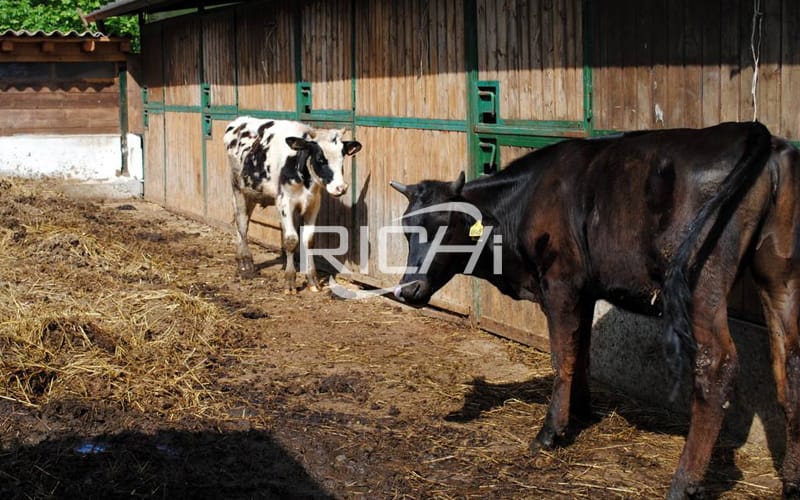
A cattle feed mill plant is an industrial processing facility used to manufacture formulated feed for cattle and other ruminants.
Depending on the production requirements, a feed mill can produce compound mash feed, pellet feed, or other formulated feed products.
A complete cattle feed pellet plant normally includes raw material receiving, cleaning, grinding, batching, mixing, conditioning, pelletizing, cooling, screening, conveying, and packaging equipment.
Unlike a single feed pellet machine, a complete cattle feed mill is designed to coordinate multiple processing stages and maintain stable commercial production.
Customizable 1-100 T/H Cattle Feed Mill Plant Solutions
RICHI Machinery provides customized cattle feed production systems for different project capacities, from small commercial plants to large industrial feed factories.
The appropriate capacity depends on expected feed demand, operating hours, market conditions, raw material availability, and future expansion plans.
| Production Capacity | Typical Application | Production Characteristics |
|---|---|---|
| 1-2 T/H | Small commercial feed mills and large livestock farms | Relatively simple production configuration |
| 3-4 T/H | Medium-sized feed processing businesses | Flexible batching and packaging options |
| 5-7 T/H | Regional commercial feed manufacturers | Higher-capacity continuous production |
| 8-10 T/H | Established commercial feed factories | Greater automation and storage requirements |
| 15-30 T/H | Large livestock feed manufacturing enterprises | Industrial material handling and centralized control |
| 40-100 T/H | Large-scale industrial feed manufacturing projects | Customized multi-system or multi-line configurations |
Very large production capacities may require multiple pelletizing lines, parallel processing systems, and extensive raw material storage facilities. A 100 T/H project should therefore be evaluated as a complete industrial plant rather than assuming one pellet mill can produce 100 tons per hour.
Main Technical Parameters of a Cattle Feed Production Line
| Production Capacity | 1-100 T/H, subject to customized plant design |
| Finished Products | Cattle feed pellets, ruminant compound feed and other formulated livestock feeds |
| Pellet Diameter | Commonly around 4-10 mm for many cattle feed applications; other sizes subject to requirements |
| Raw Materials | Grains, protein meals, bran, alfalfa, grass meal, suitable fiber ingredients, minerals and premixes |
| Batching System | Manual, semi-automatic or automatic |
| Pelletizing Equipment | Industrial ring die feed pellet mill |
| Packaging System | Manual, semi-automatic, automatic or bulk loading |
| Power Supply | Industrial three-phase electricity |
| Control System | Customized electrical control or PLC-based automation |
All parameters should be confirmed through engineering design. Actual production capacity and equipment specifications depend on the selected feed formula and operating conditions.
How to Start a Cattle Feed Mill Business
Building a cattle feed manufacturing plant requires careful planning before purchasing machinery.
1. Determine Your Target Market
Identify whether the finished feed will be supplied to your own cattle farms, local livestock producers, distributors, or commercial customers.
Evaluate annual feed demand, market competition, local feed prices, and expected sales volume.
2. Select the Required Production Capacity
Calculate the expected daily and annual feed output.
For example, a 10 T/H feed plant operating eight hours per day has a theoretical output of 80 tons per day before accounting for production downtime and other operating losses.
3. Evaluate Raw Materials
Identify available ingredients, seasonal supply variations, purchase prices, moisture levels, and storage requirements.
Raw material characteristics directly influence the grinding, mixing, conditioning, and pelletizing equipment configuration.
4. Develop Feed Formulations
Different cattle categories require different nutritional formulations.
Feed formulas should be developed according to the requirements of dairy cows, beef cattle, calves, breeding animals, and other intended livestock.
5. Select the Production Process
The production process should match the feed formula, raw material properties, pellet specifications, and required automation level.
6. Plan the Factory Layout
Consider raw material storage, equipment arrangement, finished feed storage, vehicle access, maintenance space, ventilation, dust control, and future expansion.
7. Calculate Total Project Investment
In addition to machinery, account for civil construction, electrical installation, logistics, labor, installation, commissioning, permits, and working capital.
Cattle Feed Mill Plant Design and Equipment Layout
The design of a cattle feed mill should coordinate material flow, production efficiency, equipment maintenance, and operational safety.
Small commercial plants may use relatively simple equipment arrangements, while larger factories generally require more sophisticated batching, storage, conveying, and control systems.
Important design considerations include:
- Raw material receiving capacity.
- Storage bin arrangement.
- Grinding system capacity.
- Batching accuracy.
- Mixing efficiency.
- Pelletizing line capacity.
- Cooling and screening capacity.
- Finished product storage.
- Dust collection and ventilation.
- Maintenance and personnel access.
- Electrical safety and centralized control.
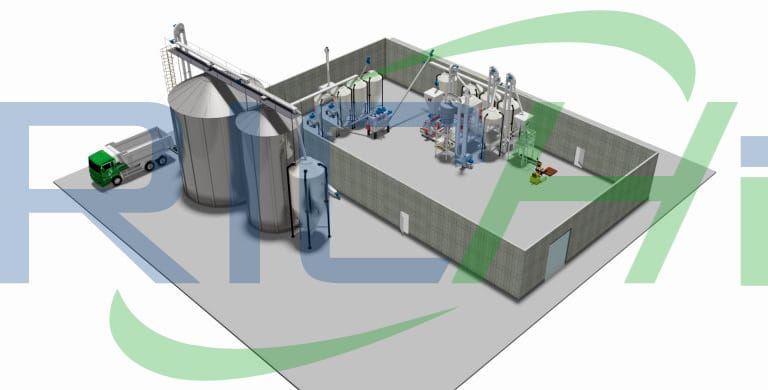
RICHI Machinery can prepare a customized process design and equipment arrangement based on the available workshop or proposed factory site.
Cattle Feed Manufacturing Process Flow Chart
The typical industrial cattle feed pellet manufacturing process includes:
Raw Material Receiving → Cleaning → Grinding → Batching → Mixing → Conditioning → Pelletizing → Cooling → Screening → Packaging
Depending on the feed formula, additional systems may be required for fiber preparation, micro-ingredient dosing, liquid addition, dust collection, and bulk finished feed handling.
Raw Material Receiving and Cleaning
Raw materials are received, inspected, and transferred into appropriate storage facilities.
Cleaning equipment removes stones, metal contaminants, oversized impurities, and other foreign materials before processing.
Grinding Process
Grains and other suitable ingredients are reduced to the required particle size using a hammer mill or other grinding equipment.
Particle size should be selected according to the feed formula, pellet diameter, and processing requirements.
Fibrous raw materials such as hay, straw, or alfalfa may require cutting or pre-crushing before fine grinding.
Batching Process
Different ingredients are weighed according to the required feed formula.
Depending on the production capacity and automation requirements, batching can be manual, semi-automatic, or fully automatic.
Industrial plants often use dedicated weighing and dosing equipment to improve formulation consistency.
Mixing Process
After batching, the ingredients enter a feed mixer to achieve uniform distribution.
Mixing quality is particularly important when small quantities of minerals, vitamins, and other premix ingredients are included in the formulation.
Liquid ingredients may be introduced through a dedicated dosing system when required.
Conditioning Process
Before pelletizing, mixed feed may be conditioned using steam to adjust temperature and moisture.
Conditioning helps prepare the feed material for pellet formation. Operating conditions depend on the formulation, equipment, and required pellet characteristics.
Pelletizing Process
The conditioned material enters an industrial ring die pellet mill, where rollers force the material through die openings to form pellets.
Pellet diameter, durability, and actual production output depend on the feed formulation, die specification, conditioning conditions, and machine settings.
Cooling Process
Freshly produced feed pellets leave the pellet mill at an elevated temperature and may contain excess moisture.
A counterflow cooler reduces pellet temperature and helps stabilize the finished product before screening and storage.
The target finished moisture content must be established according to the formulation, applicable feed standards, storage conditions, and product stability requirements. It should not be assumed that every cattle feed pellet must be cooled to 3-4% moisture.
Screening Process
Screening equipment separates qualified pellets from fines and broken particles.
Depending on the process design, fines can be returned to an appropriate production stage for reprocessing.
Packaging and Bulk Loading
Finished cattle feed can be packed in bags or transferred to bulk storage and loading systems.
Common commercial bag sizes include 10 kg, 20 kg, 25 kg, 40 kg, and 50 kg, depending on market requirements.
Electrical Control and Automation
The electrical control system coordinates equipment operation and may include motor controls, interlocks, alarms, operating status monitoring, and automated sequencing.
Larger feed factories may use PLC-based centralized control to coordinate multiple processing systems.
What Equipment Is Required for a Cattle Feed Mill Plant?
A complete cattle feed factory requires different machines for each processing stage.
The following equipment is commonly included in commercial feed pellet manufacturing projects.
| Equipment | Main Function |
|---|---|
| Raw Material Cleaning Machine | Removes impurities from incoming materials |
| Feed Hammer Mill | Reduces grain and other suitable raw materials to the required size |
| Feed Mixing Machine | Mixes ingredients according to the feed formulation |
| Ring Die Cattle Feed Pellet Mill | Compresses prepared feed into pellets |
| Counterflow Pellet Cooler | Reduces pellet temperature after pelletizing |
| Pellet Screening Machine | Separates finished pellets from fines |
| Automatic Bagging System | Weighs and packages finished feed |
| Material Conveying Equipment | Transfers raw materials and processed feed between production stages |
Other auxiliary equipment may include storage bins, bucket elevators, magnetic separators, dust collectors, liquid dosing equipment, weighing systems, and centralized electrical control cabinets.
The final equipment list depends on the plant capacity and process design.
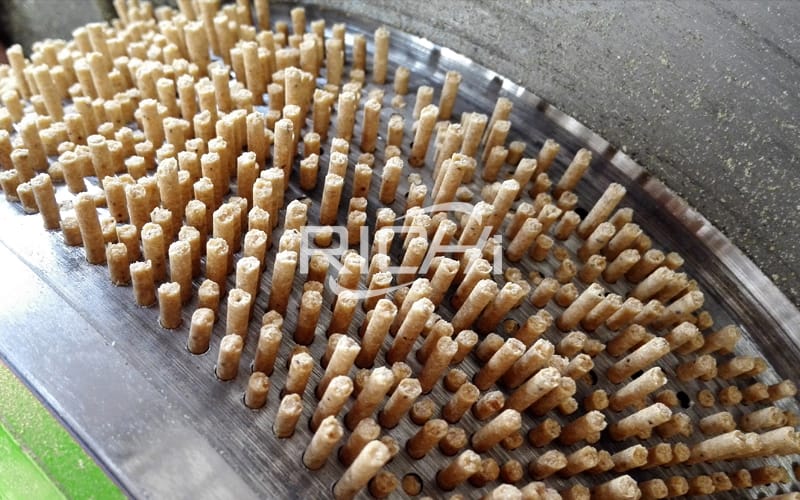
How to Select a Ring Die Pellet Mill for Cattle Feed
The pellet mill is one of the central machines in a commercial cattle feed pellet production line.
When selecting a pellet mill, consider the following factors:
- Required hourly production capacity.
- Feed formulation and raw material characteristics.
- Fiber content and moisture.
- Required pellet diameter.
- Conditioning system configuration.
- Ring die specifications.
- Expected operating hours.
- Maintenance accessibility.
- Spare parts requirements.
- Compatibility with upstream and downstream equipment.
For commercial projects, RICHI Machinery recommends industrial ring die pelletizing equipment rather than household, portable, flat die, diesel, or gasoline pellet machines.
In larger factories, multiple pellet mills may operate in parallel to achieve the required total production capacity.
Typical Cattle Feed Pellet Production Line Design
The following process diagram illustrates a possible cattle feed pellet manufacturing arrangement.
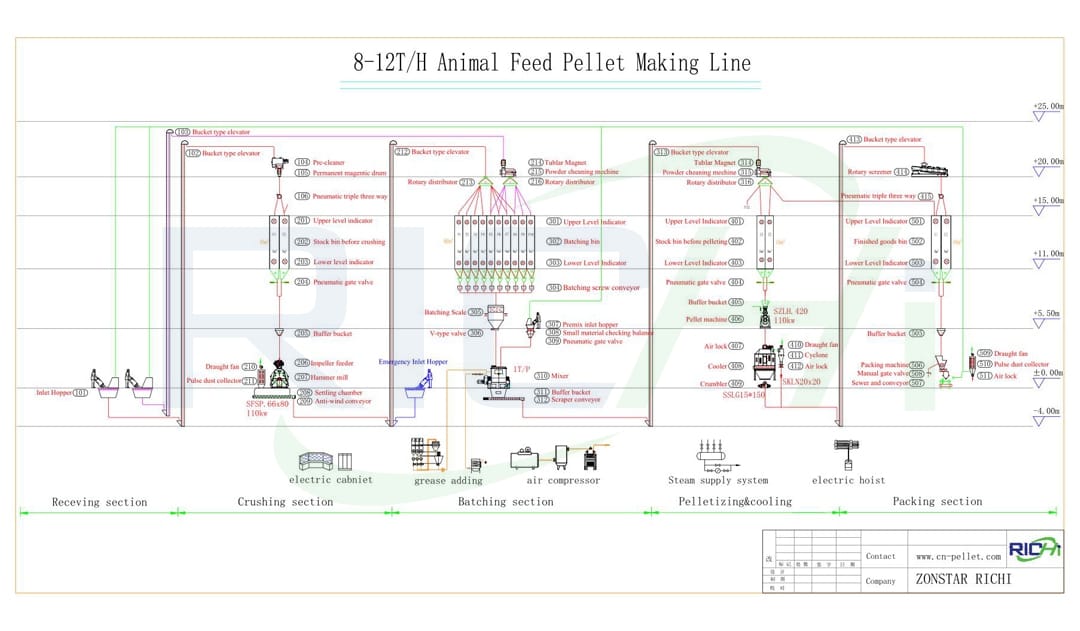
This diagram is for reference only. The actual production process should be customized according to raw materials, capacity, feed formula, automation requirements, and available factory space.
Micro-Ingredient and Nutritional Supplement Handling in Cattle Feed Production
In commercial cattle feed manufacturing, vitamins, trace minerals, amino acids, and other permitted micro-ingredients may be included in small quantities according to the feed formulation.
Because some ingredients are used at relatively low inclusion rates, accurate weighing, controlled handling, and uniform distribution are essential.
Micro-ingredients vary significantly in their physical characteristics, storage requirements, and recommended inclusion levels.
The appropriate dosing system depends on the formulation, production scale, ingredient characteristics, and applicable regulations.
Why Is Accurate Micro-Ingredient Dosing Important?
Incorrect dosing may cause nutritional imbalance, inconsistent product quality, or noncompliance with applicable feed standards.
Commercial feed plants should establish appropriate procedures for ingredient identification, weighing, recording, and verification.
Separate Storage and Ingredient Identification
Micro-ingredients should be clearly labeled and stored according to supplier instructions.
Storage conditions may need to control moisture, temperature, light exposure, and contamination risks.
Ingredients with different handling requirements should be appropriately segregated.
Premixing and Uniform Distribution
Very small quantities of micro-ingredients may be incorporated into a suitable carrier or premix before entering the main feed mixer.
The purpose is to achieve more consistent distribution throughout the finished feed.
The required premixing procedure should be established according to ingredient properties, mixer performance, and validated production methods.
Preventing Cross-Contamination
Feed factories should adopt procedures to minimize unintended transfer of ingredients between different formulas or production batches.
These may include dedicated handling equipment, controlled production sequencing, cleaning procedures, and traceability records.
Medicated ingredients, where legally permitted, require additional regulatory controls and should not be treated as ordinary nutritional supplements.
Dust Control and Worker Safety
Fine powders can create dust during weighing, transfer, and mixing.
Appropriate local extraction, enclosed conveying, housekeeping, and personal protective measures may be required.
Equipment materials should be selected according to ingredient compatibility, corrosion resistance, cleaning requirements, and applicable hygiene standards.
Micro-Ingredient Dosing Equipment for Industrial Feed Mills
The appropriate micro-ingredient dosing system depends on production capacity and automation requirements.
Smaller commercial feed mills may use carefully controlled manual weighing and premixing procedures.
Larger factories may require dedicated micro-ingredient batching stations, automated weighing systems, ingredient storage bins, and centralized control.
Important design considerations include:
- Weighing accuracy and repeatability.
- Minimum and maximum ingredient dosage.
- Batch size.
- Ingredient flow characteristics.
- Premixing requirements.
- Dust collection.
- Traceability and recordkeeping.
- Cross-contamination prevention.
- Maintenance and cleaning access.
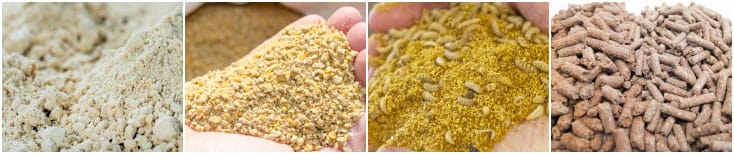
RICHI Machinery can evaluate batching and mixing requirements as part of the complete feed production line design.
How Much Does a Cattle Feed Mill Plant Cost?
The cost of a cattle feed mill plant depends on capacity, equipment configuration, raw material requirements, automation, storage facilities, and project scope.
It is not practical to provide one fixed price for every cattle feed factory because different projects require different processing systems.
The following are broad reference ranges for commercial feed production line equipment, not confirmed quotations for any specific cattle feed project.
| Production Capacity | Indicative Equipment Investment |
|---|---|
| 1-2 T/H | USD 30,000-60,000 |
| 3-4 T/H | USD 60,000-200,000 |
| 5-6 T/H | USD 80,000-250,000 |
| 10 T/H | USD 170,000-320,000 |
| 15 T/H | USD 240,000-400,000 |
| 20 T/H | USD 440,000-600,000 |
| 30 T/H | USD 600,000-700,000 |
| 40 T/H | USD 700,000-800,000 |
| 60 T/H | Generally above USD 1,100,000 |
These ranges are preliminary planning references only. They are not guaranteed prices and may not reflect the equipment scope required for a particular cattle feed formulation.
Projects requiring extensive fiber preparation, raw material storage, automated batching, multiple pellet mills, steel structures, or specialized auxiliary systems may require substantially different investments.
For capacities above 60 T/H, including plants targeting 100 T/H, a project-specific engineering assessment and quotation are required.
What Factors Affect Cattle Feed Mill Plant Investment?
Production Capacity
Larger production capacities generally require higher-capacity machinery, additional storage, more conveying equipment, and larger electrical systems.
Raw Material Processing Requirements
Different raw materials require different cleaning, cutting, crushing, and conveying arrangements.
High-fiber materials may require additional equipment compared with conventional grain-based feed formulas.
Automation Level
Manual batching and packaging may reduce initial equipment costs, while automatic batching, centralized control, and automated packaging increase capital investment but can improve production consistency and reduce manual handling.
Factory Buildings and Storage
The total project cost may include raw material warehouses, finished product storage, silos, equipment foundations, and steel structures.
Environmental and Safety Systems
Dust collection, ventilation, noise control, electrical protection, and other required safety systems must be considered during plant design.
Installation and Transportation
International freight, customs duties, local installation labor, commissioning, and site preparation can significantly affect the final project budget.
How Much Feed Can a Cattle Feed Mill Produce Per Day?
The theoretical daily output depends on hourly capacity and operating hours.
| Plant Capacity | 8 Hours/Day | 16 Hours/Day |
|---|---|---|
| 1 T/H | 8 tons | 16 tons |
| 5 T/H | 40 tons | 80 tons |
| 10 T/H | 80 tons | 160 tons |
| 20 T/H | 160 tons | 320 tons |
| 40 T/H | 320 tons | 640 tons |
| 60 T/H | 480 tons | 960 tons |
| 100 T/H | 800 tons | 1,600 tons |
These figures represent theoretical production at full rated output. Actual production depends on equipment utilization, maintenance, raw material supply, feed formulation, product changeovers, and operational conditions.
Can One Cattle Feed Mill Produce Different Types of Animal Feed?
A properly designed feed mill can manufacture different ruminant feed formulations, including cattle, sheep, goat, and dairy cow feeds.
Some processing equipment can also be shared with poultry and other livestock feed manufacturing systems.
However, different products may require different pellet diameters, conditioning conditions, formulations, and process configurations.
For factories planning to produce multiple animal feed products, the intended product range should be confirmed during the initial engineering design stage.
Why Choose RICHI Machinery for a Cattle Feed Mill Plant?
RICHI Machinery provides commercial feed processing equipment and customized complete feed manufacturing solutions.
Our services can include:
- Project requirement analysis.
- Raw material evaluation.
- Production capacity planning.
- Feed processing technology design.
- Equipment selection and configuration.
- Workshop layout planning.
- Electrical control system design.
- Installation guidance.
- Commissioning support.
- Spare parts and technical support.
Each project is evaluated according to the customer's production objectives, raw materials, automation requirements, factory conditions, and investment considerations.
Commercial Cattle Feed Mill Project References
RICHI Machinery has provided cattle and livestock feed processing solutions for customers in different markets.
10 T/H Cattle Feed Production Line in South Africa
View the 10 T/H cattle feed pellet manufacturing plant in South Africa for a commercial project reference.
15-16 T/H Combined Cattle and Chicken Feed Plant in Saudi Arabia
View the 15-16 T/H cattle and chicken feed production line in Saudi Arabia for an example of a combined livestock feed manufacturing project.
Different projects require different process designs, equipment combinations, and operating configurations.
Frequently Asked Questions About Cattle Feed Mill Plants
What Machines Are Needed to Start a Cattle Feed Mill?
A commercial cattle feed pellet plant normally requires cleaning, crushing, batching, mixing, conditioning, pelletizing, cooling, screening, conveying, and packaging equipment.
The exact equipment configuration depends on the raw materials, capacity, and automation requirements.
What Is the Minimum Capacity for a Commercial Cattle Feed Mill?
RICHI Machinery generally focuses on commercial production lines starting at approximately 1-2 T/H, depending on the project requirements.
Can I Make Cattle Feed from Maize?
Yes. Maize is commonly used as an energy ingredient in cattle feed formulations.
However, maize alone does not provide a complete balanced cattle feed formula. Other ingredients must be selected according to the nutritional requirements of the intended animals.
Can Straw and Alfalfa Be Used in Cattle Feed Pellets?
Yes, subject to suitable feed formulation and processing requirements.
Straw, hay, and alfalfa may require cutting, grinding, and moisture adjustment before mixing and pelletizing.
Does a Cattle Feed Mill Need Three-Phase Electricity?
Industrial cattle feed manufacturing equipment normally requires three-phase electricity.
The motors and electrical control system should be configured according to the destination country's voltage and frequency.
Can the Production Line Be Expanded Later?
Yes. Future expansion can be considered during the initial plant design stage by reserving suitable space, conveying capacity, electrical infrastructure, and equipment interfaces.
How Can I Get a Complete Cattle Feed Plant Quotation?
To prepare a suitable proposal, RICHI Machinery needs information about the intended feed products, raw materials, required production capacity, pellet specifications, factory conditions, and destination country.
Get a Customized Cattle Feed Mill Plant Design and Quotation
Are you planning to build a commercial cattle feed mill plant?
RICHI Machinery can provide customized equipment configurations and complete production line solutions based on your project requirements.
To receive a suitable proposal, please provide the following information:
- What type of cattle or ruminant feed do you want to manufacture?
- What raw materials will you use?
- What are the raw material sizes and approximate moisture levels?
- How many tons of feed per hour do you plan to produce?
- What pellet diameter do you require?
- How many hours per day will the factory operate?
- Which country will the equipment be installed in?
- What is the local voltage and frequency?
- Do you have an existing workshop or available land?
- Do you require manual or automatic batching and packaging?
Based on your requirements, our sales and engineering team can prepare a customized production process, equipment list, factory layout, technical proposal, and quotation.
RICHI Machinery – Industrial Cattle Feed Mill Plants and Complete Feed Production Line Solutions