Are you planning to build a small commercial cattle feed plant or upgrade the feed processing system for your cattle farm? Choosing the right cattle feed pellet machine and production line configuration is one of the most important decisions affecting feed quality, production cost, labor requirements, and future expansion.
RICHI Machinery is a professional feed machinery manufacturer and complete feed production line solution provider from China. We focus on commercial and industrial feed processing projects rather than household or portable pellet machines.
For cattle, dairy cow, sheep, goat, and other ruminant feed projects, we can provide complete solutions covering raw material cleaning, crushing, mixing, conditioning, pelletizing, cooling, screening, conveying, and packaging.
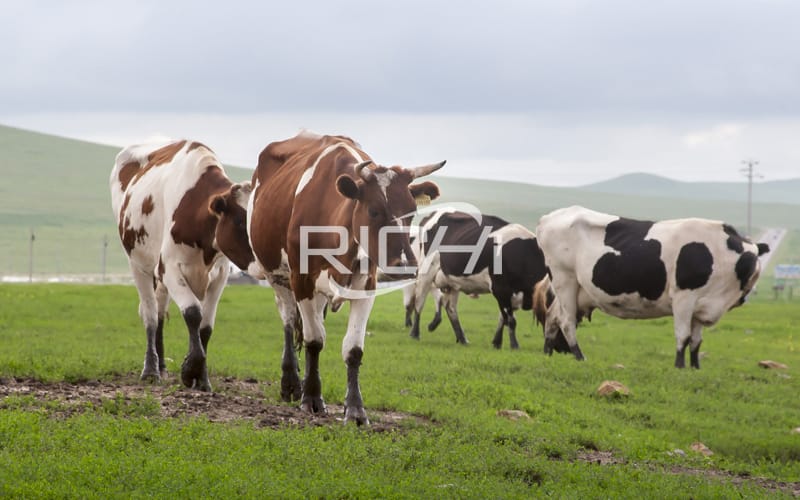
How Much Investment Is Needed For A Small Cattle Feed Plant?
The investment required for a cattle feed production project depends on much more than the price of a pellet machine.
For a commercial cattle feed mill, the total project investment may include:
- Feed processing machinery.
- Raw material storage facilities.
- Finished product storage.
- Workshop or steel structure.
- Electrical installation.
- Dust collection and ventilation systems.
- Installation and commissioning.
- Transportation.
- Labor.
- Working capital for raw materials.
The equipment cost depends mainly on capacity, raw materials, automation level, and production process.
For reference, a complete commercial 1-2 T/H cattle feed production line may generally require an equipment investment of approximately USD 30,000-60,000, depending on the configuration.
Larger projects with automatic batching, multiple bins, higher automation, more advanced dust collection, and complete steel structures will require higher investment.
Should A Cattle Farm Produce Its Own Feed?
For cattle farms with stable daily feed consumption, producing feed on-site can reduce dependence on external feed suppliers and provide better control over feed formulation.
However, whether self-produced feed is economical depends on:
- Daily feed consumption.
- Local raw material prices.
- Electricity cost.
- Labor cost.
- Feed formulation.
- Equipment utilization.
- Finished feed purchase price in the local market.
For very small farms, purchasing finished feed may still be more economical. For medium and large cattle farms, feed distributors, agricultural cooperatives, and commercial feed plants, a complete feed production line can provide better long-term production efficiency.
What Is A Cattle Feed Pellet Machine?
A cattle feed pellet machine is used to compress properly prepared feed material into uniform pellets for cattle and other ruminants.
In a commercial feed mill, the pellet machine is not used independently. Before pelletizing, raw materials normally need to be cleaned, crushed, proportioned, mixed, and conditioned.
The basic process is:
Raw Material Receiving → Cleaning → Crushing → Batching → Mixing → Conditioning → Pelletizing → Cooling → Screening → Packaging
RICHI Machinery mainly provides industrial ring die pellet mills for commercial cattle feed production rather than flat die, portable, household, diesel, or gasoline pellet machines.
Why Use A Ring Die Pellet Mill For Cattle Feed?
Ring die pellet mills are widely used in commercial animal feed plants because they are suitable for continuous production and higher-capacity processing.
Compared with small household-type pellet machines, an industrial ring die pellet mill offers several advantages:
- Higher production capacity.
- More stable continuous operation.
- Better pellet uniformity.
- More suitable for complete automated production lines.
- Better compatibility with conditioning systems.
- Longer service life under commercial operating conditions.
- Easier integration with cooling, screening, and packaging equipment.
For customers planning long-term commercial cattle feed production, ring die pelletizing equipment is generally the more suitable solution.
Why Produce Cattle Feed In Pellet Form?
Pellet feed is widely used in cattle and ruminant feeding because it can combine different ingredients into a more uniform physical form.
Depending on feed formulation and processing conditions, pelletizing may provide the following benefits:
- More consistent ingredient distribution.
- Reduced feed segregation.
- Convenient storage and transportation.
- Reduced dust during feeding.
- Improved feed handling efficiency.
- More convenient automated feeding.
Pellet quality depends not only on the pellet machine but also on grinding, mixing, conditioning, formulation, moisture, raw material properties, and die specification.
What Raw Materials Can Be Used For Cattle Feed Pellets?
Cattle feed formulations vary between countries, regions, animal stages, and raw material availability.
Typical ingredients may include:
- Corn.
- Barley.
- Wheat.
- Sorghum.
- Wheat bran.
- Rice bran.
- Soybean meal.
- Rapeseed meal.
- Cottonseed meal.
- Alfalfa.
- Grass meal.
- Hay.
- Minerals.
- Premixes.
- Molasses.
When the feed formula contains large amounts of hay, grass, alfalfa, straw, or other fibrous materials, additional cutting and crushing equipment may be required before the material enters the mixing system.
What Equipment Is Required For A Small Cattle Feed Production Line?
A complete cattle feed production line is a coordinated equipment system rather than a single pellet machine.
The exact configuration depends on the customer's raw materials, formula, capacity, workshop, and automation requirements.
1. Raw Material Cleaning Machine
The cleaning section removes stones, metal pieces, oversized impurities, and other foreign materials before crushing.
This helps protect downstream equipment and improve feed processing reliability.
2. Cattle Feed Crushing Machine
Grains and other large raw materials need to be reduced to a suitable particle size before mixing.
A cattle feed hammer mill is commonly used for this stage.
The required grinding size depends on feed formulation, pellet diameter, animal type, and processing requirements.
3. Cattle Feed Mixing Machine
After grinding, different feed ingredients are mixed according to the required formulation.
A cattle feed mixer helps distribute raw materials, minerals, premixes, and liquid additives evenly.
Mixing uniformity is one of the key factors affecting finished feed quality.
4. Conditioning System
Before pelletizing, the mixed feed can enter a conditioner.
The conditioning process helps adjust temperature and moisture and prepares the feed material for stable pellet formation.
The required conditioning parameters depend on feed formulation, raw materials, and pellet quality requirements.
5. Cattle Feed Pellet Making Machine
The pellet mill is the core machine in the cattle feed pelletizing section.
RICHI Machinery supplies industrial ring die cattle feed pellet machines for different production capacities.
The mixed and conditioned feed is compressed through the ring die, producing uniform cylindrical pellets.
For many cattle feed applications, pellet diameters of approximately 4-10 mm may be used. The actual pellet size should be selected according to animal age, feed formula, and customer requirements.
6. Feed Pellet Cooling Machine
Freshly produced pellets leave the pellet mill at a relatively high temperature.
A counterflow cooler reduces pellet temperature and helps stabilize the pellets before screening and packaging.
7. Feed Pellet Screening Machine
The screening machine separates qualified feed pellets from fines and broken particles.
Qualified pellets continue to the packaging section, while fines can generally be returned to the production process.
8. Cattle Feed Packaging Machine
Finished cattle feed pellets can be packed using manual, semi-automatic, or automatic bagging systems.
Common packaging sizes include:
- 20 kg.
- 25 kg.
- 40 kg.
- 50 kg.
The bagging system can be customized according to local market requirements.
Small Cattle Feed Pellet Production Line Capacity
RICHI Machinery can design cattle feed production systems for different commercial capacities.
Typical options include:
- 1-2 T/H: Small commercial cattle feed mill.
- 3-4 T/H: Medium-scale cattle or livestock feed plant.
- 5-7 T/H: Commercial regional feed production.
- 8-10 T/H: Medium-to-large feed factory.
- 10 T/H and above: Customized industrial feed mill.
The appropriate production capacity should be selected according to actual market demand and expected operating hours.
1-2 T/H Cattle Feed Production Line Technical Parameters
| Production Capacity | 1-2 T/H |
| Finished Product | Cattle and ruminant feed pellets |
| Pellet Diameter | Approximately 4-10 mm |
| Raw Materials | Grains, meals, bran, grass meal, alfalfa, minerals, premixes and other feed ingredients |
| Batching System | Manual or automatic |
| Bagging System | Manual, semi-automatic or automatic |
| Power Supply | Industrial three-phase electricity |
| Application | Commercial cattle feed plant, ruminant feed factory, large cattle farm |
Typical 1-2 T/H Cattle Feed Production Process
A standard 1-2 ton per hour cattle feed pellet production line may include:
Raw Material Receiving → Cleaning → Crushing → Mixing → Conditioning → Pelletizing → Cooling → Screening → Packaging
The production process is not fixed. It can be modified according to different raw materials and customer requirements.
For example:
- High-fiber raw materials may require additional cutting or crushing.
- Multiple formulations may require more raw material bins.
- Molasses-based formulas may require a liquid addition system.
- Higher automation may require automatic batching and centralized control.
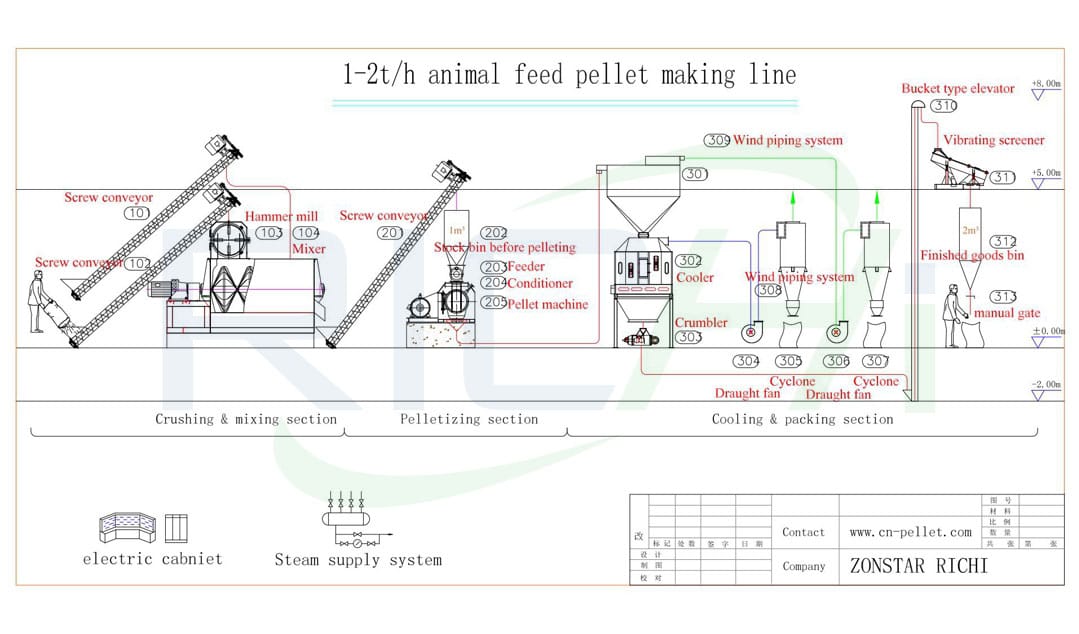
Typical Small Cattle Feed Mill Plant Design
The following production line layout is for reference only. RICHI Machinery can customize the process and equipment configuration according to project conditions.
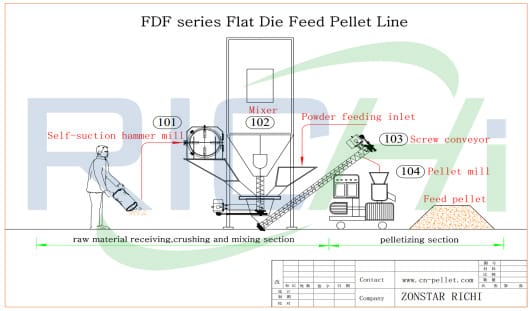
For commercial projects, we recommend using an industrial ring die pellet mill system rather than a flat die or household pellet machine.
1-2 T/H Commercial Cattle Feed Production Line
A 1-2 T/H cattle feed production line is suitable for customers who need stable commercial production but do not require a large industrial feed factory.
It can be used by:
- Commercial feed manufacturers.
- Large cattle farms.
- Dairy farms.
- Agricultural cooperatives.
- Feed distributors.
- Livestock farming enterprises.
How Much Space Is Needed For A Cattle Feed Mill?
The required plant area depends on the production capacity, equipment arrangement, storage requirements, and automation level.
A complete plant should provide sufficient space for:
- Raw material storage.
- Feed processing equipment.
- Finished product storage.
- Electrical control cabinets.
- Maintenance access.
- Forklift movement.
- Ventilation and dust collection.
- Future expansion.
RICHI Machinery can design the complete factory layout according to the customer's workshop dimensions or available land.
Power Requirements For Cattle Feed Production Equipment
Commercial cattle feed processing equipment generally requires three-phase industrial electricity.
Before equipment selection, customers should provide:
- Local voltage.
- Frequency.
- Three-phase power standard.
- Available transformer capacity.
RICHI can configure motors and electrical control systems according to the destination country's electrical conditions.
Why Choose RICHI Machinery For A Cattle Feed Project?
RICHI Machinery provides more than individual cattle feed machines.
We provide complete project solutions including:
- Raw material analysis.
- Capacity planning.
- Feed process design.
- Equipment selection.
- Production line configuration.
- Workshop layout design.
- Electrical control system design.
- Installation guidance.
- Commissioning support.
- Spare parts and after-sales service.
Before preparing a quotation, our engineers normally evaluate the customer's actual project rather than recommending a standard machine blindly.
Information Required For Cattle Feed Line Design
To recommend a suitable cattle feed production line, please provide the following information:
- What type of feed do you want to produce?
- What raw materials will you use?
- What is the raw material size?
- What is the approximate moisture content?
- How many tons per hour do you need?
- What pellet diameter do you require?
- How many hours per day will the plant operate?
- What is the local voltage?
- What are the workshop dimensions?
- Do you require manual or automatic batching?
- Do you require manual or automatic packaging?
Typical Turn-Key Cattle Feed Pellet Plant Projects
RICHI Machinery has provided complete cattle and livestock feed production solutions for customers in different countries and regions.
Saudi Arabia 15-16 T/H Cattle & Chicken Combined Feed Pellet Production Line
South Africa 10 T/H Cattle Feed Pellet Manufacturing Plant
In addition to cattle feed, the production system can also be designed for sheep, goat, dairy cow, and other ruminant feeds according to formula requirements.
Frequently Asked Questions About Cattle Feed Pellet Machines
Can I Buy Only A Cattle Feed Pellet Machine?
Yes, but only when your raw materials have already been properly crushed, mixed, and prepared for pelletizing.
For most commercial projects, a complete feed production line is more suitable than purchasing only one pellet machine.
Can One Production Line Make Both Cattle And Sheep Feed?
Yes. One line can generally produce different ruminant feed products by changing the formulation, processing parameters, and ring die specification.
Can A Cattle Feed Line Process Alfalfa And Grass?
Yes, but fibrous materials such as alfalfa, hay, and grass normally require appropriate cutting and crushing before mixing and pelletizing.
What Is The Minimum Commercial Capacity?
For commercial feed production projects, RICHI normally recommends approximately 1-2 T/H or above depending on project conditions.
Smaller outputs may be technically possible, but the economics of the project should be evaluated carefully.
Does The Pellet Machine Work With Single-Phase Electricity?
Industrial cattle feed production equipment normally requires three-phase electricity.
Can The Production Line Be Expanded Later?
Yes. During the initial factory design stage, space and interfaces can be reserved for additional bins, larger pellet mills, automatic batching systems, or additional production capacity.
Get A Customized Cattle Feed Production Line From RICHI Machinery
If you are planning to build a commercial cattle feed production line, RICHI Machinery can provide a customized equipment solution based on your raw materials, capacity, feed formulation, automation requirements, and factory conditions.
We can provide solutions for:
- 1-2 T/H cattle feed production line.
- 3-4 T/H feed production line.
- 5-7 T/H feed production line.
- 8-10 T/H feed production line.
- Customized higher-capacity ruminant feed plants.
Contact RICHI Machinery and provide your project requirements. Our sales and engineering team can prepare a suitable process design, equipment configuration, factory layout, and complete quotation.
RICHI Machinery – Commercial Cattle Feed Pellet Machines & Complete Feed Production Line Solutions