How do you choose the right cattle feed pellet machine for a 5 tons per hour cattle feed production plant? For commercial feed manufacturers, cattle farming enterprises, and agricultural cooperatives, the selection of a suitable pellet mill is essential for stable production, consistent feed quality, and long-term operating efficiency.
A 5 T/H cattle feed production line requires more than a pellet machine. It is a complete industrial processing system that may include raw material cleaning, crushing, batching, mixing, conditioning, pelletizing, cooling, screening, conveying, and packaging.
RICHI Machinery is a professional feed machinery manufacturer from China, providing industrial ring die pellet mills and customized cattle feed production line solutions. This article explains how to select a suitable cattle feed pellet machine, understand the complete production process, evaluate equipment configurations, and plan a commercial 5 T/H cattle feed mill.
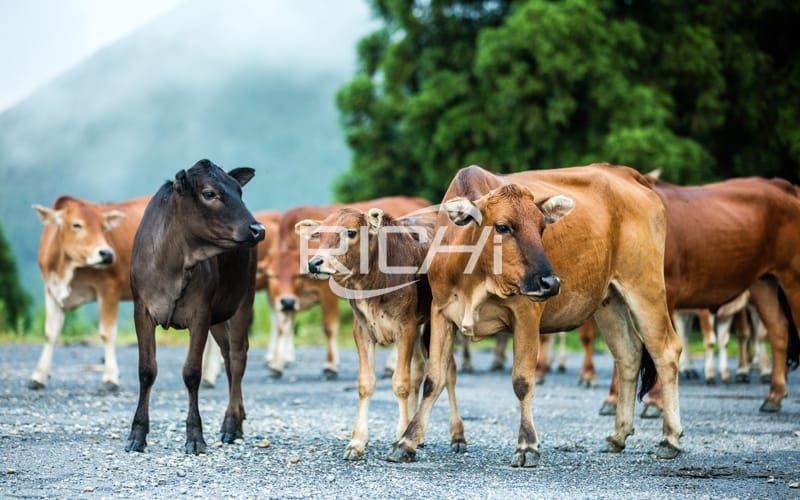
What Is a 5 T/H Cattle Feed Pellet Machine?
A 5 T/H cattle feed pellet machine is an industrial pelletizing machine designed to process approximately five tons of suitable cattle feed material per hour under specified operating conditions.
In commercial cattle feed factories, ring die pellet mills are commonly used because they support continuous production and can be integrated with automated feeding, conditioning, cooling, and packaging systems.
However, the actual output of a pellet mill depends on the raw material composition, particle size, moisture content, pellet diameter, conditioning parameters, and equipment configuration.
For a complete 5 T/H cattle feed plant, the pellet mill should be selected according to the required finished feed output rather than its nominal capacity alone.
What Are Cattle Feed Pellets?
Cattle feed pellets are manufactured by processing and compressing formulated feed ingredients into uniform cylindrical particles.
Typical cattle feed ingredients include:
- Corn and maize.
- Wheat and barley.
- Sorghum.
- Soybean meal.
- Rapeseed meal.
- Wheat bran and rice bran.
- Alfalfa and grass meal.
- Dried beet pulp.
- Molasses.
- Minerals and vitamin premixes.
- Other suitable agricultural feed ingredients.
The nutritional composition of cattle feed pellets depends on the feed formulation. Different formulations may be required for dairy cows, beef cattle, calves, breeding cattle, and other ruminants.
Pelletizing improves the physical uniformity and handling characteristics of compound feed, but nutritional adequacy must be established through appropriate feed formulation.
Why Use a 5 Ton Per Hour Cattle Feed Pellet Production Line?
A 5 T/H cattle feed production line is suitable for commercial operations requiring a continuous and relatively high volume of finished feed.
Compared with small-scale manual processing, an industrial production line can offer several operational advantages.
Higher Production Efficiency
A properly configured 5 T/H production line can process substantial quantities of cattle feed during regular factory operations.
At a nominal capacity of five tons per hour, the theoretical production volume is approximately 40 tons during an eight-hour shift, before allowing for downtime, changeovers, and other operating losses.
Consistent Feed Quality
Mechanical batching, mixing, conditioning, and pelletizing help maintain more consistent production conditions and pellet specifications.
Reduced Manual Handling
Automatic conveyors, feeding systems, and packaging equipment can reduce labor requirements and improve material handling efficiency.
Flexible Feed Formulations
A properly designed cattle feed mill can manufacture different cattle and ruminant feed formulations by adjusting raw material proportions, operating parameters, and pellet specifications.
Commercial Production Capability
A 5 T/H production line can serve commercial feed factories, livestock farming enterprises, feed distributors, and agricultural cooperatives.
How to Choose a 5 T/H Cattle Feed Pellet Machine
Selecting the right cattle feed pellet mill requires evaluating the complete production requirements rather than considering motor power or equipment price alone.
1. Determine the Required Production Capacity
The first step is to confirm the required finished feed output.
For example, a plant producing five tons of finished pellets per hour should select a pellet mill and supporting equipment capable of maintaining the required production rate under the intended feed formulation.
Capacity should also be evaluated in relation to daily operating hours, expected utilization, and future expansion requirements.
2. Evaluate Raw Material Characteristics
Different raw materials have different processing characteristics.
Grain-based cattle feed formulations may be relatively straightforward to pelletize, while formulations containing high proportions of alfalfa, hay, straw, or other fibrous materials may require additional size reduction and specialized processing adjustments.
Raw material moisture, bulk density, fiber content, and particle size can affect pellet mill performance.
3. Select a Suitable Ring Die Pellet Mill
Industrial ring die pellet mills are generally preferred for commercial cattle feed production because of their continuous operating capability and compatibility with complete feed mill systems.
RICHI Machinery provides 5 T/H feed pellet making machine solutions and other industrial pelletizing equipment for different feed processing requirements.
The final pellet mill model should be selected after evaluating the feed formula, target capacity, pellet size, and operating conditions.
4. Confirm Pellet Diameter
Pellet diameter is determined by the ring die specification.
For many cattle feed applications, pellet diameters of approximately 4-10 mm may be used, depending on animal age, feed formulation, and feeding requirements.
Different pellet sizes may require different ring dies and processing adjustments.
5. Consider Conditioning Requirements
Conditioning is an important part of commercial feed pellet production.
A suitable conditioner helps regulate material temperature and moisture before pelletizing.
Depending on the formulation and required processing conditions, different conditioning configurations may be considered.
6. Evaluate Automation and Maintenance
For commercial production, equipment reliability, maintenance accessibility, spare parts availability, and automation compatibility should be considered alongside the initial purchase price.
A properly designed production line should allow operators to monitor equipment operation and maintain stable production conditions.
RICHI Industrial Ring Die Cattle Feed Pellet Machine Features
RICHI Machinery manufactures industrial ring die pellet mills for commercial feed production applications.
Depending on the selected model and configuration, equipment features may include:
- Industrial ring die pelletizing structure.
- High-precision gear transmission.
- Variable-frequency feeding control.
- Adjustable feeding rates.
- Conditioning equipment integration.
- Overload protection.
- Interlocking safety systems.
- Lubrication systems.
- Replaceable ring dies and rollers.
- Integration with centralized electrical control systems.
Different conditioning systems may be selected according to the customer's feed formulation, pellet quality requirements, and production process.
These features help support stable industrial operation, although the exact specifications depend on the selected pellet mill model.
Complete 5 T/H Cattle Feed Production Line Equipment
A commercial cattle feed production line consists of several processing sections connected through a coordinated material handling system.
The main equipment configuration is described below.
Raw Material Cleaning Equipment
The cleaning system removes foreign materials such as stones, metal impurities, and oversized contaminants before raw materials enter the crushing section.
Cleaning equipment helps protect downstream machinery and improve production reliability.
Cattle Feed Hammer Mill
Grain ingredients such as corn, wheat, and barley generally require crushing before mixing.
A cattle feed hammer mill reduces the raw material to a suitable particle size.
The required grinding fineness depends on feed formulation, pellet diameter, and processing requirements.
Automatic or Manual Batching System
The batching system measures different feed ingredients according to the required formulation.
For a 5 T/H commercial feed plant, automatic batching can be considered to improve weighing consistency and reduce manual operations.
Cattle Feed Mixing Machine
The cattle feed mixer combines crushed ingredients, protein materials, minerals, premixes, and other feed components.
Uniform mixing helps maintain consistent nutrient distribution throughout the feed batch.
Depending on the formulation, a liquid addition system may also be required for ingredients such as molasses or oil.
Feed Conditioning Equipment
Before pelletizing, mixed feed may pass through a conditioning system where steam and moisture are controlled according to the processing requirements.
Appropriate conditioning can improve pellet formation and help maintain consistent operating conditions.
5 T/H Cattle Feed Pellet Mill
The pellet mill compresses the prepared feed through the ring die to form cylindrical pellets.
The pellet mill is one of the central machines in the production line, and its performance directly affects the overall output of the factory.
Counterflow Feed Pellet Cooler
Fresh pellets discharged from the pellet mill have elevated temperatures and moisture levels.
A counterflow cooler reduces pellet temperature and helps prepare the pellets for subsequent screening and packaging.
Feed Pellet Screening Machine
The screening system separates qualified pellets from fines and broken particles.
Fines can generally be returned to the appropriate stage of the production process to reduce material waste.
Automatic Feed Packaging Machine
Finished pellets can be packed using manual, semi-automatic, or automatic bagging equipment.
Common bag sizes include 20 kg, 25 kg, 40 kg, and 50 kg, depending on local market requirements.
5 T/H Cattle Feed Pellet Production Process Flow Chart
The typical process flow for a commercial cattle feed pellet production line is:
Raw Material Receiving → Cleaning → Crushing → Batching → Mixing → Conditioning → Pelletizing → Cooling → Screening → Packaging
Depending on the customer's raw materials and feed formulation, the process may also include additional cutting equipment, liquid dosing systems, storage bins, dust collection, and automated control systems.
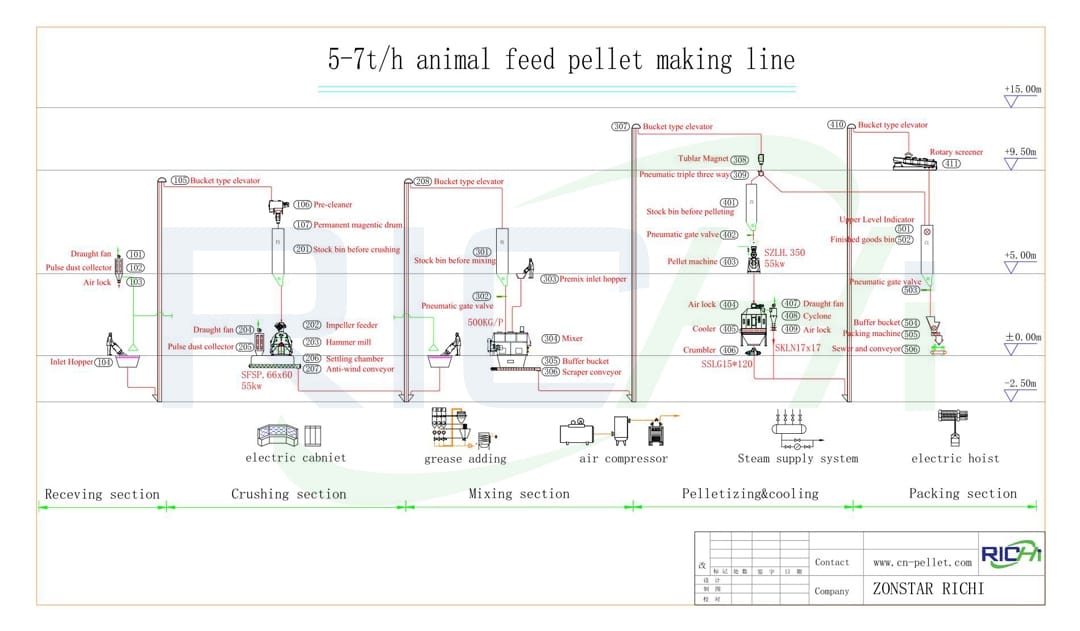
The process flow chart is for reference only. RICHI Machinery can customize the complete production process according to the project requirements.
5 T/H Cattle Feed Production Line Technical Parameters
The following table presents general reference parameters for a commercial 5 T/H cattle feed pellet production project.
| Item | Reference Specification |
|---|---|
| Production Capacity | 5 T/H |
| Finished Product | Cattle and ruminant feed pellets |
| Pellet Diameter | Approximately 4-10 mm, customizable |
| Raw Materials | Corn, wheat, barley, soybean meal, bran, alfalfa, grass meal and other suitable ingredients |
| Pelletizing Equipment | Industrial ring die feed pellet mill |
| Batching System | Manual or automatic |
| Mixing System | Industrial feed mixer |
| Cooling System | Counterflow pellet cooler |
| Packaging System | Manual, semi-automatic or automatic |
| Power Supply | Industrial three-phase electricity |
| Application | Commercial cattle feed mills and livestock feed production facilities |
The final technical specifications depend on the selected equipment and customized production line design.
How Much Does a 5 T/H Cattle Feed Production Line Cost?
The investment required for a 5 T/H cattle feed production line depends on equipment configuration, automation level, raw material characteristics, workshop requirements, and auxiliary systems.
As a general reference, commercial feed production lines in the 5-6 T/H capacity range may require an equipment investment of approximately USD 80,000-250,000, depending on the project configuration.
The final quotation may vary according to:
- Raw material receiving and storage systems.
- Crushing equipment configuration.
- Manual or automatic batching.
- Mixing system requirements.
- Conditioning system configuration.
- Pellet mill selection.
- Cooling and screening equipment.
- Automatic packaging requirements.
- Dust collection and environmental protection systems.
- Electrical control and automation.
- Factory layout and steel structures.
The reference equipment investment does not necessarily include land, civil construction, international freight, customs duties, local installation expenses, or working capital.
For an accurate quotation, RICHI Machinery recommends preparing a complete equipment configuration based on the customer's actual project requirements.
How Much Feed Can a 5 T/H Cattle Feed Mill Produce Per Day?
The theoretical daily production volume depends on operating hours.
| Operating Hours | Theoretical Feed Output |
|---|---|
| 8 hours/day | 40 tons/day |
| 10 hours/day | 50 tons/day |
| 16 hours/day | 80 tons/day |
| 20 hours/day | 100 tons/day |
These figures represent theoretical production at a constant output of five tons per hour.
Actual output depends on equipment utilization, feed formulation, maintenance, raw material supply, production changeovers, and operating conditions.
What Raw Materials Are Suitable for a 5 T/H Cattle Feed Mill?
Different cattle feed formulas require different processing equipment and operating parameters.
Grain-based feed formulations generally require cleaning, crushing, batching, mixing, and pelletizing.
High-fiber feed formulations containing alfalfa, hay, grass, or straw may require additional cutting and crushing equipment.
Formulations containing molasses may require a suitable liquid addition system.
Before selecting equipment, customers should provide the types, approximate proportions, moisture content, and particle sizes of their raw materials.
Can One 5 T/H Feed Line Produce Cattle, Sheep and Goat Feed?
Yes. A properly configured ruminant feed production line can generally manufacture different cattle, sheep, and goat feed formulations.
Different feed products can be produced by changing the ingredient formulation, pellet diameter, and processing parameters.
However, nutritional requirements vary between animal species and production stages, so feed formulations should be developed accordingly.
Some equipment may also be shared with other livestock feed production processes, subject to suitable equipment configuration and operating requirements.
What Workshop Is Required for a 5 T/H Cattle Feed Plant?
The workshop dimensions depend on the equipment arrangement, raw material storage, finished product storage, conveying systems, and automation level.
A commercial cattle feed mill should provide adequate space for:
- Raw material receiving.
- Raw material storage bins.
- Crushing and mixing equipment.
- Pelletizing and cooling equipment.
- Finished feed screening.
- Packaging equipment.
- Finished product storage.
- Electrical control cabinets.
- Maintenance access.
- Dust collection and ventilation.
RICHI Machinery can prepare a customized equipment layout based on the customer's available land, workshop dimensions, and production requirements.
Electrical Requirements for a 5 T/H Cattle Feed Mill
Commercial cattle feed production equipment generally requires industrial three-phase electricity.
The electrical configuration should be designed according to the destination country's power standards.
Customers should confirm:
- Local voltage.
- Frequency.
- Three-phase power standard.
- Available transformer capacity.
- Electrical installation requirements.
The total installed power depends on the selected pellet mill, hammer mill, mixer, conveyors, cooler, packaging system, and other auxiliary equipment.
Why Choose RICHI Machinery for a 5 T/H Cattle Feed Plant?
RICHI Machinery provides industrial feed pellet machines and complete feed production line solutions for commercial projects.
Our engineering services include:
- Raw material and feed formulation evaluation.
- Production capacity planning.
- Equipment selection.
- Process flow design.
- Customized production line configuration.
- Workshop layout planning.
- Electrical control system design.
- Installation guidance.
- Commissioning support.
- Spare parts and technical support.
We recommend equipment according to actual project requirements rather than using the same standard configuration for every customer.
RICHI Cattle Feed Production Line Project References
RICHI Machinery has provided complete cattle and livestock feed processing solutions for customers in different countries.
Saudi Arabia 15-16 T/H Cattle and Chicken Combined Feed Pellet Production Line
South Africa 10 T/H Cattle Feed Pellet Manufacturing Plant
For other capacities, customers can also explore the following production line solutions:
- 1-2 T/H Feed Pellet Production Line
- 3-4 T/H Feed Pellet Production Line
- 5-7 T/H Feed Pellet Production Line
- 8-10 T/H Feed Pellet Production Line
- Complete Ruminant Feed Production Line
Frequently Asked Questions About 5 T/H Cattle Feed Pellet Machines
Is a 5 T/H Pellet Machine Enough to Build a Complete Feed Plant?
No. A pellet mill is only one part of a complete cattle feed production line. Raw material cleaning, crushing, mixing, conditioning, cooling, screening, conveying, and packaging equipment may also be required.
Can a 5 T/H Cattle Feed Mill Process Alfalfa?
Yes, provided the production line is properly configured for fibrous raw materials. Alfalfa may require cutting, crushing, and appropriate moisture control before mixing and pelletizing.
What Pellet Size Is Suitable for Cattle Feed?
Pellet sizes of approximately 4-10 mm are commonly considered for different cattle feed applications. The final size should be selected according to the feed formula and animal requirements.
Can the Production Line Be Automated?
Yes. Depending on project requirements, the production line can incorporate automatic batching, liquid dosing, conveying, centralized electrical control, and automatic packaging.
Can a 5 T/H Cattle Feed Plant Be Expanded Later?
Yes. The factory layout can reserve space for additional storage bins, upgraded equipment, or additional production capacity. However, the feasibility of expansion depends on the original equipment sizing and factory design.
How Can I Get an Accurate 5 T/H Cattle Feed Mill Quotation?
To prepare a suitable equipment proposal, RICHI Machinery needs information about the raw materials, required capacity, pellet size, automation requirements, destination country, local voltage, and workshop dimensions.
Get a Customized 5 T/H Cattle Feed Production Line Quotation
Are you planning to build a commercial 5 tons per hour cattle feed processing plant?
RICHI Machinery can provide a complete solution covering process design, equipment selection, factory layout, pelletizing equipment, auxiliary systems, and installation guidance.
To receive a customized proposal, please provide:
- What type of cattle or ruminant feed do you want to produce?
- What raw materials will you use?
- What are the raw material sizes and moisture levels?
- How many tons per hour do you need?
- What pellet diameter do you require?
- Which country will the equipment be installed in?
- What is your local voltage?
- Do you need a pellet machine only or a complete feed production line?
Based on this information, our sales and engineering team can prepare a suitable production process, equipment configuration, technical proposal, and complete quotation.
RICHI Machinery – Industrial Cattle Feed Pellet Machines & Complete Feed Production Line Solutions