Environmental protection is an important part of planning and constructing an industrial duck feed mill plant. In addition to selecting suitable feed processing equipment, commercial poultry feed manufacturers must consider dust collection, wastewater management, noise control, solid waste handling, and applicable environmental approval requirements.
A duck feed manufacturing project in Wuhe County, Bengbu, Anhui Province, China, provides a useful reference for understanding how environmental protection measures can be incorporated into a commercial poultry feed processing facility.
According to the original project documentation, the development included a duck feed manufacturing facility with a planned annual production capacity of 40,000 tons, together with other agricultural and poultry processing operations.
This article introduces the project's reported construction scope, environmental impact assessment arrangements, pollution control measures, and key considerations for designing an industrial duck feed production line.
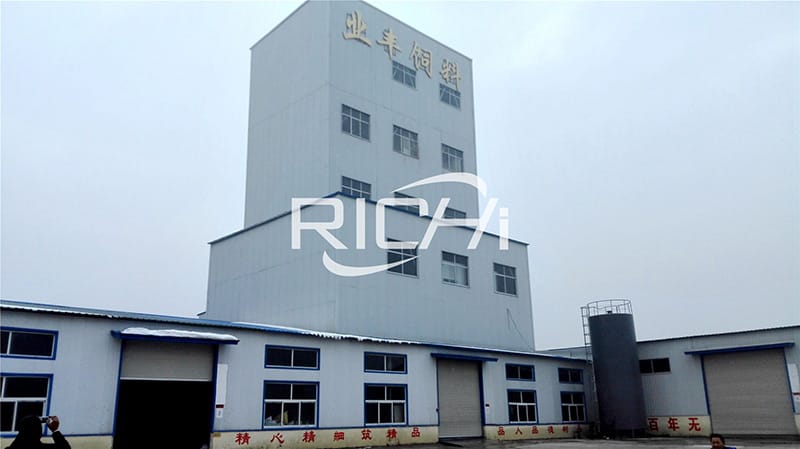
Overview of the 40,000 Tons Per Year Duck Feed Mill Project
The project was described as part of a larger agricultural industrialization development in Wuhe County, Anhui Province.
Its reported business scope covered several related activities, including poultry breeding, meat duck farming, slaughtering, refrigerated storage, further processing of poultry products, and feed manufacturing.
The original documentation described a planned annual duck feed production capacity of 40,000 tons.
| Project Item | Reported Information |
|---|---|
| Project Location | Wuhe County, Bengbu, Anhui Province, China |
| Feed Product | Duck and poultry feed |
| Planned Annual Feed Capacity | 40,000 tons/year |
| Project Type | Integrated agricultural and poultry processing development |
| Original Reported Total Investment | RMB 120 million for the wider development |
| Original Reported First-Phase Investment | RMB 50 million for multiple facilities |
| Environmental Considerations | Air emissions, wastewater, noise, solid waste and environmental management |
The investment figures above refer to the broader development described in the original project information. They should not be interpreted as the equipment price or construction cost of the duck feed mill alone.
The original material also described planned slaughtering, freezing, cold storage, office, and accommodation facilities. These activities have different infrastructure and environmental requirements from the feed manufacturing process.
The historical construction schedule and subsequent operating status have not been independently confirmed in this article.
How to Determine the Production Capacity of a 40,000 T/Y Duck Feed Plant
Annual production capacity and hourly equipment capacity are different measurements.
To determine the appropriate machinery configuration, investors must consider the planned number of operating days and production hours.
The following examples illustrate the theoretical hourly output required to produce 40,000 tons of feed annually.
| Operating Days/Year | Hours/Day | Required Average Output |
|---|---|---|
| 250 days | 8 hours | 20 T/H |
| 250 days | 16 hours | 10 T/H |
| 300 days | 8 hours | 16.7 T/H |
| 300 days | 16 hours | 8.3 T/H |
These calculations represent average required output before accounting for downtime, maintenance, product changeovers, and other operating losses.
Actual equipment selection should include an appropriate allowance for production availability and operating conditions.
Therefore, an annual capacity of 40,000 tons does not automatically mean the factory requires one particular hourly-capacity pellet mill.
Main Equipment in an Industrial Duck Feed Production Line
A commercial duck feed factory generally requires a coordinated system for raw material handling, feed preparation, pelletizing, cooling, and finished product packaging.
RICHI Machinery provides customized poultry feed production line solutions for different production capacities and manufacturing requirements.
Typical equipment includes:
| Equipment | Main Function | Environmental Consideration |
|---|---|---|
| Raw Material Receiving and Cleaning Equipment | Receives ingredients and removes impurities | Dust extraction and waste collection |
| Feed Hammer Mill | Reduces raw material particle size | Dust collection, noise and vibration control |
| Batching and Weighing System | Measures ingredients according to the formula | Enclosed handling and dust management |
| Feed Mixer | Mixes feed ingredients uniformly | Dust containment and cleaning |
| Ring Die Poultry Feed Pellet Mill | Manufactures feed pellets | Noise, heat and process ventilation |
| Counterflow Pellet Cooler | Reduces pellet temperature | Airflow and entrained dust control |
| Screening Equipment | Separates finished pellets from fines | Dust extraction and fines recovery |
| Packaging Equipment | Weighs and bags finished feed | Packaging dust and material loss control |
| Conveying Equipment | Transfers materials between processing stages | Enclosed transfer points and dust containment |
The final equipment configuration depends on the raw materials, required feed products, hourly capacity, automation level, and factory layout.
Environmental Impact Assessment for a Duck Feed Mill Project
An environmental impact assessment evaluates the potential environmental effects of a proposed industrial development and identifies appropriate mitigation measures.
For a duck feed manufacturing facility, the assessment may address emissions from raw material handling, grinding, batching, pellet cooling, boilers, wastewater systems, industrial equipment, and waste management activities.
In the original project documentation, the environmental protection measures were organized into four principal categories:
- Air emissions and dust control.
- Wastewater collection and discharge.
- Equipment noise and vibration.
- Solid waste collection, recycling and disposal.
Environmental approval requirements vary by jurisdiction and project characteristics. Any new factory should be assessed under the regulations applicable to its actual location and construction date.
1. Air Emissions and Dust Control in Duck Feed Manufacturing
Dust is one of the main environmental and operational concerns in commercial feed manufacturing.
Dust may be generated during unloading, cleaning, crushing, conveying, batching, mixing, screening, cooling, and packaging.
The original project information described several dust collection arrangements.
Raw Material Receiving Dust Collection
Dust generated at powder and granular material receiving pits was proposed to be collected using pulse bag filtration equipment.
Receiving stations can be designed with local extraction and suitable enclosure arrangements to reduce the escape of dust into the surrounding workshop.
Batching and Storage Bin Dust Control
Bag filters were described for granular, powdered, and mixed-material batching bins.
Storage bins and transfer points may require dedicated vent filters or local dust extraction, depending on the material characteristics and handling system.
Hammer Mill Dust Collection
The original documentation described a bag filter for the feed grinding process, with treated air discharged through a reported 15-meter exhaust stack.
In modern feed mill design, grinding system ventilation must be coordinated with the hammer mill, pneumatic conveying arrangement where applicable, filtration system, and industrial safety requirements.
Pellet Cooler Dust Collection
The project description specified cyclone dust collection for the pellet cooling process, with treated exhaust discharged through a reported 15-meter stack.
Pellet coolers move substantial quantities of air through hot feed pellets. Appropriate separation and filtration arrangements help control dust entrained in the cooling air.
Boiler Emission Treatment
The wider project documentation described a biomass boiler with bag filtration and a reported 25-meter exhaust stack.
Boiler selection and emission treatment should be designed according to the fuel type, boiler capacity, combustion characteristics, and applicable emission requirements.
The original project also included exhaust treatment arrangements for its canteen, which belonged to the broader development rather than the duck feed processing line.
Combustible Dust Safety
In addition to environmental emissions, grain and feed dust can present combustible dust hazards.
Feed factories should evaluate dust accumulation, ignition sources, electrical equipment, housekeeping, and appropriate explosion and fire protection measures through a project-specific risk assessment.
Dust collection equipment should not be selected solely according to airflow capacity without considering these safety requirements.
2. Wastewater Management in a Duck Feed Factory
Wastewater generation depends on the equipment configuration, utility systems, cleaning methods, and associated site operations.
The original project identified several wastewater sources:
- Domestic wastewater from employees.
- Canteen wastewater.
- Boiler drainage.
- Water softening system backwash or regeneration wastewater.
Domestic and Canteen Wastewater
The historical project documentation described grease separation for canteen wastewater and septic tank treatment for other domestic sewage before transfer to the municipal wastewater network.
Boiler and Water Treatment Discharge
Boiler blowdown and water treatment system discharge may contain dissolved salts or treatment-related constituents.
Discharge arrangements should be based on wastewater characterization, local sewer acceptance requirements, and applicable environmental permits.
Wastewater Discharge Planning
The original project proposed transferring relevant wastewater streams into the local municipal wastewater treatment system.
This should be understood as a historical project-specific arrangement, not as a universal authorization for untreated industrial wastewater discharge.
For a new feed factory, wastewater collection, treatment, reuse, or discharge must be designed according to local requirements.
3. Noise and Vibration Control in Feed Mill Equipment
Industrial feed manufacturing equipment can generate noise and vibration during operation.
Common noise sources include:
- Hammer mills.
- Feed mixers.
- Ring die pellet mills.
- Vibrating screens.
- Industrial fans.
- Air compressors.
- Material conveying equipment.
The original project documentation reported equipment noise source levels of approximately 65–95 dB(A).
These values were presented for the historical project and should not be treated as guaranteed noise levels for every RICHI equipment model.
Equipment Selection
Appropriate machinery selection and preventive maintenance can help reduce excessive vibration and mechanical noise.
Acoustic Enclosures and Insulation
Where necessary, noise-generating equipment can be installed within suitable enclosures or rooms incorporating acoustic treatment.
Vibration Isolation
Proper foundations, vibration isolators, and equipment alignment can reduce the transmission of mechanical vibration.
Factory Layout
Locating high-noise machinery away from sensitive areas can help reduce environmental noise exposure.
The final noise control design should be evaluated against the applicable site boundary and occupational exposure requirements.
4. Solid Waste Management in Duck Feed Manufacturing
The original project documentation identified several categories of solid waste associated with feed processing and the wider industrial development.
Raw Material Cleaning Waste
Raw material cleaning may generate stones, soil, metal fragments, and other impurities.
These materials should be collected and managed according to their characteristics and applicable waste disposal requirements.
Packaging Waste
Used packaging materials may include woven bags, plastic packaging, and other containers.
Suitable materials can be segregated for recycling where appropriate recycling services are available.
Boiler Ash
Biomass boilers may produce ash and other combustion residues.
The original documentation described agricultural reuse of certain boiler residues. However, any proposed land application must be supported by appropriate material testing and local regulatory approval.
Waste Water-Treatment Materials
Water softening and treatment systems may generate spent resins or other maintenance wastes.
These materials should be handled according to their composition, supplier instructions, and applicable waste management requirements.
Domestic Waste
Ordinary domestic waste should be collected separately and transferred to an appropriate municipal or authorized waste management service.
Environmental Protection Equipment for a 40,000 T/Y Feed Mill
The following table summarizes the environmental control systems described in the historical project and their potential functions.
| Production Area | Environmental Control Equipment | Main Purpose |
|---|---|---|
| Raw Material Receiving | Pulse bag filter | Collects unloading dust |
| Batching Bins | Bag filter | Controls dust from material handling |
| Feed Grinding | Bag filtration system | Controls hammer mill exhaust dust |
| Pellet Cooling | Cyclone dust collector | Separates entrained particles from cooling air |
| Biomass Boiler | Bag filtration system | Controls particulate emissions from combustion |
| Wastewater Collection | Grease trap, septic tank and drainage systems | Manages specified wastewater streams |
| High-Noise Equipment | Acoustic insulation and vibration reduction measures | Reduces noise and vibration transmission |
| Solid Waste Collection | Segregated collection and approved disposal arrangements | Supports waste management and recycling |
The table is a summary of the original project description. It does not establish that every measure was installed, commissioned, or independently verified as compliant.
Environmental Standards Referenced in the Original Project Documentation
The historical project material cited several Chinese environmental standards as part of its assessment and proposed pollution control arrangements.
These references are presented for historical project context only. They should not be interpreted as confirmation that the same editions remain applicable to a new project.
| Environmental Category | Standard Referenced in Original Material |
|---|---|
| Surface Water Quality | GB 3838-2002 |
| Ambient Air Quality | GB 3095-2012 |
| Acoustic Environmental Quality | GB 3096-2008 |
| Wastewater Discharge | GB 8978-1996 |
| Air Pollutant Emissions | GB 16297-1996 |
| Boiler Air Pollutant Emissions | GB 13271-2014 |
| Industrial Boundary Noise | GB 12348-2008 |
| General Industrial Solid Waste | GB 18599-2001, as referenced in the historical document |
Environmental regulations and standards may be amended, replaced, or supplemented by local requirements.
Investors planning a new duck feed factory should consult qualified environmental professionals and the relevant authorities to determine the applicable approval procedures and current technical standards.
How to Plan an Environmentally Responsible Duck Feed Mill
Environmental control systems should be considered during the initial engineering design rather than added only after the production equipment has been installed.
Integrate Dust Collection into the Process Design
Dust extraction points, air ducts, filtration equipment, and material conveying arrangements should be coordinated with the feed production process.
Provide Sufficient Space for Environmental Equipment
Bag filters, cyclones, fans, ducts, maintenance access, and waste collection areas require appropriate space in the factory layout.
Evaluate Noise at the Design Stage
Equipment location, acoustic treatment, foundations, and ventilation should be planned together.
Separate Different Waste Streams
Raw material cleaning waste, packaging waste, boiler residues, and domestic waste may require different handling methods.
Plan Utility and Wastewater Systems
Boiler operation, water treatment, drainage, and wastewater collection should be evaluated according to the actual equipment configuration.
Include Safety and Maintenance Requirements
Environmental equipment requires inspection, maintenance, cleaning, and suitable safety provisions.
For example, dust collectors require appropriate filter maintenance and consideration of combustible dust hazards.
What Factors Affect the Cost of a 40,000 T/Y Duck Feed Mill?
The total investment for a duck feed manufacturing project depends on more than the pelletizing machinery.
Major cost factors include:
- Required hourly production capacity.
- Operating days and shifts.
- Raw material receiving and storage systems.
- Grinding and mixing equipment.
- Pelletizing, cooling and screening equipment.
- Packaging and bulk loading systems.
- Automation and electrical control.
- Dust collection and industrial safety systems.
- Factory buildings and civil works.
- Utilities and wastewater management.
- Transportation, installation and commissioning.
The RMB 120 million investment reported in the original project material related to a broader integrated agricultural development and should not be used as the price of a standalone 40,000 T/Y duck feed mill.
For an accurate equipment quotation, RICHI Machinery requires information about the feed formula, raw materials, hourly capacity, pellet specifications, factory conditions, and project location.
Why Choose RICHI Machinery for a Duck Feed Mill Project?
RICHI Machinery provides industrial feed processing machinery and customized complete production line solutions for commercial poultry feed manufacturing projects.
Our engineering services can include:
- Project requirement analysis.
- Production capacity planning.
- Raw material evaluation.
- Feed manufacturing process design.
- Equipment selection and configuration.
- Factory layout planning.
- Electrical control system design.
- Coordination of process equipment interfaces for dust collection and other auxiliary systems.
- Installation guidance.
- Commissioning support.
- Spare parts and technical assistance.
Environmental assessment, permit applications, and regulatory compliance should be completed with appropriately qualified local specialists and authorities.
Frequently Asked Questions About Duck Feed Mill Environmental Design
What Are the Main Sources of Dust in a Duck Feed Factory?
Dust can be generated during raw material receiving, cleaning, grinding, batching, mixing, screening, cooling, and packaging.
Does a Duck Feed Production Line Need a Dust Collector?
Commercial feed mills generally require appropriate dust management systems. The type and capacity of dust collection equipment depend on the processing stages, material characteristics, airflow requirements, and applicable regulations.
What Is the Difference Between Annual Feed Capacity and Hourly Output?
Annual capacity represents the total quantity of feed planned over a year, while hourly output describes the production rate of the processing system.
For example, producing 40,000 tons annually over 250 operating days and two eight-hour shifts requires an average output of approximately 10 T/H before accounting for downtime.
Can One Duck Feed Mill Produce Other Poultry Feed?
Yes. A properly designed feed production line may manufacture different poultry feed formulations, subject to suitable equipment, pellet specifications, and operating adjustments.
Are Environmental Requirements the Same in Every Country?
No. Environmental impact assessment procedures, emission limits, wastewater requirements, and industrial safety obligations vary by country and project location.
Can Environmental Equipment Be Included in the Feed Mill Design?
Yes. Dust extraction, ventilation interfaces, equipment arrangements, and other relevant auxiliary systems can be considered during the production line design stage.
Get a Customized Duck Feed Mill Plant Design and Quotation
Are you planning to build a commercial duck feed manufacturing plant or expand an existing poultry feed factory?
RICHI Machinery can provide customized production process designs and industrial feed processing equipment according to your project requirements.
To receive a suitable technical proposal, please provide:
- What type of poultry feed do you want to manufacture?
- What is your required annual production capacity?
- How many hours per day will the factory operate?
- What raw materials will you use?
- What pellet diameter do you require?
- Which country will the factory be located in?
- What is the local voltage and frequency?
- Do you have an existing workshop or available land?
- Do you require automatic batching and packaging?
- Are there specific environmental or dust control requirements for the project?
Based on your requirements, our sales and engineering team can prepare a suitable equipment configuration, production process, factory layout, and commercial quotation.
RICHI Machinery – Industrial Duck Feed Mill Plants and Poultry Feed Production Line Solutions