How To Ferment Chicken Manure As Feed – EM Fermentation Equipment & Processing Line
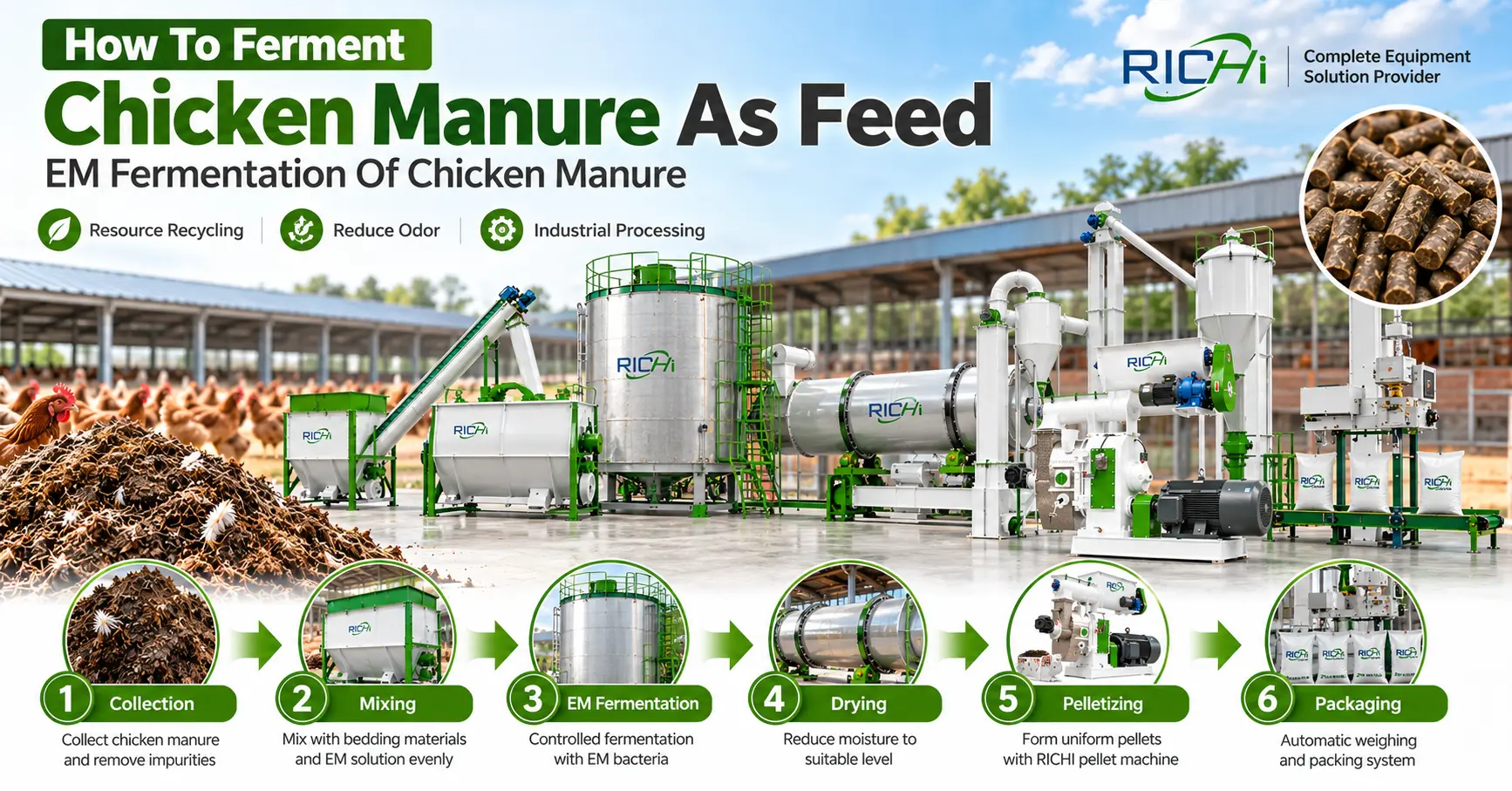
Chicken manure contains organic matter, nitrogen, minerals, and residual nutrients from poultry farming. With appropriate processing, it may be evaluated as a potential ingredient for certain regulated livestock feed applications. However, raw chicken manure cannot be considered a safe feed ingredient without proper treatment, laboratory testing, and compliance with local feed regulations.
EM (Effective Microorganisms) fermentation is one of the biological treatment methods used in chicken manure processing. For commercial operations, fermentation is only one part of the overall process. Raw material preparation, mixing, moisture control, fermentation, drying, screening, and pelletizing may all require specialized equipment.
RICHI Machinery provides industrial mixing, crushing, drying, pelletizing, conveying, cooling, and packaging equipment for customized organic material processing projects.
1. What Is EM Fermentation of Chicken Manure?
EM fermentation involves adding selected microbial cultures to organic materials under controlled conditions. The process is intended to promote microbial activity and change the physical and biochemical characteristics of chicken manure.
Depending on the microorganisms, process conditions, and raw material composition, fermentation may help:
- Reduce certain unpleasant odors.
- Improve the uniformity of mixed organic materials.
- Modify organic compounds through microbial activity.
- Prepare materials for further industrial processing.
- Improve material handling before drying or pelletizing.
However, EM fermentation alone does not guarantee the elimination of pathogenic microorganisms, antibiotic residues, or other contaminants.
For potential animal feed applications, a validated treatment process, independent laboratory testing, and confirmation of local regulatory approval are essential.
2. Chicken Manure Preparation Equipment
The first stage of an industrial processing line is the collection and preparation of chicken manure.
Fresh chicken manure often contains feathers, bedding materials, foreign objects, and variable amounts of moisture. These characteristics can affect subsequent mixing, fermentation, and pelletizing operations.
Raw Material Screening Equipment
Screening equipment is used to remove oversized contaminants and separate unsuitable materials before further processing.
Typical equipment includes:
- Rotary screening machines.
- Vibrating screens.
- Magnetic separators where appropriate.
- Conveying and material handling systems.
Chicken Manure Crushing Equipment
When chicken manure contains large agglomerates or fibrous bedding materials, crushing equipment may be required to obtain a more uniform particle size.
RICHI Machinery can configure suitable crushing equipment according to the raw material characteristics, moisture content, and required processing capacity.
3. EM Solution Preparation and Industrial Mixing Equipment
Uniform mixing is essential for consistent fermentation performance.
In traditional small-scale operations, EM solution may be sprayed manually onto layers of chicken manure. However, commercial processing facilities generally require more consistent dosing and mixing.
Industrial Mixer for Chicken Manure
A mechanical mixing system can combine chicken manure, suitable bulking materials, and the prepared microbial solution.
Depending on the application, equipment may include:
- Horizontal mixers.
- Paddle mixers.
- Liquid spraying systems.
- Metering pumps.
- Automatic dosing and weighing equipment.
Advantages of mechanical mixing:
- More consistent distribution of microbial solution.
- Reduced manual handling requirements.
- Better control of batch composition.
- Improved processing efficiency.
- Easier integration with automated production systems.
EM Solution Dosage
The original process reference describes approximately 400 mL of EM solution and 400 g of brown sugar per 500 kg of chicken manure and bedding mixture.
These values should be treated as an example rather than a universal industrial formula. Actual dosage depends on the microbial product, initial moisture, substrate composition, and validated fermentation protocol.
Industrial systems should use controlled liquid dosing rather than relying on fixed manual measurements.
4. Chicken Manure Fermentation Equipment
Fermentation is the central biological treatment stage.
Small-scale operations may use covered containers or fermentation pits. Industrial facilities can use dedicated fermentation tanks, enclosed reactors, or other controlled fermentation systems.
Industrial Fermentation Systems
Depending on project requirements, a fermentation system may incorporate:
- Enclosed fermentation vessels.
- Mechanical agitation equipment.
- Temperature monitoring.
- Moisture measurement and control.
- Ventilation or gas management systems.
- Automated process monitoring.
The appropriate equipment depends on whether the selected fermentation process is aerobic, anaerobic, or another controlled biological treatment method.
Fermentation Time and Process Control
Traditional EM fermentation descriptions sometimes refer to approximately 3 days in warm weather and 5–7 days in colder conditions.
However, fermentation duration varies significantly with temperature, moisture, microbial activity, and reactor design.
Industrial operators should monitor the process using measurable parameters instead of relying only on elapsed time, odor, or the appearance of white fungal growth.
Important: A sour smell or visible fungal growth is not reliable evidence that the material is safe for animal consumption. Pathogen reduction must be demonstrated through an appropriately validated process and testing.
5. Chicken Manure Drying Equipment
After fermentation, the material may contain more moisture than is suitable for stable storage or pellet production.
A drying stage can be required before the material enters a pelletizing system.
Industrial Rotary Drum Dryer
A rotary drum dryer can be used for moisture reduction in suitable organic material processing applications.
The drying system may include:
- Feeding and conveying equipment.
- Rotary drying drum.
- Heating system.
- Airflow and temperature control.
- Cyclone dust collection.
- Exhaust gas treatment equipment.
Dryer selection depends on the incoming moisture content, desired final moisture, thermal characteristics, and hourly production capacity.
Drying must not be presented as a substitute for validated pathogen inactivation or feed safety testing.
6. RICHI Chicken Manure Pellet Machine
Pelletizing is an important downstream processing stage for suitable, properly treated organic materials.
A pellet mill compresses conditioned material through a ring die to form pellets with a more uniform size and shape.
RICHI Ring Die Pellet Machine
RICHI Machinery manufactures industrial ring die pellet mills that can be configured for various organic material pelletizing applications.
The equipment can provide:
- Continuous industrial pellet production.
- Ring die and roller pelletizing systems.
- Adjustable pellet dimensions through appropriate die selection.
- Integration with conveyors and downstream equipment.
- Custom configurations based on material properties.
The suitability of a specific pellet mill for fermented chicken manure must be verified through material evaluation and, where necessary, pelletizing trials.
RICHI Pellet Machine Capacity Options
| Model | Main Motor Power | Reference Capacity |
|---|---|---|
| FZLH250 | 22 kW | 1-1.5 T/H |
| FZLH320 | 22 kW | 2-3 T/H |
| FZLH350 | 37 kW | 3-5 T/H |
| FZLH420 | 90 kW | 6-8 T/H |
| FZLH520 | 132 kW | 9-12 T/H |
| FZLH678 | 185 kW | 18-22 T/H |
These are reference capacities for compatible biomass pelletizing applications, not guaranteed outputs for fermented chicken manure. Actual capacity depends on moisture, particle size, formulation, and material testing.
7. Complete Chicken Manure Processing and Pellet Production Line
For commercial projects, a complete pellet processing line generally requires more than a single pellet machine.
RICHI Machinery can develop customized equipment configurations based on the raw material, production capacity, processing objectives, and available factory space.
Typical Production Process
Chicken Manure Collection → Screening → Crushing (if required) → Mixing & Dosing → Controlled Fermentation → Drying → Pelletizing → Cooling → Screening → Packaging
Main Equipment Configuration
| Processing Stage | Recommended Equipment | Function |
|---|---|---|
| Raw material preparation | Screening machine | Remove oversized foreign materials |
| Size reduction | Crusher | Reduce agglomerates and oversized material |
| Mixing | Industrial mixer | Distribute ingredients and microbial solution |
| Fermentation | Fermentation system | Provide controlled biological treatment |
| Moisture reduction | Rotary dryer | Reduce moisture for downstream processing |
| Pelletizing | RICHI ring die pellet mill | Form uniform pellets |
| Cooling | Pellet cooler | Reduce pellet temperature |
| Screening | Vibrating screen | Separate fines and finished pellets |
| Packaging | Automatic packing machine | Weigh and package finished products |
Additional dust collection, odor control, conveying, and automation equipment may be required.
8. Chicken Manure Processing Line Capacity
Industrial processing systems can be configured for different production requirements.
For example:
- 1–2 T/H: Small commercial processing facilities.
- 3–5 T/H: Medium-capacity organic material processing plants.
- 5–10 T/H: Larger industrial pellet production projects.
- 10 T/H and above: Customized high-capacity production systems.
The rated capacity must be defined carefully because wet raw material input, dried material output, and finished pellet output can differ substantially.
The final equipment configuration depends on moisture reduction requirements, fermentation residence time, raw material characteristics, and the required finished product.
9. Can Fermented Chicken Manure Be Used as Cattle Feed?
Chicken manure has historically been investigated as a potential non-conventional feed ingredient for certain ruminant applications.
However, its use is subject to significant biological, chemical, and regulatory concerns.
Potential hazards include:
- Salmonella and other pathogenic microorganisms.
- Veterinary drug and antibiotic residues.
- Heavy metals and chemical contaminants.
- Excessive mineral content.
- Foreign materials, including feathers and bedding contaminants.
- Inconsistent nutrient composition.
Some countries or regions prohibit or restrict the use of poultry manure in animal feed.
Therefore, fermented chicken manure should not be fed to cattle, goats, pigs, poultry, or other livestock solely because fermentation has been completed.
Before any feed application, the operator must confirm legal eligibility, obtain appropriate laboratory results, and establish a nutritionally suitable formulation under qualified professional supervision.
Where feed use is not permitted or cannot be validated, properly processed chicken manure may instead be considered for suitable organic fertilizer applications.
10. Why Choose RICHI Machinery?
RICHI Machinery is a China-based manufacturer of industrial pelletizing equipment and complete pellet production lines.
We provide equipment solutions for commercial projects involving biomass, organic materials, animal feed, and other suitable pelletizing applications.
Our services include:
- Raw material and project requirement evaluation.
- Production capacity planning.
- Equipment selection and configuration.
- Customized process flow design.
- Factory layout planning.
- Pellet mill and auxiliary equipment supply.
- Installation guidance and technical support.
For chicken manure processing projects, our engineering team can evaluate the mechanical processing requirements and recommend suitable equipment. Biological treatment validation, feed safety certification, and regulatory approval must be addressed separately by qualified specialists.
11. Contact RICHI Machinery for a Customized Processing Solution
Are you planning to establish a commercial chicken manure processing or pellet production plant?
Contact RICHI Machinery to discuss your project requirements.
To prepare a suitable equipment proposal, please provide:
- Raw material: Fresh chicken manure, dried chicken manure, or fermented chicken manure?
- Moisture content: What is the approximate moisture level of the material?
- Production capacity: How many tons per hour do you plan to process?
- Finished product: Organic fertilizer pellets or a legally approved feed-related application?
- Project location: In which country will the production line be installed?
Our engineering and sales team can recommend an appropriate equipment configuration, production process, and preliminary quotation.
RICHI Machinery – Industrial Pellet Machines & Complete Pellet Production Line Solutions