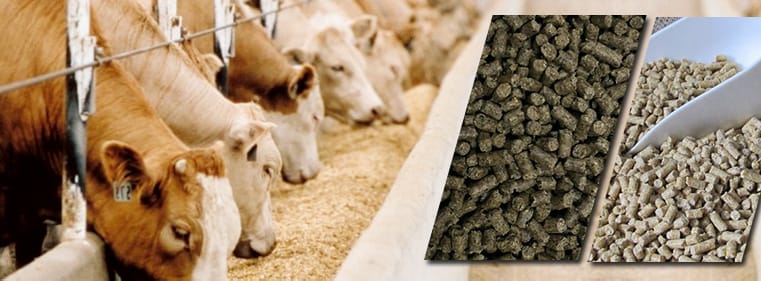
A 1-4 T/H beef cattle feed pellet plant is designed for commercial feed manufacturers, livestock enterprises, and large-scale beef cattle operations that require industrial equipment for producing formulated cattle feed pellets.
Compared with purchasing a standalone pellet mill, a complete cattle feed production line integrates raw material preparation, cleaning, grinding, batching, mixing, conditioning, pelletizing, cooling, screening, and packaging.
RICHI Machinery provides customized ruminant feed production line solutions according to the required capacity, raw materials, pellet specifications, factory conditions, and automation requirements.
This guide focuses on the machinery configuration of a 1-4 T/H beef cattle feed pellet plant, including equipment models, motor power, processing requirements, capacity selection, and investment considerations.
What Is a 1-4 T/H Beef Cattle Feed Pellet Plant?
A 1-4 T/H beef cattle feed pellet plant is a commercial manufacturing system designed to produce approximately one to four tons of formulated feed per hour, depending on the equipment configuration and feed characteristics.
The plant can process suitable grain ingredients, protein meals, minerals, and prepared fibrous materials into feed mixtures and pellets.
Unlike small household pellet machines, an industrial feed plant requires appropriate electrical infrastructure, material handling systems, safety protection, and trained operators.
The actual production capacity depends on the feed formulation, raw material particle size, moisture content, pellet diameter, ring die specification, and operating conditions.
Technical Specifications of a 1-4 T/H Beef Cattle Feed Plant
| Item | Specification |
|---|---|
| Production Capacity | 1-4 tons per hour, depending on the selected configuration |
| Finished Product | Formulated beef cattle feed pellets |
| Applicable Feed | Beef cattle growing and finishing feed, and other suitable ruminant formulations |
| Raw Materials | Maize, wheat, bran, soybean meal, suitable forage ingredients, minerals and premixes |
| Pelletizing Equipment | Industrial ring die feed pellet mill |
| Pellet Diameter | Selected according to the intended feed product and animal requirements |
| Batching | Manual, semi-automatic or automatic configuration |
| Packaging | Manual or automatic bagging |
| Electrical Supply | Industrial three-phase electricity |
| Factory Layout | Customized according to equipment and workshop requirements |
Final specifications must be confirmed through equipment selection and project engineering.
Complete Equipment List for a 1-4 T/H Beef Cattle Feed Pellet Plant
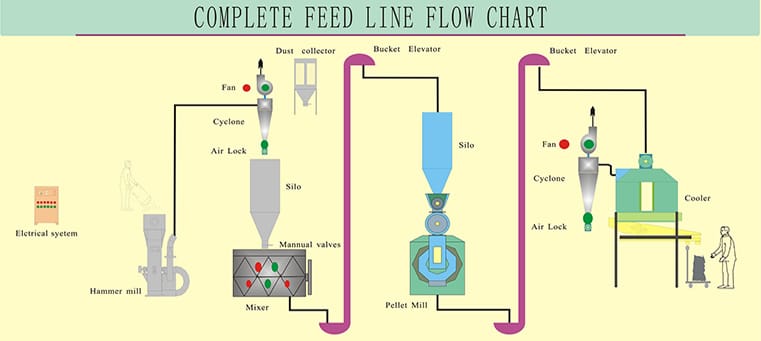
The original equipment configuration includes raw material cleaning, grinding, conveying, batching, mixing, pelletizing, cooling, screening, and packaging machinery.
The following table preserves the equipment models and motor power values provided in the original reference configuration.
| Equipment | Reference Model | Listed Motor Power |
|---|---|---|
| Feed Hammer Mill | SFSP66×60 | 75 kW |
| Bucket Elevator | TDTG36/28 | 4 kW |
| Drum Precleaner | SCY63 | 0.75 kW |
| Permanent Magnetic Separator | TCXT20 | Not specified |
| Rotary Distributor | TFPX6 | 0.75 kW |
| Powder Precleaner | SCQZ60×50×100 | 5.5 kW |
| Batching Scale | PLC0.5A | Not specified |
| Single-Shaft Feed Mixer | SLHJ1A | 11 kW |
| Ring Die Feed Pellet Mill | SZLH350 | 55 kW |
| Counterflow Pellet Cooler | SKLN17×17 | 1.5 kW |
| Pellet Crumbler | SSLG15×100 | 7.5 kW |
| Pellet Grading Screen | SFJZ100×2C | 3 kW |
| Automatic Packing Machine | DCS-50 | 3 kW |
Equipment configuration note: This is a historical reference list, not a confirmed standard package for every 1-4 T/H cattle feed plant. Equipment models, motor ratings, and quantities must be verified against the latest RICHI technical specifications before quotation.
The configuration may also require additional conveyors, feeders, dust collectors, fans, steam conditioning equipment, electrical controls, and other auxiliary systems that are not fully represented in the reference table.
The listed pellet crumbler is an optional process component and is not normally necessary for every beef cattle pellet product.
How to Select Equipment for Different Production Capacities
A 1 T/H cattle feed plant and a 4 T/H cattle feed plant do not necessarily use the same pellet mill, hammer mill, mixer, or conveying system.
Equipment selection should consider the required output of the complete production line rather than the rated capacity of one machine.
1-2 T/H Beef Cattle Feed Production Line
A 1-2 T/H configuration can be suitable for commercial operations with moderate production requirements.
The machinery should be selected according to the raw material characteristics, required pellet size, operating hours, and available workshop space.
For additional capacity-specific information, see RICHI's 1-2 T/H feed pellet production line.
3-4 T/H Beef Cattle Feed Production Line
A 3-4 T/H system requires equipment capable of supporting higher continuous material throughput.
Particular attention should be given to grinding capacity, mixer batch cycle, pellet mill selection, cooling capacity, and conveying system coordination.
See the 3-4 T/H feed pellet production line for another capacity reference.
The final configuration should be confirmed through engineering calculations and material evaluation.
Beef Cattle Feed Pellet Manufacturing Process
A typical commercial cattle feed pellet production process includes:
Raw Material Receiving → Cleaning → Grinding → Batching → Mixing → Conditioning → Pelletizing → Cooling → Screening → Packaging
1. Raw Material Cleaning
Raw materials enter the cleaning system to remove suitable categories of impurities before processing.
Precleaners and magnetic separation equipment can help protect downstream machinery from unwanted materials.
2. Raw Material Grinding
The hammer mill reduces suitable grains and other ingredients to the required particle size.
Grinding requirements depend on the feed formulation, ingredient characteristics, and intended pellet specifications.
Long fibrous materials such as straw may require cutting or preliminary size reduction before entering conventional feed grinding equipment.
3. Batching and Weighing
Different ingredients are measured according to the approved beef cattle feed formulation.
A suitable batching system helps maintain consistent ingredient proportions and supports repeatable production.
4. Feed Mixing
The weighed ingredients are transferred into a feed mixer.
The mixing process distributes ingredients throughout the batch to produce a consistent feed mixture.
Mixing performance should be evaluated according to the selected mixer, batch size, and formulation.
5. Steam Conditioning and Pelletizing
The mixed feed enters the conditioning system, where steam may be added to prepare the material for pellet formation.
Conditioned feed is then compressed through the ring die openings of the pellet mill to produce pellets.
Pelletizing performance depends on formulation, moisture, particle size, die specification, and operating conditions.
6. Pellet Cooling
Freshly manufactured pellets leave the pellet mill at an elevated temperature.
A counterflow cooler reduces pellet temperature before screening, storage, or packaging.
7. Screening and Packaging
Screening equipment separates finished pellets from fines and unwanted particle sizes.
Qualified feed pellets can then be packaged in bags or transferred to a suitable bulk handling system.
What Raw Materials Can Be Used for Beef Cattle Feed Pellets?
Commercial beef cattle feed manufacturing may use a combination of suitable energy ingredients, protein sources, fiber ingredients, minerals, and premixes.
Examples include:
- Maize and corn meal.
- Wheat and barley.
- Wheat bran.
- Soybean meal.
- Sunflower meal.
- Suitable cottonseed products.
- Alfalfa meal.
- Prepared grass and forage ingredients.
- Suitable processed straw.
- Minerals and approved feed additives.
The nutritional suitability of each ingredient must be evaluated according to the intended cattle diet and applicable feed safety requirements.
Not every cattle ration is intended to be manufactured entirely as pellets. In many beef cattle feeding systems, pelleted concentrates or formulated supplements are fed alongside separately managed roughage.
For this reason, customers should specify whether the plant will manufacture concentrate pellets, formulated compound feed, or a particular complete feed product.
How Do Different Beef Cattle Feed Products Affect Equipment Selection?
Beef cattle feed requirements vary according to the intended production stage and feeding system.
From a feed manufacturing perspective, the key consideration is whether the factory must produce one standard formulation or several products with different ingredients and physical specifications.
Growing Cattle Feed
Growing cattle formulations may require a particular balance of energy, protein, fiber, minerals, and other nutrients.
The manufacturing equipment must be suitable for the selected ingredients and pellet specifications.
Finishing Cattle Feed
Finishing feed formulations may differ from growing diets in ingredient proportions and physical characteristics.
These differences can influence grinding, mixing, conditioning, and pelletizing performance.
Concentrate Feed and Supplement Pellets
Some feed factories manufacture concentrate pellets or supplements intended to be used with other components of the cattle ration.
These products should not automatically be described as complete diets.
High-Fiber Feed Formulations
Feed products containing substantial amounts of fibrous ingredients may require additional raw material preparation and careful equipment selection.
High-fiber formulations can behave differently from conventional grain-based feed during grinding and pelletizing.
RICHI Machinery can evaluate the raw materials and intended finished products before recommending an equipment configuration.
Is the SZLH350 Pellet Mill Suitable for Every 1-4 T/H Cattle Feed Plant?
The original reference equipment list includes an SZLH350 ring die pellet mill with a listed main motor power of 55 kW.
However, the inclusion of this model in a reference equipment list does not mean it can achieve every capacity between 1 T/H and 4 T/H under all cattle feed formulations.
The required pellet mill model and quantity should be selected according to:
- Target hourly output.
- Feed formula and ingredient characteristics.
- Pellet diameter.
- Ring die specifications.
- Conditioning requirements.
- Operating hours and production schedule.
- Required production availability.
Customers should request a model-specific technical quotation rather than selecting a pellet mill solely from the nominal capacity range of a complete feed plant.
Electrical Power Requirements for a 1-4 T/H Cattle Feed Plant
Industrial feed production equipment normally requires three-phase electricity.
The total installed power of a complete production line includes more than the hammer mill and pellet mill motors.
Additional electrical loads may include:
- Material conveyors and bucket elevators.
- Feeders and distributors.
- Mixing equipment.
- Cooling fans.
- Dust collection systems.
- Screening equipment.
- Packaging machinery.
- Air compressors.
- Control and auxiliary equipment.
The total installed motor power is not the same as actual electricity consumption during operation.
Electrical engineering should account for motor starting requirements, simultaneous operating loads, local voltage and frequency, and appropriate protection systems.
The final electrical requirements must be confirmed after the equipment configuration is finalized.
How Much Feed Can a 1-4 T/H Plant Produce Per Day?
Daily production depends on hourly output and the number of operating hours.
| Hourly Capacity | 8 Hours/Day | 16 Hours/Day |
|---|---|---|
| 1 T/H | 8 tons | 16 tons |
| 2 T/H | 16 tons | 32 tons |
| 3 T/H | 24 tons | 48 tons |
| 4 T/H | 32 tons | 64 tons |
These figures are theoretical calculations at full rated output. Actual daily production will depend on equipment utilization, feed formulation, maintenance, cleaning, and product changeovers.
1-4 T/H Beef Cattle Feed Pellet Plant Cost
The investment required for a commercial cattle feed production line depends on the selected machinery, capacity, automation level, and factory conditions.
The original reference material provided a broad historical price range of USD 10,000-120,000. However, that figure does not establish a current quotation for a complete industrial plant, and its equipment scope was not clearly defined.
For reliable project budgeting, customers should request a configuration-specific quotation.
Main Factors Affecting Equipment Price
- Required hourly capacity.
- Raw material types and particle sizes.
- Grinding and fiber preparation requirements.
- Batching and mixing configuration.
- Pellet mill model and quantity.
- Cooling and screening equipment.
- Automation and electrical controls.
- Packaging requirements.
- Dust collection and auxiliary systems.
Factory construction, freight, installation, utilities, and working capital should be evaluated separately when calculating total project investment.
Factory Requirements for a Commercial Beef Cattle Feed Mill
Before ordering equipment, investors should evaluate the available factory conditions.
Workshop Space
The factory should provide adequate space for equipment installation, raw material receiving, finished feed handling, maintenance access, and safe operation.
Raw Material Storage
Suitable storage facilities are required to protect ingredients and support continuous production.
Electrical Infrastructure
Industrial three-phase electrical supply should be available at the required voltage and frequency.
Steam and Utilities
If the selected production line includes steam conditioning, the project requires an appropriate steam supply system.
Dust Control and Safety
Feed processing facilities should incorporate suitable dust management, equipment guarding, electrical protection, and industrial safety measures.
Finished Feed Packaging
Packaging equipment should be selected according to the required bag sizes, weighing accuracy, production output, and local distribution methods.
RICHI Beef Cattle Feed Production Line Applications
RICHI Machinery supplies industrial feed processing equipment for commercial ruminant feed manufacturing projects.
Depending on the formulation and equipment configuration, the production line may be designed to manufacture beef cattle feed, dairy cattle feed, sheep feed, goat feed, or other suitable livestock feed products.
Different products may require adjustments to the feed formula, grinding specifications, ring die, and processing conditions.
For a reference application, see the cattle and sheep feed production project in Uzbekistan.
Why Choose RICHI Machinery?
RICHI Machinery provides customized industrial feed pellet mills and complete feed manufacturing solutions for commercial projects.
Our engineering services can include:
- Production requirement analysis.
- Raw material evaluation.
- Equipment model selection.
- Production process design.
- Machinery configuration and technical specifications.
- Factory layout planning.
- Electrical control system configuration.
- Installation guidance.
- Commissioning support.
- Spare parts and technical assistance.
Each production line is designed according to the customer's intended feed products, production capacity, raw materials, and factory conditions.
Frequently Asked Questions
What Equipment Is Required for a Beef Cattle Feed Pellet Plant?
A complete plant generally includes cleaning, grinding, batching, mixing, conditioning, pelletizing, cooling, screening, conveying, and packaging equipment.
Can One SZLH350 Pellet Mill Produce 4 Tons of Cattle Feed Per Hour?
Actual pellet mill output depends on the equipment specifications, feed formulation, pellet diameter, and operating conditions. The complete plant capacity should be confirmed through engineering selection rather than assuming one machine can cover the full 1-4 T/H range.
Can Straw Be Used in a Cattle Feed Pellet Production Line?
Suitable straw may be used in certain formulations after appropriate preparation. Long fibrous materials generally require size reduction before conventional pelletizing.
Can the Same Plant Manufacture Beef Cattle and Dairy Cattle Feed?
Yes, a properly designed production line may manufacture different cattle feed formulations. Product changeovers may require changes to ingredients, processing parameters, and pellet specifications.
Does a 1-4 T/H Cattle Feed Mill Require Three-Phase Electricity?
Yes. Industrial feed processing machinery normally requires three-phase electrical power.
Can I Purchase Only a Cattle Feed Pellet Machine?
Yes. RICHI Machinery supplies individual industrial feed pellet mills as well as complete feed production lines. The appropriate purchasing option depends on whether the customer already has suitable upstream and downstream processing equipment.
How Can I Get an Accurate Equipment Quotation?
Provide the required production capacity, raw materials, pellet specifications, project location, electrical supply, and whether you need a standalone pellet mill or a complete production line.
Get a Customized 1-4 T/H Beef Cattle Feed Pellet Plant Quotation
Are you planning to establish a commercial beef cattle feed manufacturing plant?
RICHI Machinery can prepare a customized equipment configuration, production process, factory layout, and quotation according to your project requirements.
Please provide the following information:
- What type of cattle feed do you want to manufacture?
- What raw materials will you use, and what are their sizes?
- How many tons per hour do you need to produce?
- What pellet diameter is required?
- Do you need a standalone pellet mill or a complete production line?
- Which country will the equipment be installed in?
- What is the local voltage and frequency?
- Do you have an existing workshop?
- Do you require automatic batching and packaging?
- What is your expected project investment budget?
Our sales and engineering team can evaluate your requirements and provide a suitable technical and commercial proposal.
RICHI Machinery – Industrial Beef Cattle Feed Pellet Plants and Feed Processing Equipment