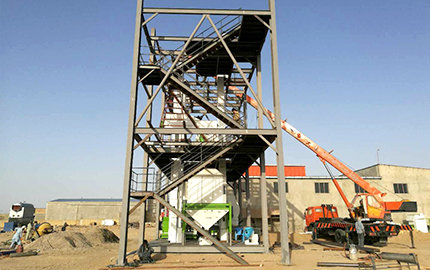
Ruminant Feed Pellet Production Process:
Raw Material Cleaning-Grinding-Batching-Mixing-Liquid Adding & Coating-Pelleting-Cooling-Screening-Packaging
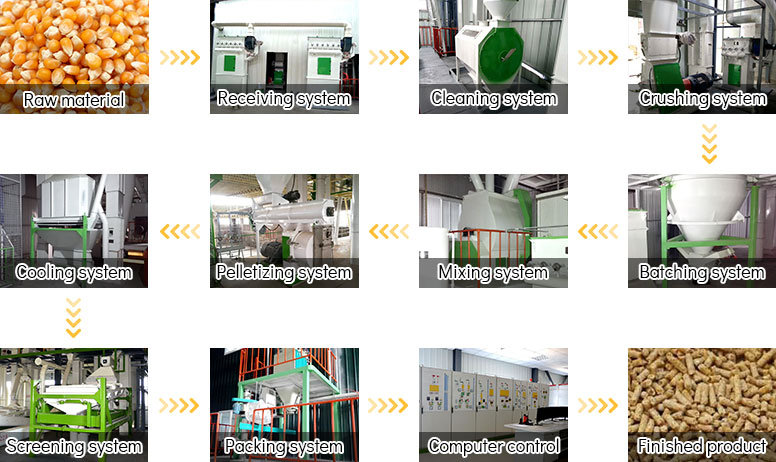
Main challenges involved in the poultry and livestock feed manufacturing process:
Because the pelletization of feed can improve the palatability of feed, increase the digestion and utilization of nutrients, avoid picky eaters, and reduce feed waste, it is very common to feed ruminants such as cattle and sheep with full pellet feed. The production process of ruminant powdered feed is basically the same as that of general poultry feed, that is, raw material receiving, crushing, ingredients, mixing and packaging. However, there are certain differences between the manufacturing process of ruminant pellet feed and the processing technology of poultry and livestock feed.
1.When producing compound feed for ruminant animals, the raw materials include grass meal in addition to general grains, protein feeds and minerals. Grass meal is a powdery raw material obtained by pulverizing dry forage grass, which has a small bulk density and a large volume. According to the characteristics of the grass meal, the pneumatic conveying system is used to receive it, which can increase the output and prevent the grass meal from flying around during the conveying process. The grass meal batching bin adopts a large outlet and is equipped with a screw feeder to send the grass powder to the batching scale in proportion. Due to the formation of a larger feeding area, it can effectively prevent the grass meal from arching in the silo and at the same time increase the output of grass meal ingredients.
For cattle sheep feed mills that do not have a special conveying device for grass meal, in order to prevent the grass meal from flying around or arching in the silo during the ordinary raw material conveying device, the hay required for compound feed can be crushed according to the actual situation, and then prepared according to the proportion. , Directly put it into the mixer and mix with the concentrate supplements to improve the output and quality of grass meal ingredients. In addition, talcum powder can be added to the grass powder to increase the specific gravity of the grass powder. In addition, RICHI provides special forage grinders, guillotine machines and other equipment for the pre-treatment stage of forage.
2. The mixing uniformity of ruminant edible feed is related to the feed intake. The greater the animal intake, the lower the mixing uniformity requirement; the smaller the animal feed intake, the higher the mixing uniformity requirement. The feed intake of ruminants is large, so the mixing uniformity coefficient of variation of ruminant feed CV ≤ 15% meets the requirements of cattle. Therefore, the RICHI ruminant feed production line is equipped with suitable low-speed feed mixer products for customers.
3. Conditioning is the most important link in the pelleting process, and the quality of conditioning is an important factor affecting the quality of pellet feed. The powder feed prepared according to the nutritional needs of ruminants enters the conditioner from the silo, and steam is introduced into the conditioner to condition the material. When producing high-fiber complete animal feed, the amount of steam passed through during conditioning and the temperature of the material after conditioning are slightly lower.
4. The granulation process of the ruminant feed production line is almost the same as other livestock and poultry granulation processes, but it needs its own process parameters. Ruminant feed does not require all feed pelleting, starch does not need to be completely gelatinized, generally controlled at 35%~45%, because complete gelatinization and partial gelatinization, the weight gain of ruminants such as beef cattle and dairy cows is almost the same, and dairy cows do not It needs to be completely gelatinized, and the gelatinization degree is 15%~25%, which meets the requirements of dairy cow breeding.
5. Ruminants love sweetness, so molasses needs to be added to feed processing for both beef and dairy cows. Molasses can improve the palatability of the feed, increase feed intake, and benefit the growth of cattle. In the granulation stage of ruminant feed, molasses can be added in the conditioner of the ruminant feed pelletizer or in the molasses mixer. Because the high-temperature steam is mixed with the molasses in the high-speed conditioner, the viscosity of the molasses is reduced. Conducive to uniform mixing of molasses and feed.